Hindu Dietary Customs
Spanning a vast region from Kashmir to Bali, thousands of years, diverse
peoples and languages as different as Hindi (Indo-European) and Tamil
(Dravidian), Hindu dietary customs could hardly be expected to be uniform,
and they aren't. Here we've got your hard core vegetarians, and we've got
your spit roasted pig - and even beef in some regions and cities.
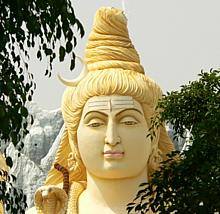
Photo of Shiva © i0154
Overview
"Hinduism" is a British invention, to conveniently lump together a
whole lot of somewhat different but related religions, philosophies and
cultures of the Indian Subcontinent. This term, while imprecise, is much
in common use outside India, without regard to the details, and has
come to represent a diverse religio-cultural expanse, even in India.
Considering Hindu as a religious complex, it is the third most populous
religion in the world, dominating India, Nepal and Bali with significant
populations in other South and Southeast Asian countries. Beyond its
traditional range, the Hindu population of the Americas is nearly 2.5
million with 1.4 million in the U.S. while Guyana, Suriname and Trinidad
and Tobago in South America are together about one third Hindu.
Other religions native to the region are Sikhism and Jainism but they
are both significantly different. Buddhism is an offspring of Jainism and
various Hindu cults. Whether the Hare Krishna cult should be added to
the Hindu count is debatable as they themselves say not, but waffle a
bit on that point. They do, however, use the Hindu texts and adhere to
the Brahman Diet.
Hinduism very much dominates the entirety of India, except the far
northeastern corner where Christianity dominates. Islam has a
significant minority presence in many Indian states. In Kerala, in
the far southwest, Islam and Christianity both have a significant
share, while Hinduism still holds a small majority.
Though it's thought not actually a part of Hinduism, a major feature
of Indian society is the caste system (Link-1).
Exactly how this complex and very rigid structure developed is a subject
of conjecture. The sacred Vedas do divide people into four Varnas
(castes) but not with the complexity or hereditary rigidly of the current
system. In any case, a person's caste and region affect how s/he is
expected to adhere to the various dietary customs.
General Rules
Tamas, Rajas and Sattva.
- these Ayurvedic "vibrations" are
characteristics of various foods and affect both the physical and astral
bodies. This is the root theory behind various Hindu food customs.
- Tamasic (heavy) foods, such as meat and fermented foods
(including alcohol), promote dullness and inertia.
- Rajasic (expanding) foods, including onions, garlic, hot
spices, stimulants, fish, eggs and salt, are thought to excite
intellect and passion, which interfere with meditation.
- Sattvic (ascending) foods, including fruits, vegetables and
grains, are thought to promote transcendence, sublimity and
orderliness.
Clearly those of higher caste should adhere to the Sattvic for their
spiritual development, while the middle castes indulge in the rajasic and
the lower castes in the tamasic - they're thought spiritually beyond
hope anyway.
Vegetarianism:
Large numbers of Hindus (perhaps as many
as 30%) are vegetarian, depending on region and sect, though strictness
varies. In some regions fish are eaten as "fruits of the sea" (what a
cop-out). Vegetarianism is practiced particularly in the southern
regions of India and in Gujarat on the northwest coast. Members of the
Brahman caste are supposed to be vegetarian (see
Brahman Diet), but in some areas Brahmans
traditionally eat meat.
Onions & Garlic
and all other members of the Allium
genus including shallots, chives, leeks, etc. are forbidden to many
Hindu sects and castes. Onions and garlic inhibit transcendence by
clouding one's mind with "passion" (rajasic). Others say they cause
"odors of the breath" which are offensive to Lord Krishna. Problem:
no onions or garlic leaves a huge hole in the flavor spectrum which
is partially patched by using the "aromatic" resin Asafoetida.
Asafoetida
, resin from a plant related to celery and fennel,
has the same sulfurous stink as SAE 90 weight hypoid gear oil. Tiny
amounts are fried briefly in hot oil before adding other ingredients
to tame the odor and develop the flavor. It provides a complexity and
sophistication similar in effect to the onions and garlic (also
sulfurous) forbidden to many Hindu cooks.
Mushrooms
have been avoided by the higher castes because
they "grow in dung and unclean ground", however morels have long been
picked and enjoyed in Kashmir, and significant mushroom farming operations
have been started in Kerala, Karnataka and other states.
Pigs
are not forbidden by Hinduism except by those sects that
ban all meat. Some regions do not eat pork due to lingering influence
of Mughal (Muslim) rule. On the other hand not much pork is consumed in
India except in a few areas that traditionally hunted wild boar or are
near the border with China. Most of India can't afford to eat pork,
because pigs would compete directly with humans for food, and there
just isn't enough to go around.
Beef:
That cows are sacred to Hindus is well known but
not exactly accurate. It is true a large part of the Hindu population
venerate cows as "The Mother" and do not eat beef, but in some states,
and within some castes, cow is definitely eaten. The largest amount of
beef production, consumption, and export in India is Water Buffalo
(Carabeef). In any case, in 2019, more than 2.6 million metric tons
of beef and veal were eaten in India, and 1.6 million metric tons were
exported.
 Whether or not the sacred Vedas prohibit slaughtering cows depends
on who is translating and what verses are selected as "proof", but they
were probably eaten in those times, at least to some extent. Veneration
of cows probably stems from the rise of the Krishna cult, from economics,
and from Brahmanism's response to Buddhism. Milk and milk products, like
butter and yogurt, are more efficient use of the animals.
Whether or not the sacred Vedas prohibit slaughtering cows depends
on who is translating and what verses are selected as "proof", but they
were probably eaten in those times, at least to some extent. Veneration
of cows probably stems from the rise of the Krishna cult, from economics,
and from Brahmanism's response to Buddhism. Milk and milk products, like
butter and yogurt, are more efficient use of the animals.
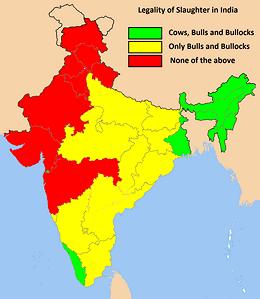
Battles over banning slaughter of cows are very complex and extremely
political. The bans are often seen as moves by the upper casts to
maintain control, and as part of anti-Muslim pogroms. The bans have
resulted in widespread smuggling of cattle from states that ban
slaughter to those that don't. Eating beef is not banned in any state.
Consumption of milk and milk products brings up the always
embarrassing problem of what to do with male calves, which will never
be good milk producers (and aren't "The Mother" either). In the northwest
states, there is a total ban on cattle slaughter, but in most of India,
slaughter of male cattle is legal, and often cows over a certain age.
Some activists say that since all cattle shit, and cowpies are dried
and used for household fuel, none qualify as non-productive.
Map by Barthateslisa (2015) distributed under license
Creative Commons
Attribution-ShareAlike v3.0 Unported.
Versions & Regions
This section is by no means comprehensive of what is eaten by Hindus
in India - that varies from state to state and from one side of a state
to another. Only about 30% of Hindus are vegetarians, so the rest eat
whatever animals, birds, fish and shellfish are available and allowed
by the religious doctrine they follow. The diets listed here are
are of particular current or historical interest.
The Brahman Diet
This diet is familiar to many Americans as that promoted by the
Hare Krishna cult and it is the diet members of the Brahman caste are
expected to adhere to in India and elsewhere. The objective is to
emphasize sattvic foods, minimize rajasic and eliminate tamasic foods.
- Meat is forbidden along with all meat products.
- Eggs are forbidden.
- Milk and milk products are permitted, butter, yogurt, cream,
etc. (but in India they're very expensive).
- Cheese must not be coagulated with rennet (an animal product).
In India the acid coagulated cheese panir predominates. It is roughly
the same as hoop cheese, a form of farmer's cheese with more of the
liquid squeezed out.
- Onions - forbidden along with all other members of the
Allium genus, including garlic, scallions, chives, shallots,
etc.
- Mushrooms are forbidden along with all other fungi.
- Stimulants - coffee, tea, etc. are rajastic and to be avoided
as they interfere with meditation.
- Alcohol - no.
There are, of course, exceptions. In Kashmir Brahmans eat meat (though
not beef) and to a lesser extent in Orissa, Bengal and Maharashtra where
eggs, fish, chicken and even lamb and goat may be included.
Hare Krishna Diet
The Hare Krishna cult (International Society of Krishna Consciousness)
adheres quite strictly to the Brahman Diet, but adapts some Western foods
to it. They have always been rather food oriented and run a worldwide
chain of dining halls called "Govindas" where inexpensive sattvic food
is served (non-believers are welcome). The food is good enough to have
been listed by Saveur magazine in their annual top 100 favorite things
(Jan/Feb 2008). Back in the mid 1970s I ate a few meals at the main
Los Angeles temple and the food was good then too. I met A.C.
Bhaktivedanta Swami Prabhupada in person back then, but in 1977 ISKCON
fell on confusing times due to lack of succession planning.
Photo distributed under license
Creative Commons
Attribution-ShareAlike v3.0 Unported..
Muslim Influence

From 1206 to 1857 Muslim invaders ruled various parts of India and
nearly all of India at the height of the Mughal (Mongol) Empire around
1800. They established a culinary tradition based on Persian cuisine
melded with Indian ingredients. This tradition continues in the current
era even though the population is now nearly all Hindu. It predominates
in the Northwest and is also found in the city of Hyderabad in east
central India.
This Mughal cuisine is the one most familiar to Americans as
"Indian cuisine". It's spicing is rich and aromatic with dishes including
lamb, chicken, yogurt and cheese but beef and pork are not eaten. Leavened
naan bread is commonly served as are complex rice pilafs. Most predominant
in Kashmir, Rajasthan, Punjab, Delhi and Hyderabad.
Gujarat
 With the meat eaters of Pakistan and Rajasthan to the north and the
seafood eaters of Maharashtra to the south, Gujarat is noted for
uncompromising and sophisticated vegetarian cuisine. About 89% of
Gujarat's population is Hindu, with the sect of Shrinathji (a form of
Krishna (a form of Vishnu)) predominating. It is also home of the sect
Bhagawan Swaminarayan founded based on love, peace, purity and
non-violence. Vegetarian Jains, though, account for only about 1%
of the population.
With the meat eaters of Pakistan and Rajasthan to the north and the
seafood eaters of Maharashtra to the south, Gujarat is noted for
uncompromising and sophisticated vegetarian cuisine. About 89% of
Gujarat's population is Hindu, with the sect of Shrinathji (a form of
Krishna (a form of Vishnu)) predominating. It is also home of the sect
Bhagawan Swaminarayan founded based on love, peace, purity and
non-violence. Vegetarian Jains, though, account for only about 1%
of the population.
Meat, chicken, fish and other animal flesh is little used in Gujarat,
but milk products are very popular, with Gujarat the largest milk producer
in India. Followers of Swaminarayan do not eat eggs but other Gurjarati
do. "Roti" flat bread, usually made of millet, is much served but so is
rice and a very wide variety of seasonal vegetables and pulses. Dishes
tend to be a bit sweeter than in other parts of India.
Gurjarat is an educated and highly industrialized area so it both has
considerable influence on the rest of India and attracts outsiders who
seek employment there. Many Gurjarati have taken up residence in the U.S.
and other Western countries filling technical positions.
Udupi
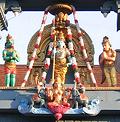 Udupi is in Karnataka state, on the west coast of India south of
Maharashtra. Here, in the 13th century, was established the Udupi Sri
Krishna Temple. This temple became the center for the most strict,
and most inventive purely Sattvic cuisine. This cuisine is now world
famous, and Udupi restaurants are found all over India and beyond.
Udupi is in Karnataka state, on the west coast of India south of
Maharashtra. Here, in the 13th century, was established the Udupi Sri
Krishna Temple. This temple became the center for the most strict,
and most inventive purely Sattvic cuisine. This cuisine is now world
famous, and Udupi restaurants are found all over India and beyond.
Also in Karnataka, a bit south from Udupi, live the Kodava people,
who are barely Indian by culture, and not Hindu by religion. They erect
no images of gods and do not recognize the caste system at all. The
history of this warrior people is unknown, whether they came from
somewhere else, or have always been there. In Kodava, pork is the
favorite meat, with lamb, chicken and fish also appearing on the
dinner table.
The (largely) Vegetarian Southeast

While the Mughali cuisine of northern India has been most familiar to
Americans as "Indian cuisine", restaurants specializing in the famous
vegetarian cuisines of Southeastern India are now becoming common,
especially in Southern California, but also in New York.
Dal (split and peeled pigeon peas, mung beans and lentils) is the
foundation of the cuisine, but rice is also much used, Coconut and coconut
milk are major ingredient and frying is done largely in coconut oil. Dairy
products are expensive but yogurt is popular. Rather than bread thin lacy
pancakes made from a mix of rice and dal are widely served.
Potatoes and many other vegetables are used, usually in combination
with dal. The green and white balls known here as Thai Eggplants, are
also the most common eggplants in southeast India. Curry leaves,
tamarind, and lots of chilis are major spicings, while the aromatic
spices of the Mughali cuisine are little used. Pickles and chutneys
appear at every meal.
While southeastern India is famous for its vegetarian cuisine, it
isn't by any means a totally vegetarian region. In Andhra Pradesh
(91% Hindu), mutton, chicken and seafoods of all kinds are enjoyed by
the majority of the population. In Tamil Nadu (88% Hindu), especially
around the city of Channai (formerly Madras), pork, mutton, chicken
and seafoods of all kinds are enjoyed by the majority. Muslims (6%)
skip the pork, but the Christians (6%) will eat anything.
Kerala
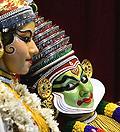 This is the southernmost state in western India, back to back with
Tamil Nadu. The cuisine is quite typical of southern India, with a
lot of coconut used and cooking in coconut oil. Many spices are used
in Kerala, since it was long a center of the spice trade.
This is the southernmost state in western India, back to back with
Tamil Nadu. The cuisine is quite typical of southern India, with a
lot of coconut used and cooking in coconut oil. Many spices are used
in Kerala, since it was long a center of the spice trade.
Seafood and fresh water fish are very popular, and chicken has a
major place on the table, but the most notable feature of Kerala
cuisine is Beef. Beef is much enjoyed by Hindus (55%), Muslims (27%),
and Christians (18%) alike. This is a major region for raising, eating,
and exporting beef.
Fasting - Navaratri Festivals, etc.
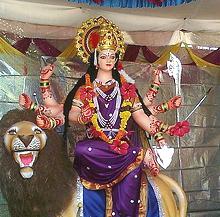 The major Navaratri festival is held in the September - October period,
and is a 10 day and 9 night festival celebrating victory of good over evil.
The legends and central character featured vary from one region to another.
Shown here is Durga, very popular in Maharashtra. Lesser Navaratri occur at
the other three changes of season.
The major Navaratri festival is held in the September - October period,
and is a 10 day and 9 night festival celebrating victory of good over evil.
The legends and central character featured vary from one region to another.
Shown here is Durga, very popular in Maharashtra. Lesser Navaratri occur at
the other three changes of season.
Many people fast for all or some specific days during the main festival.
During the fast, certain foods are allowed, and certain are not allowed.
This varies somewhat with region and family, so the list here is approximate,
but a fairly good guide. This list is primarily from Uttar Pradesh state in
northern India, rules may be stricter in Udupi.
?? = opinions vary, consult your religious leaders.
Permitted
- Grains
Barnyard Millet (Sama ke Chawal / Vrat ke Chawal) Echinochloa frumentacea.
- Flours
Amaranth flour (Rajgira/Chaulai ka Atta)
Barnyard Millet flour (Sama ka Atta) Echinochloa frumentacea
Buckwheat Flour (Kuttu ka Atta)
Tapioca Flour & Pearls (Sabudana)
Water Chestnut flour (Singhade ka Atta)
Fox Nut Flour (Makhana ka Atta)
- Nuts & Similar
True tree nuts: Walnuts (Akhrot), etc;
Almonds (Baadam)
Cashews (Kaaju)
Melon seeds (Magaj ke Beej)
Peanuts (Mungfali)
Pine Nuts (Chilgoza)
Pistachio (Pista)
Raisins (Kishmish)
Fox Nuts, puffed (Phool Makhana)
- Fruits & Berries
All seasonal fruits & Berries
(but not fruits (technically) used as vegetables)
- Vegetables
Banana, Unripe (Kacha Kela)
Bottle Gourd, Opo (Lauki)
Papaya, Unripe (Kacha Papeeta)
Potato (Aloo)
Pumpkin (Kaddu/Kashifal) - Kabocha Squash, similar
Taro Root (Arbi)
Yam (Jimikand)
- Fresh Herbs & Fresh Seasonings
Cilantro Leaves
Chilis (fresh green)
Ginger Root
?? Lemon Juice
- Spices
Rock salt (Sendha Namak) - but not Table Salt
Cardamom, Green (Elaichi Chhoti)
Cumin powder (Jeera)
Pepper, Black powder (Kali Mirch)
- Coconut
Grated, Dehydrated, Milk
- Sweets
Honey
Jaggery
Sugar, Raw & Refined
- Oils
Ghee
Peanut Oil
Vegetable Oils
- Dairy Products
Milk
Yogurt
Cheese (Panir) - acid coagulated only
Cream, fresh
Malai (a form of clotted cream)
Khoya / Mawa / Khoa (dehydrated milk solids)
Forbidden
- Non Vegan: (Milk, Milk products, and Honey permitted)
Meats, any
Eggs
- Grains & Flours
Wheat - any form
Rice - any form
Corn - any form
Millets - any form, except Barnyard Millet (see Permitted)
Chickpea Flour (Besan) - Chickpeas too
- Vegetables
Onions, Garlic & All Other Alliums.
Pretty much any not listed in the Permitted section
Eggplants (Baingan)
Okra (Bhindi)
Greens - all kinds
?? Spinach
?? Tomatoes
- Beans, Peas, Lentils
All are forbidden
- Spices
Salt, Table (Namak) - Rock Salt permitted)
?? Ajwain
Asafetida (Hing)
Coriander (Dhaniya)
Curry Powder
Garam Masala
Mustard Seeds (Sarso, Rai)
Turmeric (Haldi)
- Souring Agents
?? Lemon
?? Kokum
?? Pomegranate Seeds
?? Tamarind
Links
hindu.html 080111 r 200524 r 21015
©Andrew Grygus
- ajg@clovegarden.com - Linking and non-commercial use permitted