Taro / Colocasia Corms
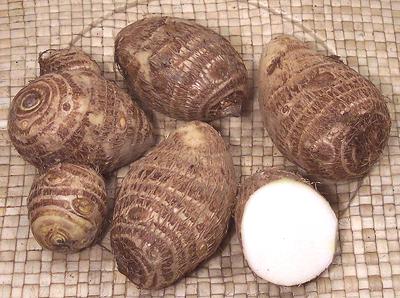 [Taro (Polynesian); Kalo (Hawaiian); Colocasia (Rome); Kolocasi (Cyprus);
Ocumo, Cocoyam, Madumbi, Nduma (Africa); Macabo (Cameroon); Khoai mo,
khoai so (Vietnam); Laing (Philippine); Dasheen, Eddoes (Caribbean);
Malanga cabeza, Malanga islena (Cuba); Arvi, Colocasia (India); Talas
(S.E. Asia); Dalo (Fiji); Cara (Brazil); Calaloo (Caribbean, leaves
only); Yautia (Puerto Rico); Colocasia esculenta]
[Taro (Polynesian); Kalo (Hawaiian); Colocasia (Rome); Kolocasi (Cyprus);
Ocumo, Cocoyam, Madumbi, Nduma (Africa); Macabo (Cameroon); Khoai mo,
khoai so (Vietnam); Laing (Philippine); Dasheen, Eddoes (Caribbean);
Malanga cabeza, Malanga islena (Cuba); Arvi, Colocasia (India); Talas
(S.E. Asia); Dalo (Fiji); Cara (Brazil); Calaloo (Caribbean, leaves
only); Yautia (Puerto Rico); Colocasia esculenta]
Probably native to the wetlands of Malaysia, taro was carried throughout
the Pacific as far as Hawaii by seagoing canoe, and by traders as far as
ancient Egypt and Rome. In more modern times it has been carried to all
tropical and near tropical regions, including Africa and Central America.
Cold tolerant varieties are grown in China, Korea and Japan.
Taro Corms (called taro root) are short underground stems rich in
starch. Unlike most starchy vegetables they are high in amylose, a starch
soluble in hot water, and contain 3% sugar, which makes them somewhat
sweet. Taro is indigestible raw and can cause severe gastrointestinal
distress if not properly prepared and cooked. The photo specimens run
up to about 5 inches long, 2-1/2 inches diameter and about 5 ounces
More on Arums.
See also Taro Leaves & Stems
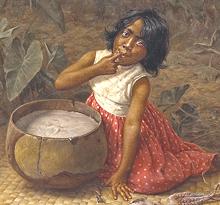 A well known use of taro in the U.S. is for making the Hawaiian staple
"poi". Taro corms are peeled, boiled, then mashed on a board with special
masher tools, usually of stone, and usually by the men. The mash is then
adjusted with water to make the desired thickness, "one finger",
"two finger" and "three finger" (the thinnest). It may be eaten fresh or
fermented for a few days when it will be a little sour and smell similar
to yogurt. "Table Taro" is Taro steamed and served whole or as chunks like
Potato, and Taro Chips are also made. Hawaii grows both wetland and
dryland varieties of Taro.
Painting "A Kamaaina" (1901), by Grace Hudson, copyright
expired.
A well known use of taro in the U.S. is for making the Hawaiian staple
"poi". Taro corms are peeled, boiled, then mashed on a board with special
masher tools, usually of stone, and usually by the men. The mash is then
adjusted with water to make the desired thickness, "one finger",
"two finger" and "three finger" (the thinnest). It may be eaten fresh or
fermented for a few days when it will be a little sour and smell similar
to yogurt. "Table Taro" is Taro steamed and served whole or as chunks like
Potato, and Taro Chips are also made. Hawaii grows both wetland and
dryland varieties of Taro.
Painting "A Kamaaina" (1901), by Grace Hudson, copyright
expired.
All across Oceania (the remote Pacific Islands) taro is used similarly
to how it is used in Hawaii, boiled, baked, and roasted. This is part of
Polynesian and Micronesian culture. Earliest evidence of use is from the
Solomon Islands, predating 20,000 BP (Before Present).
In India, recipes call for taro corms as "colocasia root". They are
used as chunks in Curries and Sambars in South India. Colocasia stems are
also used, and in some areas the leaves also, but rarely the flowers. We
cover leaves and stems on a separate Taro
Leaves & Stems page.
In ancient Rome, colocasia root was boiled and served with sauces or
boiled along with meats, much as potatoes are today. Because it was
imported from Egypt, colocasia disappeared from Europe upon the fall of
the Roman Empire, except for Cyprus where it is still grown and cooked
as kolokassi.
Buying:
Taro corms are widely available in North
America, due to their common use by Hispanic, Southeast Asian, Caribbean,
Hawaiian, African and other communities of tropical and subtropical
origin. They should be firm and unwrinkled, with no soft spots or mold.
Select the larger ones, as they will be easier to peel.
Storing:
Store like potatoes, in a cool dry place with
no direct sunlight. They will keep for a week or so.
Cooking:
Taro corms must be peeled to remove toxic Oxalic
Acid and Calcium Oxalate in the skins (see Health &
Nutrition). Cooking time is short, 10 to 15 minutes for 3/4 inch cubes,
but it will hold its shape well if cooked a bit longer. Some people cook
them skin-on and peel after when they're less slippery. In this case, the
cooking water should be discarded.
Subst:
Boiling potatoes make an acceptable substitute
in some recipes, but they will have a less silky texture, be less sweet,
and take longer to cook. They cannot be used for things like Poi where
exact flavor, texture and cooking properties are critical. Other than for
Poi, Malanga makes
an excellent substitute.
Health & Nutrition - Oxalate
Taro leaves, stems and corm skins all contain both soluble oxalic acid and
sharp crystals of calcium oxalate, both types being serious health problems
if not used with discretion.
Peeling and cooking the Taro corms removes the Oxalic Acid and
Calcium Oxalate. This makes the corms harmless in even large quantities,
demonstrated by the prevalence of Taro in the cuisines of Southeast Asia,
and in particular the Pacific Island regions, including Hawaii.
Taro Leaves and Stems are another matter entirely, but on this site they
are covered on our Taro Leaves &
Stems page.
am_taroz.html 080319 r 150929 r 220105 www.clovegarden.com
© Andrew Grygus - agryg@clovegarden.com - Photos on
this page not otherwise credited are ©
cg1.- Linking to and non-commercial use
of this page permitted.