Origins

Ingredients

Search
CloveGarden
SAFARI
Users
|
|
|
stem from a common ancestor named LUCA (Last Universal Common Ancestor)
which existed nearly 4 billion years ago. Complex Eukaryote cells
developed about 2 billion years ago, and it was perhaps about 1.7 billion
years ago that the Plant and Animal lineages separated. Both were still
single celled, because multi-celular Eukaryotes first appeared
about 1.4 billion years ago. About 1.2 billion years ago,
Eukaryote cells began to adopt sexual reproduction, greatly
accelerating the pace of evolution.
Opisthokonts
About 1.3 billion years ago, after a number of intermeidate steps,
complex Opisthokont cells had developed within the Animal lineage,
Podiata. Perhaps 1.2 billion years ago, two populations of single
celled Opisthokonts separately developed into complex
multi-celular organisms, Animals and
Fungus.
Unlike oganisms in the Plant lineage, Opisthokonts cannot generate
their own food from sunlight and raw materials, so both Animals and
Fungi live by digesting other organisms, living and/or dead.
Fungus
As the Fungi branched off from the Animal lineage (or vice versa), we
have branched them off into their own
Fungus page.
Animals
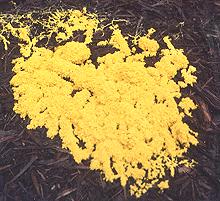 How could a single celled proto-fungus evolve into animals?
That seems totally absurd - yet we have a current example of how it
could happen. Slime molds are no longer considered fungus, but are
similarly structured. They belong to the Amoebozoa, which are
thought to have split from the animal lineage a little before the
Opisthokonts evolved and split into animals and fungus. Ordinarily
they are independent single cell entities, but when times are tough and
it's time to move on, they assemble into a multi-cell creeping critter,
an "animal" if you will, and head off to seek their fortune. Some cells
modify themselves to fill particular roles, as we would expect from a
proto-animal. Slime mold photo by Dr. Jonathan Gott contributed
to the Public Domain.
How could a single celled proto-fungus evolve into animals?
That seems totally absurd - yet we have a current example of how it
could happen. Slime molds are no longer considered fungus, but are
similarly structured. They belong to the Amoebozoa, which are
thought to have split from the animal lineage a little before the
Opisthokonts evolved and split into animals and fungus. Ordinarily
they are independent single cell entities, but when times are tough and
it's time to move on, they assemble into a multi-cell creeping critter,
an "animal" if you will, and head off to seek their fortune. Some cells
modify themselves to fill particular roles, as we would expect from a
proto-animal. Slime mold photo by Dr. Jonathan Gott contributed
to the Public Domain.
We have not found a transition form between proto-fungus and animals,
and it may be extinct, but we have stumbled on several other "extinct"
transition forms, so it's possible we eventually will find one.
Here we present a chart of the edible animals. It follows their
evolutionary descent but for simplicity we include only animal lines
that are used by humans for food. Extinct lines are omitted (you can't
eat those) as are intermediate evolutionary stages that aren't of culinary
interest. All the first level entries were already in existence during
the Cambrian era, about 530 million years ago. Very little is known
about animal evolution in the Precambrian due to a very faint fossil
record.
- Cnidaria (Jellyfish, corals, anemones)
- Arthropoda (insects, etc.)
- Echinoderms (urchins, sea cucumbers, starfish)
- Molluscs (mollusca)
- Chordata (vertebrates, etc.)
- Sharks,
Skates & Rays (chondrichthyes)
- cartilaginous fish
- Osteichthyes (bony fishes)
- Ray Finned Fish (Actinopterygii) - all the familiar fish
- Lobe Finned Fish (Sarcopterygii) - Coelacanths still live!
- Tetrapods
- Amphibians (Salamanders, Frogs)
- Anapsids (early reptiles - extinct unless
Turtles are
Anapsids - controversial)
- Synapsids (mammal-like reptiles)
- Mammals
- Marsupials (Possum, Kangaroo)
- Monotrems (Platypus, Echidnas) - egg laying mammals
- Eutheria
- Diapsids
Who Eats What Animals?
Whether it's "right" (or healthy) to eat our fellow critters has been
intensely debated for thousands of years with no resolution. Parrots have
learned to talk (compose and speak meaningful sentences for their own
purposes), less vocal animals have been shown to understand sentences.
Ravens form clubs, use tools and can think out problems. Sociological
studies show we're all pretty similar, so traditional notions of human
exceptionalism and dominion over animals really don't wash.
On the other hand, it's been shown that all animals, including ourselves,
live by eating other living things, and many live exclusively on other
animals, and in some cases animals of intellectual achievement superior to
their own - so it's been pointed out this is the natural order. An order
in which we participate - until something eats us.
So it all boils down to a matter of personal viewpoint, or the strictures
of your religion (which is also a personal viewpoint). I was a vegetarian
for some time (though not a very "ethical" one), and not at other times,
so I'll make no condemnation one way or the other.
North Americans are predominantly Christians, a powerful
subtribe of the Pagans, and have no religious food prohibitions except
for a few small sects that adhere more or less to Jewish law or promote
vegetarianism. Most churches don't even forbid eating people (though
it's rarely done).
By secular law and/or custom, Americans are forbidden to eat dog, cat
and horse. Just about everything else is fair game. These prohibitions
have no logic but are the result of pressure by pet lovers. Pigs are
smarter than dogs and cats, and can be just as friendly, and they're way
smarter than horses, but are eaten in quantity by pet lovers because
they're not cute and cuddly. The horsey set has even pressured government
to forbid exporting horses to places that do eat horse, despite the fact
that horses, in the wild, kill and eat smaller animals, and have killed
and eaten people.
Of course North America includes vegetarians of every possible stripe,
including a strong contingent of "vegans" who won't eat any animal or use
any animal derived products for anything. Eggs, milk products and honey
are off their menu because they amount to "exploiting animals". Of
course, they have no strictures against exploiting people, ignoring that
people are animals too.
The U.S. is also host to many large and strong immigrant communities and
Native American communities, so an occasional cat, dog or horse does end up
in the stew pot - you just have to be a little careful about who knows.
The U.S. also hosts large contingents of Jews, Muslims, Hindus and
other religious persuasions that follow their own dietary rules. Europeans are much like Americans but with some
variations. The French, for instance, do eat horse, though it has
declined in popularity, but it is still quite popular in southeastern
Europe. I have it on good authority that the Germans ate plenty of cats
during World War II, and the English ate some too (for cat, use any
rabbit recipe, they cook and taste the same).
Europe, due to past conquest of distant countries and importation of
labor in times of worker shortage (especially Muslim Turks in Germany and
Indians and Pakistanis in England) also has plenty of religious contingents
following their own rules. Hinduism is a British "word of convenience" for
a large number of schools of though in India, both Vedic and non-Vedic.
While some sects are vegetarian, many Hindus do eat meat, though most
don't eat cow. Cow is clearly not forbidden by the sacred Vedas (which
provide guidance on eating them), but from later political / religious
prohibitions inspired by the Krishna cult, anti-Islam sentiment and
economics (better return on investment from milk than meat).
Pig is not prohibited to meat eating Hindus but is rarely eaten due
to pure economics (not enough high quality grains and vegetables to feed
both the people and pigs) and due to a suspicion of the animal possibly
picked up from other cultures. Pigs are eaten in northeastern areas
influenced by China, and where wild pigs were traditionally hunted
(Kodava and Tamil Nadu).
The main meat eaten by Hindus is goat, which British conquerors were
pleased to call "mutton" so it would taste better. In areas of India
influenced by Islam (north), lamb and mutton predominate for both Muslims
and Hindus.
Hindus who eat meat avoid skin and fat - it is always removed before
cooking.
Many Hindus are vegetarians of various degrees of purity. On the east
coast they excuse fish and shellfish consumption by defining fish as fruit
(fruit of the sea). On the west coast many won't eat anything that
even suggests meat and go to great effort not to harm insects or even
"nosee'ems".
Brahmans, the highest Hindu cast, are supposed to adhere to the
"Brahman diet" (introduced to Americans by the Hari Krishna folks),
which forbids any meat, onions, garlic, shallots, or mushrooms - but in
Kashmir Brahmans eat meat, but not cow.
Buddhists are supposed to
go through life "doing no harm", so some sects are vegetarians. Their
presence in China, Japan, Tibet and Southeast Asia has provided those
area with a good number of excellent vegetarian recipes. Of course, in
Tibet, vegetarianism is often almost impossible.
In Southeast Asia, where Theravada Buddhism predominates, animals are
widely eaten, but priests are expected to be vegetarian. Since they live
entirely by begging, there is an escape clause. Strict Buddhists may
accept meat provided it was not in any way prepared for them or
as a result of them - in other words, they did no harm. If you invite
a strict Buddhist to dinner, you are responsible for providing vegetarian
food and no meat will be accepted. If, on the other hand, the Buddhist
showed up completely unexpectedly and meat was what there was, you could
offer it and it may be accepted, or may not.
Of course in the U.S. we have traditional Buddhists of all sects plus any
number of varieties of half baked "Buddhists" who follow any set of rules
they fancy. If they think they're getting off the wheel of Karma that
way they may have to rethink in their next life, but, hey, life's not all
that bad, really. Jews have a strict set of dietary guidelines, the
Kosher laws (A3), which are adhered to more or less
strictly depending on the sect of Judaism a person belongs to and personal
viewpoint. Kosher is an anglicized form of Hebrew kasher which means
"fit" or "proper".
Pig is completely forbidden for eating, but the Jews are not pathological
about pig like the Muslims are - you can sell them, use leather made from
them, just not eat them.
Edible animals must chew a cud and have a cloven hoof: cattle, antelope,
buffalo, bison, deer, eland, gazelle, goat, hart, moose, ox, sheep
and yak. - though certain parts (brain, major nerves, etc.) are forbidden
as well as any blood at all - thus killing and salting (koshering) rules
must be strictly followed.
Forbidden are: camel, dog, dolphin, donkey, horse, pig, porpoise,
rabbit, hyrax, rodents, whale, all reptiles, frogs, lizards, snakes,
turtles, toads, all insects (except certain locusts
(A5)) and other invertebrates, and crocodiles (though
now known to not be reptiles but related to birds they still don't
qualify).
Edible birds must have a projecting claw, a crop and a gizzard the
inner lining of which can be peeled away: chicken, Cornish hen, duck,
dove, goose, pigeon, songbirds and turkey.
Forbidden birds are wild birds and birds of prey: eagle, heron,
ostrich, owl, pelican, stork, swan, vulture, raven and crow.
Edible fish must have both fins and scales that can be removed without
breaking the skin: anchovy, bass, blackfish, bluefish, butterfish, carp,
chub, cod, flounder, fluke, haddock, halibut, herring, mackerel, mahimahi,
mullet, perch, pickerel, pike, pompano, porgy, red snapper, sablefish,
salmon, sardine, shad, smelt, snapper, sole, tilefish, trout, tuna,
weakfish, whitefish and whiting.
Among forbidden fish are: catfish, eel, lamprey, marlin, rays, puffer,
sailfish, shark, sturgeon, swordfish and turbot.
Forbidden seafoods are all shellfish and mollusks, including: clam,
lobster, octopus, oyster, scallop, squid, shrimp and snail (the popularity
of expensive sushi bars among Jewish professionals in Los Angeles and what
they eat there is strictly between them and their rabbi).
Milk products and meat must not be mixed nor eaten at the same meal,
and separate cooking utensils are required for the two.
In general, great care must be taken to insure that no kosher food is
in any way contaminated by or comes in contact with any non-kosher food
or substance, or machinery and utensils that have.
The primary purpose for all these rules was to make Jews so different
from other peoples they could not mingle with them. These rules are so
effective in that regard that the majority of North American Jews have
come to ignore them in part or in whole. Muslims follow Islamic food law which is derived
from the Jewish kosher law and is very similar but particularly sticks
at pig in any shape form manner or use. Acceptable foods are called
Halal (lawful), unacceptable are haram (unlawful) and
questionable items are mushbooh (suspected) and should not be
consumed (A4).
Alcohol and other intoxicants are strictly forbidden - though the
Turks seem to have received a special dispensation from Allah on this
item - either that or they're all going straight to Hell with the rest
of us. Because a literal reading of the Koran forbids "wine", some
Muslims feel free to drink arak (a hard liquor similar to Greek ouzo)
and beer.
All halal animals must be properly slaughtered and must not have been
dead before slaughter. No animal that was killed in the name of anyone
other than Allah is acceptable. As you might expect, halal meat is
extra expensive, and there is fraud. Chinese (other than the Buddhists) are very big
on eating animals. They particularly favor pig, chicken and duck. Beef
and fish are also used, and Lamb and Mutton in the Muslim regions. In
the Southeast, they'll stop at nothing (fried scorpions, anyone?
Tarantulas?). Recently, restaurants there were promoting rat, because
they'd already served all the snakes that had been eating the rats -
so plenty of rats.
Chinese saying, "The Cantonese will eat anything with legs except a
table, and anything with wings except an airplane". Actually, this
underestimates the Cantonese - they are perfectly fine with eating things
that have neither legs nor wings. There is now some conflict between
Northern China and Southeast China. Many northerners have adopted a
Western attitude towards cats and dogs as pets, while they are still
eating them in the southeast.
Chinese Buddhists are supposed to be strictly vegetarian. Buddhist
monks in this region grow and process their own food so they can avoid
meat entirely. This extends down into Vietnam, but only 12% of
Vietnamese are Buddhist, there are a few Christians, and the rest
are Pagans. Korea is big on beef, fish, and
moderately hot chilis. Pork is also used, and everything is served with
rice and kimchee (pickled cabbage (and/or other vegetables) usually with
red chili, but sometimes not).Japan is a land of two major religions, Shinto, the
indigenous religion, and Zen Buddhism, originally imported from Korea.
To my knowledge, Shinto has no restrictions on eating animals. Zen
Buddhism at one time forbade (by command of the Emperor) eating animals
except fish and birds, but in later times Japanese Zen has
de-emphasized vegetarianism, though it is still respected. These two
religions are now so intertwined the saying is, "You're born Shinto,
and die Buddhist".
Southeast Asia: While Buddhists in Vietnam
adhere to Chinese Buddhism, they account for only 12% of the population.
The vast majority adhere to the indigenous Pagan / Animist religion with
dashes of Confucianism and Buddhism added. Any restrictions on eating
animals are local. Thailand is 93% Theravada Buddhist, but in much of
the country this Buddhism is strongly influenced by indigenous Pagan /
Animist religion and Hinduism. Pretty much all animals are on the menu.
In Laos it's 66% Theraveda and 31% Pagan / Animist, but again, the
Buddhism is heavily influenced by the indiginous religion. Cambodia is
97% Theravada Buddhist, but with strong traditional influence from
Hinduism. There are no restrictions on eating animals except those
followed by priests.
Links
|