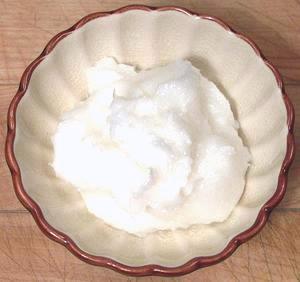
 [Manteca (Mexico)]
Lard is the rendered fat of pigs. It was so vilified by the American Heart Association that Americans are afraid to use it. Now that the AHA has been thoroughly discredited for promoting deadly trans fats, the cholesterol scare, and other major publicity campaigns based on bad science, lard is coming back into the picture, with top chefs in the lead.
The AHA's claims against lard are not well supported by demographics. Even at the kick-off show for the AHA's "Heart Healthy Diet", an elderly heart specialist in attendance pointed out that early in his career Americans practically lived on pig fat, and congestive heart disease and cancer were very rare then. He refused to endorse the diet and stated that it might have been better had Americans "never even heard of corn oil".
Even by AHA standards, lard has a better health profile than butter (but they wanted you to replace butter with trans fat laden margarine anyway). I will point out that those long-lived Bulgarians often mentioned in health food articles do their cooking with lard. Today food experts are increasingly rejecting industrially manufactured seed oils, particularly those high in polyunsaturates, in favor of the natural fats we evolved with, lard being one of them.
Actual research has shown that enough saturated fat in the diet will protect the heart from damage caused by Canola Oil. That data is from rats, but is consistent with human demographic data from China.
|
Lard is essential to accurately present the flavors and textures of many ethnic cuisines, as well as for making crisp cookies, flaky pie crusts and light pastries. Foods fried in lard come out crispy and flavorful and do not become soggy as they cool. Foods baked or fried with lard have a desirable "mouth feel" not approachable by vegetable oils. Beef tallow can get fairly close, but the flavor is not as good. Lard use has lately been increasing under the influence of leading chefs and bakers, and has also been resurgent in England for recreating traditional dishes. The resurgence is also due in part to the recent revelation that partially hydrogenated vegetable shortenings, formerly promoted as "healthier", are a lot more deadly than animal fats. Lard is the traditional cooking fat of Thailand and major parts of China, regions not noted for unhealthy diets. It is the dominant cooking fat for Polish and Hungarian cuisines and is very widely used in Mexico and Central and South America. Of course if you're a Muslim or an observant Jew lard is out of the question - but the fat rendered from the tails of fat tailed sheep is reputed to be very good. Unfortunately there are no fat tailed sheep in North America, in fact most sheep here have their tails cut off at birth to prevent a health problem you'd rather not know about. Buying Lard:The stuff they sell in tubs in the markets is highly processed, devoid of flavor and is no longer a natural product. It may even contain trans fats. Render your own - it's not at all difficult - you just need some pig fat.Leaf Lard:This is the finest variety of lard, rendered from fat from around the kidneys. It has almost no pork flavor and is often used in fine baked goods, producing light pastries and flaky pie crusts. It is difficult to find locally but you can easily order it on the Internet.The next best is fatback lard from under the skin at the top of the pig. The product "fatback" though is not lard, it's the unrendered fat as it comes off the pig. Commercial lard in tubs is rendered fat from various parts of the pig mixed together, bleached and processed. Storing:Lard you render yourself has not been bleached and hydrogenated to make it "shelf stable", and it contains no preservatives, so it should not be left long at room temperature - refrigerate (3 months in a tightly sealed container) or freeze (1 year).Hydrogenation:Lard, like other fats, can be hydrogenated to make it more solid and resistant to rancidity. Some lard is "partially hydrogenated" and contains Trans Fats, but this form is used mainly in the food processing industry. Most "shelf stable" lard in the markets today lists "Lard and Hydrogenated Lard". This is "fully hydrogenated lard" which does not contain a significant amount of Trans Fats. Basically, full hydrogenation converts the non-saturated fats to solid, rancidity resistant saturated fats.It is appropriate to note that "Trans Fat Free" vegetable shortening is done the same way. Vegetable oils are converted to all saturated fat by "full hydrogenation", then mixed with unhydrogenated oils to make the product softer than a hockey puck. Cooking with Lard:Lard is particularly good for frying things that are a sticking problem. They are less likely to stick when fried in lard than when fried in olive oil. They will also fry up nice and crisp and will not become soggy as they cool as oil fried foods tend to.If you are coating baking sheets or broiling pans to oven brown meats or similar uses, coat them with lard, not oil. Vegetable oils turn into varnish under heat and are far more difficult to clean off. Lard really shines when used in cookies, pastries, pie crusts and other baked goods. Leaf Lard is preferred here because of its purity and almost complete absence of meat flavor. When frying in lard, keep in mind that it's a low temperature fat. It should not be heated beyond 360°F/185°C. It can be reused (after filtering and if it hasn't been overheated) to a limited extent. It has an oxidation index of 1.7, not quite as good as olive oil's 1.5, while beef tallow goes to 420°F/220°C with an oxidation index of 0.86. 1.7 is still a whole lot better than Canola Oil's 5.5 though. For details see our Oils Chart - Smoke Temperature & Composition page. Rendering Lard:You can make your own lard very easily. There are two methods, dry rendering and wet rendering.
|