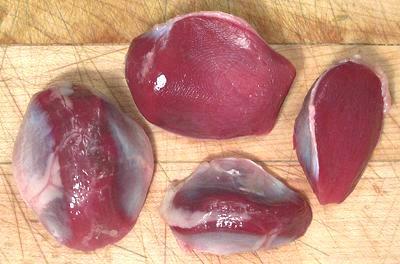
 Duck gizzards are very popular in France, but in North America they are most
used in Asian recipes. Duck gizzards have a different flavor (duck) and
different texture than Chicken gizzards - they are crunchy rather than
rubbery. They are expensive in France and China, but reasonably priced in
North America due to fewer cooks who know what to do with them.
Duck gizzards are very popular in France, but in North America they are most
used in Asian recipes. Duck gizzards have a different flavor (duck) and
different texture than Chicken gizzards - they are crunchy rather than
rubbery. They are expensive in France and China, but reasonably priced in
North America due to fewer cooks who know what to do with them.
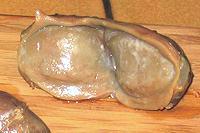
Whole duck gizzard split open cooked and canned packed in fat, as commonly
sold in France.
Photo by
Anthere
distributed under license
Creative Commons
Attribution 2.5 Generic.
Buying:
Find them in ethnic markets serving a Chinese community. In Southern California they're generally peeled, cut and cleaned as shown above, packed in foam plastic trays weighing about 1 pound.French duck gizzards, as shown to the left, are probably available in upscale gourmet outlets. They are sold canned, whole or cut, as confit (seasoned, cooked and packed in fat).
Yield:
If in the form described above, about as close to 100% as you can get.Prep:
If in the form described above, rinse gizzards and remove any fat left by the processor. Just scrape it down to the edge where it's easy to cut off. Gizzard pieces vary quite a bit in size, but they are usually sliced fairly thin before cooking.If you have fresh whole gizzards or in the form shown to the left, you
need to peel off the tough outer membrane before cutting.