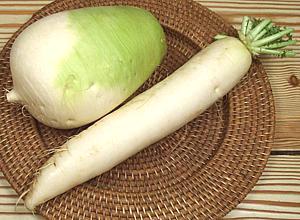
 [Raphanus Sativus]
Essential to Japanese, Korean and Chinese cuisines, these large white radishes are now available throughout the U.S. even in regular supermarkets. Asian markets may have several shapes and will also carry both roots and leaves in various dried, pickled and salted forms. Most markets remove the leaves because they yellow quickly but some farmer's markets will have them with leaves on.
These are fairly mild radishes, generally similar to a very mild red radish. Most Japanese daikons are shaped like fat carrots and are marketed in various sizes from a few ounces to several pounds, but in Japan spherical varieties are also grown. Korean daikons are fatter and shorter, often quite cylindrical. The photo specimens are: Korean, 4-3/4 inches diameter, 7 inches long and 3-1/4 pounds, about average size, and Japanese, 2-1/4 inches diameter, 12 inches long and 1-1/2 pounds, again about average.
More on Cabbage Roots.
One of the least aware recipes I've seen asks for "1/2 daikon radish". In Southern California I can easily find daikons ranging from less than 5 ounces to well over 5 pounds - from 6 inches to 2 feet long - long thin daikons and short fat daikons. So just exactly how big is "half a #&)*# daikon radish" in England, lady? This behavior is typical of cookbooks from England, where apparently they have neither scales or rulers, and where all fruits, vegetables and bunches of herbs must be of uniform size, and probably a lot smaller than in Californai.
 These are easy to find here in Southern California, and are always
from Daikon radishes because their sprouts are large and fast growing.
They are particularly popular in vegetarian sandwiches and salads,
where their sharp radishy bite helps liven up the mix. They are
generally packaged in a tall flimsy plastic container with growing
matrix in the bottom. The photo specimen was 5 inches high (including
matrix and roots) and weighed 5-3/8 ounces with a 2-1/2 ounce edible
yield.
These are easy to find here in Southern California, and are always
from Daikon radishes because their sprouts are large and fast growing.
They are particularly popular in vegetarian sandwiches and salads,
where their sharp radishy bite helps liven up the mix. They are
generally packaged in a tall flimsy plastic container with growing
matrix in the bottom. The photo specimen was 5 inches high (including
matrix and roots) and weighed 5-3/8 ounces with a 2-1/2 ounce edible
yield.