 [Kapusta Kwaszona (Poland); Kvashenoyi Kapusty (Ukraine); Kvashenaya
kapusta (Russia); Sauerkraut (German, English); Zuurkool (Netherlands);
Chocrute (French); Liberty Cabbage (North America during World War I),
Victory Cabbage (North America during World War II)]
[Kapusta Kwaszona (Poland); Kvashenoyi Kapusty (Ukraine); Kvashenaya
kapusta (Russia); Sauerkraut (German, English); Zuurkool (Netherlands);
Chocrute (French); Liberty Cabbage (North America during World War I),
Victory Cabbage (North America during World War II)]
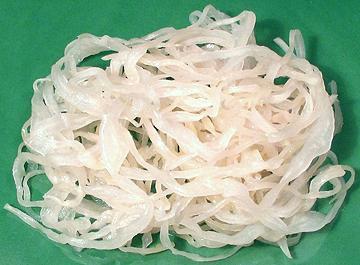
Sauerkraut is cabbage that is salted to a precise degree and allowed to ferment, pressed under its own brine, through several generations of bacteria until it reaches a desired degree of sourness from a final lactic acid fermentation. It is then refrigerated or canned to stop further fermentation. It is usually shredded before fermentation, but In some cases it is made with lengthwise wedges of cabbage rather than shredded. It is also made using whole heads, especially in the Balkan region where stuffed cabbage rolls are often made with fermented whole leaves rather than fresh.
It is very important to the cuisines of Germany, Poland, Russia, Hungary, Netherlands and parts of the Balkans. It is also popular in parts of France and Italy that have German exposure. Sauerkraut consumption has been declining in North America, which is not surprisingly since it is often prepared with little care.
More on Pickled and Preserved
Cabbages.
From China it is said to have been adopted by Genghis Kahn for his invading armies of Mongols, who carried it to Europe. I find this questionable, since these were nomadic herding people, not cabbage growers, and sauerkraut is rather heavy by weight and very light in calories - rather suboptimal for fast moving armies on horseback. The Mongoles did penetrate parts of Hungary, but only launched a few raids agains Poland and Lithuania, and never touched Germany at all.
This story is also severely undermined by Roman authors Cato (234 BCE - 149 BCE) and Columella (4 BCE - 70 CE). Both mention preserving cabbage and turnips with salt - long before Genghis Kahn (1142 - 1227), and the Mongols didn't get to Europe until well after his death. I suggest Poland as a possible point of development for sauerkraut as we know it today. Huge salt mines have been in operation in Poland since ancient times. While salt was very expensive in most of the ancient world, it was easily available in Poland.
Kimchi is a Korean salt fermentation very similar to sauerkraut. It was originally made mostly from salted radishes, with Napa Cabbage coming into use around 900 CE. It is now most often made from Napa cabbage, with plenty of spicy chili flake (not all kimchi contains cabbage - or chili). In 2012, China banned import of Korean Kimchi in favor of its own Pao cai, which has a much milder fermentation.
In Captain Cook's day (late 1700s), British ships carried barrels of sauerkraut to ward off scurvy (a vitamin C deficiency). The British later switched to limes but German and Dutch ships continued with sauerkraut. French and Spanish ships used potatoes for this purpose.
Various Polish brands are now widely stocked by specialty and ethnic markets in North America. The photo specimen is Polish Vitarol brand, my favorite because it's packed with plenty of brine. These are put up in glass jars and most are pretty good. American brand Claussen (refrigerated) is excellent and fresh, though I consider it rather costly for cooking. I have seen references to fresh Bubbies brand in the jar, but I haven't seen it anywhere I shop, and US 2015 $9 for a 25 ounce jar seems a little high for cabbage when Vitarol is $2.25 for 31.7 ounces. The German brand Gundelsheim Barrel is highly thought of, but I've never seen it here in Southern California.
Just because sauerkraut is in a refrigerated bag rather than a jar doesn't mean it's better. Back in 2001 Trader Joe's sauerkraut in the bag was absolutely awful - my opinion, which was shared by the Los Angeles Times Test Kitchen. Libby's Crispy Kraut is considered quite good at the economy end. Franks Quality Kraut is considered among the best American made brands, but is somewhat regional in availability. The fresh in refrigerated bags recently appeared in one of the markets I shop at, so I can confirm it is very good, and very evenly shredded. I have not seen the canned version here. In years past I used many jars of Meeter's Wisconsin Kraut, but Stokeley has discontinued that product. Of course you don't have to buy sauerkraut, it's not hard to make in 5 and 10 pound batches, but is best made in a cool climate. not in Sunny Southern California.
Sauerkraut is low in calories and high in calcium and magnesium. It is a very good source of folate, iron, potassium, copper, manganese and dietary fiber, as well as being a source of vitamins C, B and K, and the antioxidants lutein and zeaxanthin. The fermentation process improves bioavailability of nutrients over the original raw cabbage.
For nutrition, there is a great difference between fresh raw sauerkraut (the refrigerated sort) and Pasteurized sauerkraut in unrefrigerated cans or jars. Fresh, raw sauerkraut has more vitamin C, enzymes, and live lactic acid bacteria cultures that are beneficial to digestion and may even relieve lactose intolerance. Of course, these advantages are lost if you cook it.
Current research shows raw sauerkraut to be a powerful immune booster and cancer fighter, particularly for breast cancer. Raw sauerkraut was used during the American Civil War to significantly reduce deaths from smallpox among prisoners of war, and it has recently been found effective against avian flu in birds.
Since sauerkraut is high in fiber and has plenty of vitamins but is very low in calories, it has endeared itself to a number of top models and other celebrities. They can eat plenty of it without gaining a pound. No need to jam their fingers down their throats after pigging out.
cb_skrautz 100227 - www.clovegarden.com