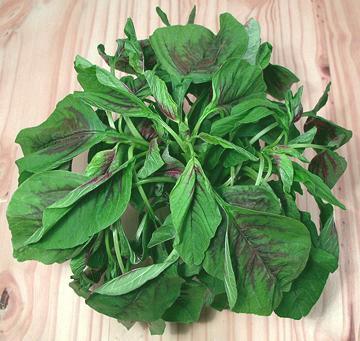
 Amaranth Greens
Amaranth Greens
[Chinese spinach; Red Spinach (markets); Pak khom (Thai); Kilitis, Kulitis, Kalunay (Philippine); Chua, Chaulai, Harive, Cheera (India); Bayam (Malaysia); Hinn Choy, Hen Choy, Yin Tsoi (China), Amaranthus cruentus, A. Blitum, A. dubius, A. tricolor and other species]
Originating in South or Southeast Asia, Amaranth greens are now grown and eaten through much of the world. The photo specimens were obtained from a market in Los Angeles serving a mixed Vietnamese / Chinese community, but it is also very popular in parts of India, Sri Lanka and the Caribbean. It is similar to spinach in use but not as fragile so it accepts rougher handling and longer cooking times. In addition to being a lot less tart, it's somewhat mucilaginous so it has a thickening effect.
Amaranth roots are also nutritious, and used in soups in China, Vietnam and Nigeria. Greens and roots have significant medicinal uses.
More on Carnations
and Amaranths.
 Amaranth Seeds
[Kiwicha (Inca), Amaranthus cruentis, A. hypochondriaca, A. caudatus]
The seed amaranths are native to the American tropics, but are
now grown worldwide, particularly in India. Amaranth was of great
importance to the Incas because it grew well in the high mountainous
regions of Peru and was highly nutritious. It has also become of some
importance in the Himalayan region of Asia for similar reasons.
Spanish conquerors of Peru were highly disturbed by its use in a
ritual too close to Christian communion for comfort, and banned its
cultivation. The crop has recently gone back into production because
of its nutritional attributes, and it is now widely available. It is
slowly escaping from the "health food" market into the mainstream,
though not as quickly as Quinoa.
|
Greens Buying: This green is almost always in stock at markets in Los Angeles that serve a Southeast Asian community, but is not yet common in the Indian markets. It is sold fresh in plastic bags. Depending on the market, they may weight between 16 ounces with moderate sized stems to nearly 3 pounds with stems up to 1/2 inch diameter. They cost about 2016 US $1.29 per pound. Storing: I treat this like spinach. I pull off the leaves and tender tips, leaving the main and leaf stems behind. I then float wash them, and finally remove all free water by spinning in my salad spinner. Wrapped loosely in plastic the leaves will keep for about four days in the fridge. Yield: Amaranth is quite stemmy, so a nice fresh bunch just 1 ounce shy of three pounds yielded 14-5/8 ounces of green leaf and tender tips (no stems) for a yield of 43%. Cooking: This green is cooked in many ways, sometimes as a recipe ingredient and sometimes just as greens. When cooking a big bunch as greens, the cooking water is usually discarded because of the oxalic acid content, and sometimes high nitrate content (depending on soil). Health & Nutrition: Amaranth greens contain an unusual amount of manganese and magnesium, as well as plenty of iron and phosphorus. They also contain significant amounts of calcium, zinc, selenium and potassium. They are also noteworthy for Vitamin E and B complex, and a high amount of protein for a leafy green. Oxalic acid content may somewhat inhibit absorption of the zinc and calcium. While the oxalic acid content is much lower than that of spinach, it is still recommended that people suffering from kidney problems, gout and rheumatoid arthritis avoid this green. Seeds Buying: Amaranth seeds are still found mainly in markets serving a Yuppie community - Whole Foods Market and the like, generally in small packages of about 8 to 16 ounces. Storing: Seeds should be kept in a tightly sealed jar, away from light and as cool as possible. Under these conditions it will keep for about a year. Once ground into flour it is highly perishable and should be kept refrigerated and only for a few days - preferably grind as needed. Health & Nutrition: Amaranth is high in protein and that protein is nearly perfectly balanced for human consumption. Wheat, rice and corn must be accompanied by beans to balance the protein content but that isn't necessary with amaranth. Amaranth is also gluten free and can be freely eaten by people with a gluten intolerance (celiacs). Amaranth seed is thought to reduce blood pressure and cholesterol levels. |