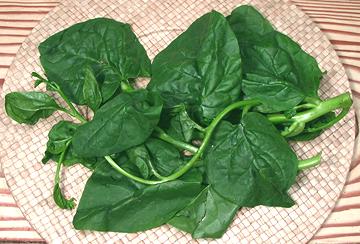
 [Ceylon / Indian / Surinam / Chinese / Vietnamese Spinach; Broad Bologi,
Poi Baagi, Calaloo, Buffalo Spinach; Mong Toi (Viet); Paag-Prung,
Phak plang yai, phalpang (Thai); Phakkang, Pak pang (Laos); Alugbati,
Dundula, Grana, Libato (Philippines); Niviti (Sri Lanka); Gendola,
Remayong, Tembayung (Malay); Genjerot, Jingga, Gendola (Indonesia);
Saan Choy (Cantonese); Shan Tsoi, Luo Kai, Shu Chieh, Lo Kwai (China);
Poi (India); Pui Shak (Bengali); Kodip PasaLi (Tamil); Tsuru Murasa Kai
(Japan); Amunututu (Yoruba); Gborongi (Igbo); Basella alba]
[Ceylon / Indian / Surinam / Chinese / Vietnamese Spinach; Broad Bologi,
Poi Baagi, Calaloo, Buffalo Spinach; Mong Toi (Viet); Paag-Prung,
Phak plang yai, phalpang (Thai); Phakkang, Pak pang (Laos); Alugbati,
Dundula, Grana, Libato (Philippines); Niviti (Sri Lanka); Gendola,
Remayong, Tembayung (Malay); Genjerot, Jingga, Gendola (Indonesia);
Saan Choy (Cantonese); Shan Tsoi, Luo Kai, Shu Chieh, Lo Kwai (China);
Poi (India); Pui Shak (Bengali); Kodip PasaLi (Tamil); Tsuru Murasa Kai
(Japan); Amunututu (Yoruba); Gborongi (Igbo); Basella alba]
Not related to regular spinach but rather to cactus and purslane (order Caryophyllales (Carnations)), this plant has a flavor vaguely similar to spinach, but more earthy and much milder due to low oxalic acid content. The leaves are thick, almost succulent, and actually quite filling. One cultivar, "Rubra", has red stems.
While regular spinach is a cool temperate plant which doesn't like the tropics at all, Malabar Spinach is a tropical vine. A fast growing perennial, it is harvested continuously by cutting new growth. It can be grown as an annual in warmer temperate regions.
More on Carnations.
This plant is used throughout southern India, Southeast Asia, southern China and as far north as Japan. In India it is used in curries, it's mucilaginous character acting as a thickener. In Southeast Asia it is briefly cooked in stir fries and in soups. It also appears in tropical African cuisine as a leafy green vegetable.
In India Malabar Spinach is used as a thickener similar to the way okra is, so it's cooked much longer in curries, sambars and the like, and with a lot more other ingredients.