Bottle Gourd - Opo / Upo
 [Opo Squash, Calabash (U.S.); Upo (Filipino); Dudhi, Lauki, Sorakaya (India);
Yugao, Kampyo (Japan); Po gua (Canton); Kwa kawa, Hu gua (China);
Cucuzzi, Cucuzza (Italy); Bau (Viet); Bu (Burma), Bu nyunt (young
shoots (Burma); Mak nam (Laos); Lagenaria siceraria]
[Opo Squash, Calabash (U.S.); Upo (Filipino); Dudhi, Lauki, Sorakaya (India);
Yugao, Kampyo (Japan); Po gua (Canton); Kwa kawa, Hu gua (China);
Cucuzzi, Cucuzza (Italy); Bau (Viet); Bu (Burma), Bu nyunt (young
shoots (Burma); Mak nam (Laos); Lagenaria siceraria]
Probably originating in southern Africa, this gourd was one of the
earliest plants to enter cultivation, probably more for containers than
for food. Genetic analysis has shown they were carried from Asia to the
Americas more than 8000 years ago.
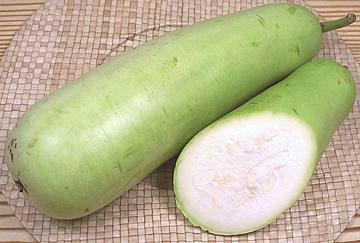
Bottle gourds come in many shapes and sizes from long and snake like
to spherical, but the form pictured is the one most common in Southern
California. They will grow much larger but they get very bitter when
more mature. Eventually the shell hardens and the gourd becomes hollow
and may be used as a container or utensil, or carved decoratively.
Young shoots and leaves are also edible. Dried strips of the
gourd called Kampyo are important in Japan and often used as edible
bindings to hold other ingredients together. The photo specimen was 12
inches long, 3-3/4 inches diameter and weighed 2-1/2 pounds, a touch
above average for those sold in Southern California.
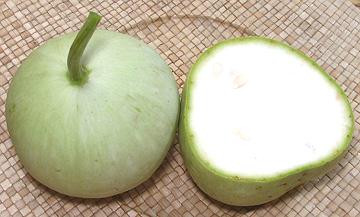 Spherical opo gourds like the one in the photo to the left have started
appearing in produce markets here in Los Angeles (2012). Some of these
have a small neck at the stem end. The photo specimen was 4.5 inches
diameter, and weighed 1 pound 1 ounces. the cut one was a little heavier
at 1 pound 3 ounces. The cut version has a faintly visible seed (upper
left), slightly beige in color, indicating this gourd is at maximum
maturity for eating. The seeds of this variety are fairly large, due
to it's large diameter. All characteristics except shape are the same
for long and spherical Opos.
Spherical opo gourds like the one in the photo to the left have started
appearing in produce markets here in Los Angeles (2012). Some of these
have a small neck at the stem end. The photo specimen was 4.5 inches
diameter, and weighed 1 pound 1 ounces. the cut one was a little heavier
at 1 pound 3 ounces. The cut version has a faintly visible seed (upper
left), slightly beige in color, indicating this gourd is at maximum
maturity for eating. The seeds of this variety are fairly large, due
to it's large diameter. All characteristics except shape are the same
for long and spherical Opos.
More on Gourds
Buying:
Find these in Asian and other ethnic markets and at
many well stocked supermarkets (in California, anyway). In Indian
markets the spherical ones may be sold as "Indian Opo", but in other
markets they are just "Opo".
Store:
They will be fine over a week unwrapped in the
refrigerator, protected by their waxy coating. In fact, they last that
long just sitting on my kitchen floor, but unrefrigerated the seeds may
continue to mature, making them undesirable for cooking. Once cut,
they spoil rapidly.
Prep:
The peel is tender and very thin so do a minimum
peel with a vegetable peeler. Many recipes call for scooping out the
seed mass, but this is wasteful and unneeded, unless the gourd is
over-aged and the seeds are darkening.
Cook:
Like other gourds they hold their shape very well
in cooking rather than becoming mush like squash do. They are done when
the flesh is translucent (about 10 to 15 minutes depending on maturity
and size of chunks). Best to pull before the seed mass starts to break
up.
gd_opoz* 070913 - www.clovegarden.com
©Andrew Grygus - agryg@clovegarden.com - Photos on this
page not otherwise credited are © cg1 -
Linking to and non-commercial use of this page permitted