 [Khing (Thai); Saenggang (Korea); Inji (Tamil, Malaysian); Aadu (Gujarati),
Alay (Marathi); Adrak (Hindi, Urdu); Zanjabil (Arabic);
Zingiber officinale]
Originally from South or Southeast Asia, ginger is far and away the
most used of the Zingiberaceae family rhizomes. The top ten
producers ship more than a million and a half tons (US) annually, with
India, China and Indonesia the major producers. Nigeria is the only major
producer outside Asia. Available fresh, dried and ground, ginger is now
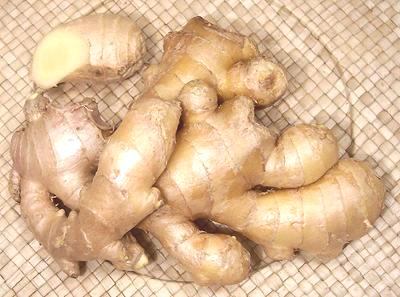
important in every major cuisine worldwide. The photo specimen was 7-1/2
inches long and weighed 12 ounces, a small part of a ginger "reef". Reefs
can easily exceed 30 pounds.
[Khing (Thai); Saenggang (Korea); Inji (Tamil, Malaysian); Aadu (Gujarati),
Alay (Marathi); Adrak (Hindi, Urdu); Zanjabil (Arabic);
Zingiber officinale]
Originally from South or Southeast Asia, ginger is far and away the
most used of the Zingiberaceae family rhizomes. The top ten
producers ship more than a million and a half tons (US) annually, with
India, China and Indonesia the major producers. Nigeria is the only major
producer outside Asia. Available fresh, dried and ground, ginger is now
important in every major cuisine worldwide. The photo specimen was 7-1/2
inches long and weighed 12 ounces, a small part of a ginger "reef". Reefs
can easily exceed 30 pounds.
Ginger is also important in both formal and folk medicine, particularly for nausea and stomach upset. It has been shown effective against motion sickness, morning sickness and nausea from chemotherapy, but not for postoperative nausea. It is also used as a flavoring to cover medicinal tastes.
 [Stem ginger, Green ginger, Pink ginger, New ginger, Spring ginger,
Zingiber officinale]
[Stem ginger, Green ginger, Pink ginger, New ginger, Spring ginger,
Zingiber officinale]
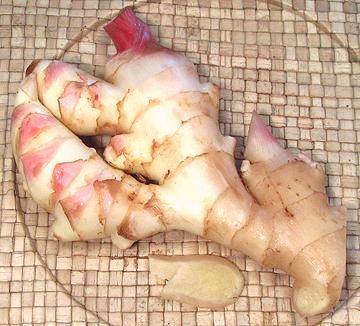
This is regular ginger when new sections of rhizome have formed and sprouted leaf stems. It is juicier and much milder than older ginger and has a tender skin that is generally not peeled. It is seasonal so not always available. Ginger in this state of growth is often pickled, particularly in Southeastern India. It is often called for in Southeast Asian recipes and is preferred for general cooking in Cambodia.
This ginger, lightly pickled and dyed a light pink, is the ginger served with sushi and sashimi in Japanese restaurants.
Countries that are significant Ginger users.
Most instructions have you wrap ginger in dry toweling and store it in the refrigerator in a paper bag - but I use it much too frequently to be all the time unwrapping and wrapping. I have found it keeps very well in a short plastic bag set in a tray in the refrigerator door with the top left wide open. In a closed bag it will soon go to mold.
Most recipes call for peeling ginger but this is not necessary. My practice, and the practice of a number of chefs, is to shave off the gnarly parts and leave most of the skin on. Some Southeast Asian recipes actually call for the skin to be left on because much of the flavor is close under the skin.
When preparing for most uses, cut slices crosswise as thin as you can to break the fibers. Then lay out the slices in an overlapping stack and cut into narrow slivers. Sometimes these are used as is, but otherwise bunch them up and cut into tiny pieces, then chop further or mash in a mortar as appropriate for the recipe. Never slice ginger lengthwise.
Do not attempt to used dried ginger in recipes calling for fresh - it just isn't the same thing at all.
Powdered ginger is familiar in North America and Europe as an ingredient in many baked goods, ginger bread for example. It is widely used in Middle Eastern and North African cuisines and in India for some specialty dishes and as an ingredient in masalas (spice powders).
Fresh ginger can not be used as a substitute for dried, nor vice versa - they just aren't the same thing at all.
gg_gingerz 090206 r 140124 - www.clovegarden.com