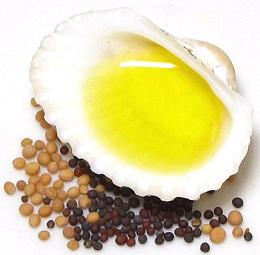
 [White Mustard; Sinapis alba alt Brassica hirta,
B. alba | Black Mustard Brassica nigra | Brown Mustard,
Indian Brown Mustard, Leaf Mustard; Brassica juncea]
[White Mustard; Sinapis alba alt Brassica hirta,
B. alba | Black Mustard Brassica nigra | Brown Mustard,
Indian Brown Mustard, Leaf Mustard; Brassica juncea]
Mustard Seed Oil is the traditional cooking oil of Bengal (Bangladesh and the northeast coast of India) and is used for some types of frying throughout northern India. It is also the primary cooking oil in parts of China and Russia. It is considered essential for reproducing the unique flavors of the regions where it is used, but in India, its use is declining because neutral flavored oils like sunflower are cheaper.
Mustard seed oil contains significant amounts of erucic acid, a monounsaturated (Omega-9) oil, which was formerly considered dangerous. This has not been supported by recent research or by demographics (unless you are a male rat). Problems from human consumption do appear in times of famine when little other food is available. Apparently adequate amounts of saturated fats in the diet protect against problems from this oil, as well as from Canola oil (low erucic acid rapeseed oil).
There is currently a project in Belgium to breed a mustard plant that produces mustard oil that meets all requirements of international health authorities. This is important because Mustard plants grow well in environments unsuitable for oilseed rape. GRAS (Generally Regarded as Safe) approval should be quick, as this is being developed by natural breeding from a variety already well known for mustard seed oil.
Mustard Seed Oil is often confused with Rapeseed Oil and Canola Oil (low erucic acid rapeseed oil). Those oils are from a related species, (Brassica napus) but are not the same oil. Rapeseed was not used as a cooking oil until the development of Canola Oil. For details see our Canola Oil page.
More on Oils |
More on Mustard Seeds.
Buying & Storage: Mustard oil is easily found in markets serving an Indian or Pakistani community. You should purchase in a quantity you will use up in 6 months or so after opening. Store it in a tightly sealed bottle away from light and heat and with as little air in the bottle as practical. It is a fairly stable oil but not as stable as pure olive oil.Cooking:Mustard oil is most often heated in the pan, with no other ingredients, until it reaches a temperature where the first wisps of smoke appear (about 480°F/250°C). Immediately take it off the heat and allow to cool to a more reasonable frying temperature (around 360°F/180°C) before adding other ingredients. This procedure removes the acrid taste of the raw oil and renders it quite pleasant.Subst: Today, in India, mustard oil is gradually being replaced by cheaper but less stable neutral flavored oils like sunflower oil. I recommend, if you don't have mustard oil, you use pure olive oil (not virgin) or avocado oil, which are sufficiently neutral but more stable and with better health profiles than most oils. Do not bring these oils up to the smoke point. Some Indian cookbooks recommend 2 Tablespoons of a regular cooking oil mixed with 1 teaspoon of Mustard Powder (such as Colman's). One cookbook I have recommends taking this mix up to the smoke point as for real mustard oil. I do not recommend this as it will surely burn the mustard powder.Health & Nutrition: Mustard oil sold in the U.S. and the European Union is always labeled "For massage use only". I suppose you could use it for that purpose, but there is some indication that small children could be harmed by such use. Pretty much all that is sold here in North America is used for cooking.The reason for this labeling is concern about the high erucic acid content, which was suspected of causing heart lesions. This is now strongly doubted by researchers, who have also noted that demographics do not support this danger. Research done on rats is invalid due to a specific difference in metabolism. Mustard oil is, in fact, now suspected to provide some protection against cardiovascular diseases, and sufficient saturated fats in the diet apparently protect against heart lesions from this oil and Canola oil, even for male rats. Currently, it is suspected the heart lesions are caused by excess Omega-3 fats, because Flax Seed Oil causes the same problem. It is high in Omega-3 fats, but has no erucic acid. Mustard oil is high in the vegetable form of Omega-3 fatty acids (6% to 11%), which can, under some circumstances, be converted in the body to the more useful fish oil form. Omega-3 is fragile and is probably at least partially destroyed when the oil is brought to the smoke point. |