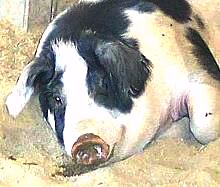
 Pig
Pig
Mammals
Contents
General and History
Pigs were one of the first animals to be domesticated, particularly becaused they found hanging around with people provided a good food supply. Scientists now believe pigs were domesticated independently in at least two places, Europe and China, and perhaps others.
Pig is very tasty and the most eaten meat in much of the world, but some religions forbid eating pig.
- Jews are forbidden from eating pig, calling it "unclean", but have no prohibitions on raising or selling pigs or using non-food pig products. A number of reasons for this prohibition have been proposed by educated people too remote from the subject. If you aren't squemish, here is the real reason.
- Islam expanded on the Jewish prohibition by forbiding any contact whatever with pigs on pain of frying forever in the sauté pans of Hell - no virgins for you, buddy!
- Buddhists of non-vegetarian sects.have no problem with pig. Members of vegetarian sects can eat pig only if it has been offered incidentally and was not prepared for them.
- India: Hindus have no prohibition on eating pig unless their sect forbids all meat as part of a vegetarian discipline. Nontheless, pig is not much eaten in India except in a few areas that have a tradition of hunting wild pigs or which have been under Chinese (Northeast) or European influence (Goa). Most of India simply can't afford pigs because they compete directly with humans for food.
- China and Southeast Asia are very big eaters of pig except in the Muslim areas and the Mongolian areas (including Korea) where beef predominates.
- Christians, a powerful sub-cult of the Pagans, have no dietary restrictions and are quite fond of pig everywhere where it can be grown economically, particularly in North America and Europe.
Cuts
Pork cuts are much simpler than beef cuts, including only four "primal" cuts.
Pork Butt Roast - Boston Butt
The top portion of the front leg of a pig from the backbone down and
including the shoulder blade. It may be sold skin-on but is more commonly
without skin and often without bone. If boneless it may be rolled up and
secured with netting.
The term "butt" has nothing to do with the rear end of the pig, this is the front shoulder. Some say it was called "Boston Butt" because it was packed in a barrel called a "butt" but I think that's reaching. The section below the Butt Roast is the Pork Shoulder Picnic Roast.
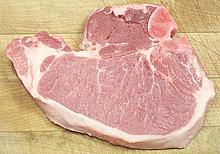 The typical "bone in" loin chop shown was 3/4 inch thick and weighed 9 ounces.
There are three types of pork chop depending on where they were cut from the
pig, but they may be properly titled in the market. They are:
The typical "bone in" loin chop shown was 3/4 inch thick and weighed 9 ounces.
There are three types of pork chop depending on where they were cut from the
pig, but they may be properly titled in the market. They are:
Pork Shoulder Picnic Roast (Fresh)
The portion of the front leg above the hocks and below the
Pork Butt Roast (Boston Butt). See also Picnic Ham for
the smoked and cured version. This is a large cut which is often roasted
intact, skin-on and bone-in, and a very fine roast it is. It's a fairly lean
cut with plenty of meat and big bones through the center, and any chef will
tell you there's lots of flavor near the bone.
If you can't handle skin and bones see Pork Butt Roast. The skin and bones are critical flavor elements and you aren't going to get anything near the same without them.
It's also a very interesting piece for parting out, particularly if you have recipes requiring skin (the whole underside of the unit in the photo is covered with skin). An 8 pound shoulder will yield 4-1/2 pounds of clear meat without fat, 10 ounces of skin, only 1/3 cup of fat rendered from the cracklings and a good 2 quarts of soup stock, particularly good if you splinter the bones.
Keep in mind this is working muscle so it has more flavor but needs more cooking time to bring it tender than a pork loin or rib roast would.
Cured Pork
See our article Ham & Cured Pork for comprehensive instructions on purchasing and cooking hams.
Health Considerations
Pork has long been condemned in the U.S. for a high content of "artery clogging saturated fat". Strangely, during the 18th and 19th centuries when America practically lived on fatty pork, heart disease was not a major problem, nor does it seem to be much a problem in other demographics with high pork consumption, so long as they have low consumption of trans fats and polyunsaturated oils. I suspect there are serious flaws in current "medical knowledge", but you make your own decisions.
In any case, the U.S. pork industry has worked hard to reduce the amount of fat in the pork they produced, even to the point flavor starts to suffer from lack of it. Fat can be removed almost entirely from many modern cuts of pork.
Trichinosis is a parasitic desease long associated with undercooked pork. It has been pretty much eliminated from American industrial pork, but is still occasionally contracted from pigs grown on small farms or from other sources.
Actually trichinosis can be acquired from eating any animal that is not strictly vegetarian. Bear is the second most common source but walrus, dog, raccoon and other omniverous animals should, as with pork, be cooked to a minimum internal temperature of 165°F/75°C.