Originating in Western Asia and/or Southern Europe, coriander has been cultivated at least since the days of Tutankhamen, and gathered wild from deep into prehistory. It was brought to North America by the first English and Dutch settlers, and to Latin America and the Canary Islands Spanish and Portuguese invaders. It is one of the most important herbs and spices through India, Southeast Asia, China and Africa. All parts of the plant are edible.

This herb was once in very wide use all over Europe, but has been almost completely supplanted by parsley. In Western Europe, only traditional recipes in southern Portugal and Spain's Canary Islands still call for it. On the other hand, it is greatly used in most non-European cuisines worldwide, and in the Caucasus where Cilantro and Coriander seed are the chief herb and spice of Georgia.
Many long years ago, when I first starting cooking, I was using the 1000 Recipe Chinese Cookbook and was totally mystified by all the calls for "Chinese Parsley". No such thing was sold in Southern California. Now remember, the public Internet was still 30 years away, so you couldn't get all your questions answered in 12 seconds back then. Today, all the markets have Cilantro, and the ethnic markets have heaps and piles of it.
There is a strong "I hate Cilantro" movement on the Internet, but the condition is curable by exposure. A leader of one such Web based group, after extensive testing for hate articles, realized to her horror that she had come to rather like cilantro and had to resign her post. Her's is far from the only such story - even some people who claim to have the genetic defect that makes Cilantro taste bad testify that exposure cures that problem.
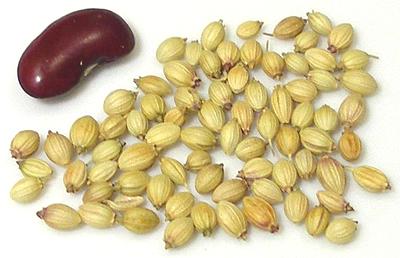
These "seeds" are actually dried fruits containing seeds. While not now used in Europe to anywhere near the extent they were in Medieval times, coriander seeds are still used in pickling and sausage making. In India they are used in vast quantity for all manner of curries and spice mixtures, almost always with Cumin at a ratio of about 1 T Coriander to 1 t cumin. This combination was also popular in Imperial Rome, and is used in Africa and the Middle East.
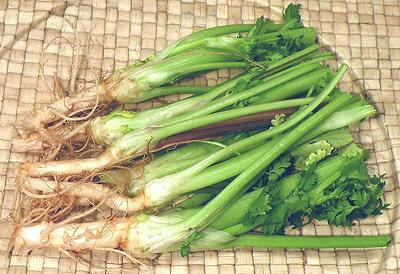
While perfectly edible, cilantro roots seem to be used only in the cuisine of Thailand, and to a much lesser extent in a couple of Thailand's neighbors. Roots are used as a component of curry pastes and in some soups.
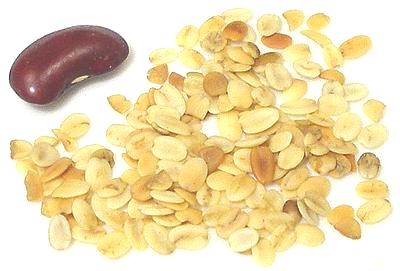
This is actually coriander seeds,extracted from the fruit husks, rolled and toasted. It's very tasty but is strictly an Indian specialty available only in Indian markets. It is a relatively new product, and named partly in hope of getting around export taxes on spices by calling it "Dal". The courts ruled otherwise.
It is used primarily as a mouth freshener after meals. If it was not
toasted as purchased it should be lightly toasted, but not enough to
significantly change its color. It is also used in Sambars and the like
in Southern India.