 [order
Rajiformes (skates & Rays): family Rajidae (skates)
Dasyatidae (stingrays) and others. Alternate: order
Rajiformes (skates), Myliobatiformes (Rays)]
[order
Rajiformes (skates & Rays): family Rajidae (skates)
Dasyatidae (stingrays) and others. Alternate: order
Rajiformes (skates), Myliobatiformes (Rays)]
Skate Wing
[order
Rajiformes (skates & Rays): family Rajidae (skates)
Dasyatidae (stingrays) and others. Alternate: order
Rajiformes (skates), Myliobatiformes (Rays)]
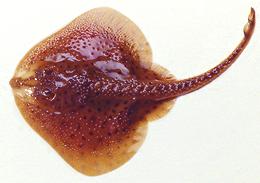
Skates and Rays are members of the shark family that have pectoral fins so exaggerated they are called "wings". This allows them to lie flat on the ocean floor and disappear into the sand. They eat mainly crustaceans and other invertebrates they find on the ocean floor, but occasionally take small fish. While most people in North America never encounter skate on their dinner plate, it is served in areas like New England that have a strong fishing and seafood tradition, and is popular in France. Photo of Little Skate (Leucoraja erinacea) by Mount Desert Island Biological Laboratory contributed to the public domain.
More on Skates and Rays.
|
|
|
Skate flesh is quite mild, but slightly more gelatinous than that of regular fish. It cooks very quickly and if overcooked breaks up along the corrugations. Buying: The key to successful skate wing cooking is for the wings to be very fresh. Since they're cut from the skate you don't have the usual methods to judge freshness, but smell will do. If it smells at all like household ammonia it is not fresh and should be rejected. Skate wing is fairly common in the larger Asian markets here in Southern California, and may be found near fishing ports in other regions of North America. Skates are generally by-catch when fishing for other kinds of fish. Storing: Because freshness is a big issue, you want to keep skate wings as cold as possible and use them as soon as possible - like immediately. If you must hold them, skin and fillet them and freeze the fillets. Refresh: Skate wings that smell of ammonia will taste like ammonia. If the smell is strong, toss them out or suffer the consequences - it won't taste good and the dead fish odor may hang around for days. If you've got wings with just a hint of ammonia smell you can refresh them. Skin them, bone them and prepare them ready to cook, then soak the pieces in strongly acidulated cold water for half an hour. Preferably acidulate with citric acid (1 T to 2 quarts water). Ammonia is alkaline and will be neutralized by the acid. The pieces of skate should now have a light fish smell and be much more edible.
Yield: Skate wing is generally sold in triangles weighting from 1 to 2 pounds. These triangles are half a wing, so there would be four from a skate. Exact yield depends a little on how the wing was cut. The photo
specimen was cut with a ridge of cartilage at the root, so one cut without
that ridge would yield a little more. The photo specimen, a 1 pound 8-3/8
ounce wing, yielded a thick side filet of 11-1/2 ounces (47%). Counting
the thin side fillet which weighed 3-1/4 ounces that would be 14-3/4
ounces (61%). The cut sides were 9-1/2 and 10-1/2 inches, so the whole
skate was at least 24 inches from wing tip to wing tip.
Lay out your wing on the cutting board, thick side up. Pry up a corner
of the skin at the thick corner and carefully scrape flesh away from the
skin until the skin pulls clean without taking any flesh.
The skin will now pull off, but takes some strength and it's slippery, so
grasp it with your long nose pliers and pull right off the thin edge. If
you'll be using the cartilage and/or the thin side meat, skin the thin side
too.
Depending on the size of your wing, the thin side may have enough flesh to be useful and can be filleted just like the thick side, though you'll run out of flesh about 2/3 the way across so the fillet will be smaller and a lot thinner than from the thick side. Stock: The cartilage structure and offcuts, simmered for
a few hours (unlike regular fish stock which should be no more than 40
minutes) makes a fairly mild stock with no oil whatever. Let it settle a
while before decanting. This should work well blended with other fish
stocks.
Cooking Skate Wings
You can grill skate wings leaving the fin rays in and serve it that way. Use a rub or sauce suitable for grilled fish. Hearty eaters may eat it rays and all (depending on size), though the finicky may flake the meat off. Note that you'll want to serve skate wings corrugated side up (the
skin side), so you'll want to fry that side first. When you turn the fillet
over with the cut side down it will curl some toward that side. This will
tend to emphasize the corrugations.
|
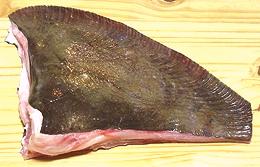
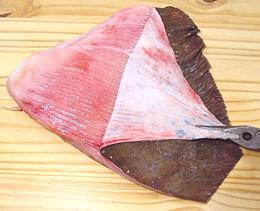 Skinning: Skate skin must be removed. It's basically shark
skin and shark skin is gritty with scales that are built more like teeth
than like regular fish scales. They don't scrape off. Male skates may also
have some sharp spines out on the wings.
Skinning: Skate skin must be removed. It's basically shark
skin and shark skin is gritty with scales that are built more like teeth
than like regular fish scales. They don't scrape off. Male skates may also
have some sharp spines out on the wings.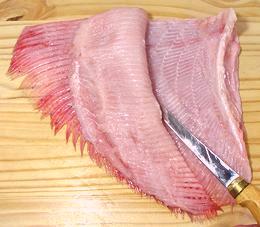 Filleting: You will now be able to filet the thick side from
the cartilage fin rays quite easily and with practically no flesh left
behind. Keep your knife at a very shallow angle to avoid cutting into the
cartilage which is quite soft. Note: not all recipes require
filleting. Skate may be grilled with the fin rays in and for some recipes
you flake the meat off the rays after poaching.
Filleting: You will now be able to filet the thick side from
the cartilage fin rays quite easily and with practically no flesh left
behind. Keep your knife at a very shallow angle to avoid cutting into the
cartilage which is quite soft. Note: not all recipes require
filleting. Skate may be grilled with the fin rays in and for some recipes
you flake the meat off the rays after poaching.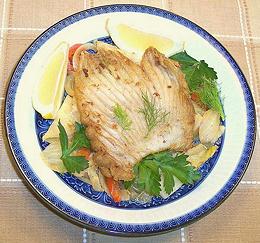 Most recipes for skate call for it to be pan fried, though some call
for poaching. In either case, keep in mind that the skate filet is not only
thin but it's deeply grooved, which allows fast heat penetration. Take care
not to overcook, particularly when poaching or your fillet may fall apart
on the corrugations. The photo shows a filet pan fried without batter on
a bed of vegetables (onion, fennel, red bell and some fish stock). Skate
wing with capers is very popular and a recipe for that will be found in
the CloveGarden recipe pages.
Most recipes for skate call for it to be pan fried, though some call
for poaching. In either case, keep in mind that the skate filet is not only
thin but it's deeply grooved, which allows fast heat penetration. Take care
not to overcook, particularly when poaching or your fillet may fall apart
on the corrugations. The photo shows a filet pan fried without batter on
a bed of vegetables (onion, fennel, red bell and some fish stock). Skate
wing with capers is very popular and a recipe for that will be found in
the CloveGarden recipe pages.