|
European Seabass
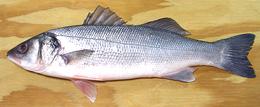 [Branzino (Italy, Restaurants); Dicentrarchus labrax]
This Seabass is native to Western Europe and northwestern Africa.
It is common along the north coast of Norway, in the North Sea,
around the British Isles, southern Iceland, and the Atlantic coasts of
France, Spain, Morocco and Senegal. It is reasonably common in the
Western Mediterranean and the north Adriatic, but relatively scarce
in the Eastern Mediterranean. It is moderately common in the Black Sea.
Details and Cooking
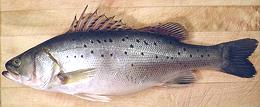
Striped Bass
 [Striped Sea-bass, Morone saxatilis]
This sea bass is found mainly in river estuaries from the Gulf Coast of
the U.S. up the Western Atlantic coast into Canada and there are some
landlocked populations. It has been introduced to other countries and
is now farmed commercially. These fish can grow to 78 inches and 125
pounds but the one in the photo was 15-1/2 inches and weighed 1-3/4
pounds, a typical market size. This fish renews its population fairly
quickly, is not listed as threatened and is now being farmed.
Details and Cooking
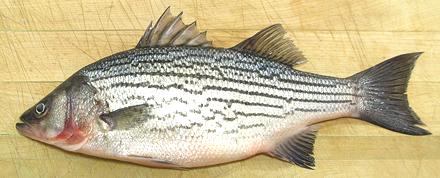
White Bass
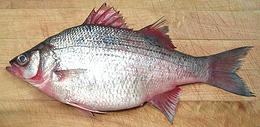 [Morone chrysops]
Native to the rivers of North America, this bass looks a lot like the
Striped Bass, but it inhabits only fresh water and does not venture to
sea. These fish can grow to almost 18 inches and
6-3/4 pounds but the one in the photo was 13-1/4 inches and weighed
1 pound 6 ounces, a little larger than the average market size. This
fish is now farmed on an experimental basis and is not listed as
threatened.
Details and Cooking
White Perch
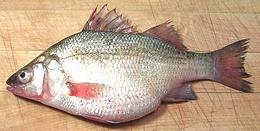 [Morone americana]
Not actually a Perch but a Bass, this fish is native to the North Atlantic
coast, living in salt, brackish and fresh water, and is an invasive species
in the Great Lakes. It is a good eating fish and can be cooked in various
ways. The White Perch is not considered threatened, in fact it is
considered a nuisance in some areas. It can grow to a little over 19
inches and 4-3/4 pounds, but the photo specimen was 10 inches long and
weighed 11 ounces, toward the high end of typical market size.
Details and Cooking.
|
 [Family Moronidae (temperate basses)]
 [Paralabrax species.]