 [Family Salmonidae Genus Salvelinus]
Char are closely related to Salmon and Trout, and a number of species are popularly called "Trout". Among these are Brook trout (northeastern North America), Bull trout (northwestern North America), Dolly Varden trout (northern California around to Russia), and Lake trout (Alaska, Canada, northeastern U.S. and introduced to northern Europe and Asia). The lake trout is the largest char, growing to just over 100 pounds.
More on Varieties of Fish
(very large page).
[Salvelinus alpinus alpinus]
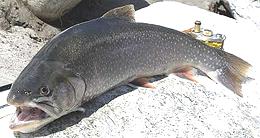
Circumpolar in both freshwater and saltwater, the Arctic Char can live
farther north and in colder waters than any other fish. It can grow to 33
pounds and 42 inches but is usually marketed at between 2 and 5 pounds.
In color it can range
from gray to gray above and red below. The photo specimen is from
Südtirol, in Alpine Italy. This fish is now farmed in Canada, Iceland,
Norway, Ireland and West Virginia. In the wild it is listed as "LC"
(least concern) by the IUCN, and farming is approved by the Monterey
Bay Aquarium.
Details & Cooking.
Photo by Saibling donated to the public domain.
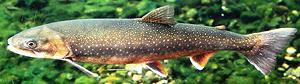 [Lake Char; Storröding (Sweden); Salvelinus umbla]
This red bellied trout-like char is native to the alpine regions of
Germany, Switzerland, Austria and Italy, and has been reported from
Sweden. It can grow to 29 inches, but there are dwarf populations in
many high Alpine lakes. I have seen Rötel described as a "perch"
in cookbooks, but cookbooks tend to call a lot of things "perch".
IUCN Red listed LC (Least Concern), but these fish were driven to
near extinction between 1950 and 1979 by eutrophication caused by
detergent, fertilizer and sewage runoff. While several other lake
fish were driven to extinction, this one survived, and populations
have slowly recovered since polution controls were instituted.
Photo by Bjoertvedt distributed under license
Creative Commons
Attribution-ShareAlike v3.0 Unported.
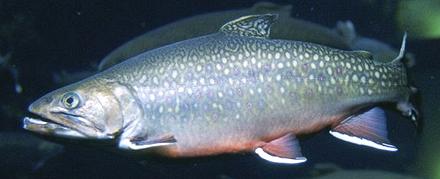
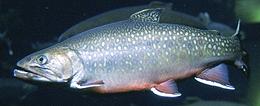 [Salvelinus fontinalis]
Actually a Char, not a Trout, Brook Trout live along most of the east
coast of Canada and down to Georgia in the United States, including
the Great Lakes and the Mississippi River drainage basin. They can grow
to 34 inches and 20 pounds but are more commonly around 10 inches. Brook
trout are now being farmed to some extent, and sold fresh, frozen and
smoked. They are also raised in hatcheries for restocking streams and
lakes, and have been introduced to other parts of the world. They are
environmentally sensitive so are much used for environmental research.
Photo by U.S. Fish and Wildlife Service = public domain
.
Details and Cooking.