Yellow Corvina / Yellow Croaker
 [Yellowfish, Yellow Croaker, Larimichthys polyactis alt
Pseudosciaena manchurica]
[Yellowfish, Yellow Croaker, Larimichthys polyactis alt
Pseudosciaena manchurica]
Native to the northwestern Pacific, particularly the Yellow and East
China seas, this fish is highly prized among Asians in Los Angeles,
especially the Koreans. In Korean markets they are sold frozen, dried,
salted cooked and sometimes fresh, usually in lengths less than 12
inches. They are often called "Corvina" (Spanish for croaker) or
"Yellow Corvina" to avoid confusion with the other fish called
Yellow Croaker. This is the only
fish allowed the name "Yellow Croaker" on Fishbase. They are easy
to tell apart. This one has a round face, the other has a pointy face.
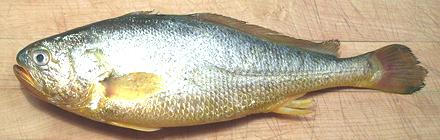
The photo specimen, purchased from a Los Angeles market serving mostly
Vietnamese and Chinese, was 13-1/4 inches long and weighed 1 pound
2-1/2 ounces. This fish is caught wild and not considered threatened.
More on Croakers and Drums.
 This is a very good eating fish with a light, pleasant flavor. It's
one drawback is the tenderness of its flesh and skin which makes handling
in cooking and serving more difficult than for many other fish. For this
reason many prefer small fish so each serving can be a whole fish. When
eating whole or pan dressed fish, be prepared to deal with a few fine rib
bones, and supply a bone bowl for the discards.
This is a very good eating fish with a light, pleasant flavor. It's
one drawback is the tenderness of its flesh and skin which makes handling
in cooking and serving more difficult than for many other fish. For this
reason many prefer small fish so each serving can be a whole fish. When
eating whole or pan dressed fish, be prepared to deal with a few fine rib
bones, and supply a bone bowl for the discards.
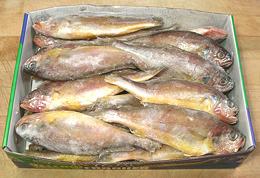
To the left is a box of 27 small Corvina as sold in the Asian markets.
These fish are about 7 inches long and weigh about 2.3 ounces each. They are
much less of a problem to eat than most small fish because the top fin pulls
out easily and there are relatively few bones. These small fish can be cooked
by any of the methods for larger fish, but I like them best dusted with
salted rice flour and pan fried, or deep fried (no rice flour needed). For
these small fish no cuts through the skin are needed for any of the cooking
methods listed below. Six of these per person makes a decent meal.
Cleaning: The scales are medium size and scrape off quite
easily with little flying about. Cleaning offers no particular problems and
the gills pull out fairly easily. There are a lot of internal membranes but
they pull out easily too. You will notice thin layers of body fat on the
inside walls of the belly. They will peel off easily but should be left in
place for any method of cooking
Cleaning (very small fish): The scales scrape off very
easily with no flying about at all. Cleaning offers no particular problem
except you will need to use your long nose pliers to pull out the gills
and for some of the other innards because they're just too small to grasp.
Of course these fish are used whole or pan dressed as filleting and
skinning is just not practical with a 7 inch fish.
Filleting: Filleting must be done with care
because the bones are short and not easy to follow and because the flesh
is very tender and breaks apart easily. When you get to the rib cage,
you will find it impossible to follow it with the knife. The ribs are very
fine and there are few of them. Just cut them from the backbone with
kitchen shears and deal with them in the fillet. Use your long nose
pliers to pull them out, pulling sharply forward because they are raked
back. There are only a couple of centerline spines worth dealing with.
Skin: Fillets are not easy to skin because the skin is
thin and not strong, but it can be done with care. The skin shrinks
moderately but not strongly when cooked. It does not have a strong or
undesirable flavor. To skin, use the standard long knife and cutting
board Method.
Yield A 13 inch 1 pound 2-1/2 ounce fish yielded 9-5/8
ounces of fillet skin-on (52%). Skinned that was 8-3/8 ounces (45%).
Cooking: This fish can be cooked by a number of methods,
but each needs special care because of the tenderness of the flesh.
- Pan Frying: Fillets are easy to fry, skin-on or
skinless. They need a light dusting with rice flour so they hold
together well and don't stick to the pan. Start skin side up and turn
when cooked most of the way through. After turning, flatten them
against the skin curl. This is a thick fish so only rather small ones
should be pan fried whole or pan dressed.
- Baking: This fish is fine for baking and will look
good if you make several steeply slanted diagonal cuts through the
skin. You will find, however, you can't remove the flesh from the bones
and part it out like you can with some fish - the flesh is simply way
too tender and will break up. Best to serve a whole fish per person.
- Steaming: Steaming considerations are similar to
baking. It is best to steam on a plate Chinese style rather than on a
rack.
- Poaching: This is a fine tasting, tender, flaky fish
poached, but if done as fillets they must be skinned or they will curl
sharply, the flesh is simply not strong enough to fight the skin shrink.
Considerations for poaching whole will be similar to baking and
steaming.
- Deep Frying: Chunks or whole small fish, this should
work fine.
- Grilling: Forget it, the only way you can grill this
fish is wrapped in foil, and that's actually baking. Any other way and
it's just going to break up.
Stock: Heads, fins, bones and skins make a serviceable
light-medium fish stock with very little oil, but remove what there is
with your gravy separator. See our recipe
Making Fish Stock for
details.
sf_corviyz 060625 - www.clovegarden.com
©Andrew Grygus - agryg@clovegarden.com - Photos
on this page not otherwise credited © cg1
- Linking to and non-commercial use of this page permitted