 [Families: Achiropsettidae (southern flounders) |
Bothidae (lefteye flounders) |
Paralichthyidae (large-tooth flounders) |
Pleuronectidae (righteye flounders)]
[Families: Achiropsettidae (southern flounders) |
Bothidae (lefteye flounders) |
Paralichthyidae (large-tooth flounders) |
Pleuronectidae (righteye flounders)]
Flounders include a number of families of fish that have evolved to lie flat on the bottom. Their eyes have moved so both are on the side marked "up". They make their living by blending into the sea bottom, often partially covered with sand, and ambush their prey, but some of them also leave the bottom and hunt like regular fish.
In Europe "Sole" means fish of family Soleidae. In North America the name is applied haphazardly to various flounders that are not members of the Soleidae family - probably because "sole" sounds more European and sophisticated. Caution: Flounders are very often mislabeled. Most of the time it doesn't matter much, but if what you get is Dover Sole (Slime Fish), it matters a lot. If the fish is dark on both sides, use caution.
More on Varieties of Fish
(very large page).
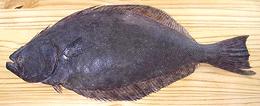
[California Flounder, Alabato, Southern Flounder;
Paralichthys californicus]
This Large-Tooth Flounder is native to both sides of Baja California
and up the coast to the Canadian border, ranging from the surf zone
to 600 feet depth. It can grow to nearly 5 feet and 72 pounds, but
the photo specimen was 23 inches long and weighed 2 pounds 15 ounces
factory cleaned - probably about 3 pounds 3 ounces with guts included.
This fish is easily identified by the high arch of the lateral line
above the pectoral fin. It is considered a very desirable eating fish
and is not considered endangered, Red List status LC
(Least Concern).
Details and Cooking.
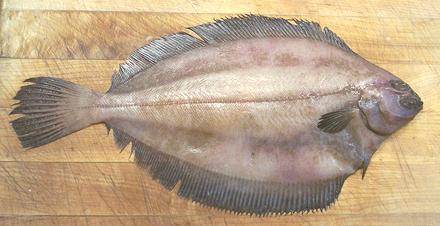
 [Summer Flounder; Paralichthys dentatus |
Southern Flounder; Paralichthys lethostigma]
[Summer Flounder; Paralichthys dentatus |
Southern Flounder; Paralichthys lethostigma]
Closely related to the California Halibut, these two Large-Tooth
Flounders are easily confused with each other. As best I can tell,
the photo specimen is a Summer Flounder, which is common from the
Florida Panhandle to Maine, but not around the Florida peninsula. To
a lesser extent it is found along the east coast of Canada and out
to Nova Scotia. The Southern Flounder is found from the southeast
coast of Texas to North Carolina, but not along southern Florida.
Both inhabit shallow coastal waters, estuaries and sometimes even in
fresh water. The Southern Flounder can grow to 32-1/2 inches long and
just over 20 pounds while the Summer Flounder can grow to 37 inches
and 26 pounds, but the photo specimen was 15-3/4 inches long and
weighed 1 pound 10-1/8 ounces. Red List status for both fish is
LC (Least Concern).
Details and Cooking.
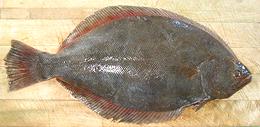
 [Slime Sole, Slippery Sole; Microstomus pacificus]
You do not want to buy this fish. This right eyed flounder is not anything like the Dover Sole or Common Sole (Solea solea) of Europe. This one's real name is "Slime Fish", and it's mainly processed into mink food. It is, however, also sometimes passed off to unsuspecting consumers as "Dover Sole", and worse, under some other name. It is edible, though insipid, but used in recipes intended for real Dover Sole it is an unmitigated disaster. It turns into slimy mush.
Slime Fish infests coastal regions from southern Japan all the
way around to just south of San Diego, California. This fish can
grow to about 30 inches long and 7.6 pounds, but the photo
specimen was 15-1/2 inches and a little over 1-1/2 pounds.
Details and Cooking.
 [Hippoglossus stenolepis (Pacific) |
Hippoglossus hippoglossus (Atlantic)]
[Hippoglossus stenolepis (Pacific) |
Hippoglossus hippoglossus (Atlantic)]
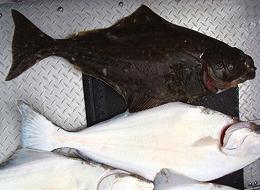
Pacific Halibut are large righteye flounders growing to almost 9 feet
long and 500 pounds. They are found from northern Baja California,
Mexico all they way around to the northern tip of Japan. They are a
prized eating fish and well known, so other flounder are sometimes
labeled "Halibut" in markets. I have seen Petrale Sole labeled as "Baby
Halibut" but it is dark on both sides while Pacific Halibut is white on
the blind side. This fish can be told from the smaller California Halibut
from the dorsal and anal fins being more pointy in the center, giving the
body a diamond shape. Pacific Halibut is not considered endangered, Red
List status NE (Not Evaluated), but the larger (to 710 pounds)
Atlantic Halibut is Red List rated "EN" (endangered) and should
not be fished or eaten.
Details and Cooking.
Photo of Pacific Halibut by Jlikes2fish contributed to
the public domain.
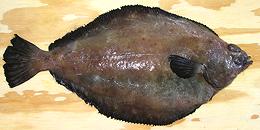
 [Brill; Eopsetta jordani]
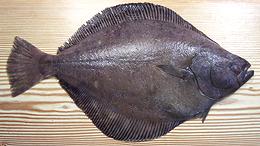
This righteye flounder is native to the Northeast Pacific coastal
region from Southern California at the Mexican border north and
around the Aleutian Islands of Alaska. It can grow to 27 inches long
and 8 pounds but the photo specimen was 17 inches and 1 pound 5
ounces, a typical market size. This fish is mainly an incidental catch
off the Pacific coast from northern Baja to the Bering Sea coast of
Alaska, but there is a designated fishery in Oregon. It is not
considered threatened, Red List status LC (Least Concern).
Details and Cooking.
 [Parophrys vetulus]
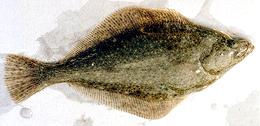
This righteye flounder is native to the same range as the Petrale Sole:
the Northeastern Pacific coast from Southern California at the Mexican
border north and around the Aleutian Islands of Alaska. It was once
a very important commercial catch, but is now at historic lows -
thought to be due to market forces and laws protecting other bottom
fish. Brown or speckled brown on top and white to yellow on the blind
side, it can grow to 22 inches long and 3.3 pounds. I have not yet
found any of these fish in the big Asian fish markets here in
Los Angeles. It is not considered threatened, Red List status NE
(Not Evaluated).
Photo by Thorke Ostergaard, distributed under license
Creative Commons
Attribution-NonCommercial 3.0 Unported, attribution required
.
 [Family Pleuronectidae: Pleuronectes platessa
(European) Hippoglossoides platessoides (American),
Pleuronectes quadrituberculatus (Alaska)]
[Family Pleuronectidae: Pleuronectes platessa
(European) Hippoglossoides platessoides (American),
Pleuronectes quadrituberculatus (Alaska)]
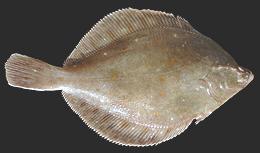
This is a group of medium size right eye flounders. The European can
get up to 39 inches and is found in the East North Atlantic and Baltic
Sea. The American gets to 32 inches and is found in the West Atlantic
as far south as Rhode Island and around Greenland. The Alaskan grows
to about 24 inches. Plaice is very popular in European recipes and is
sometimes used for fish and chips, but it's not common on the West
Coast of North America where Petrale Sole should be a suitable
substitute. Photo of European Plaice by Hans Hillewaert
distributed under license
Creative Commons Attribution-Share Alike 3.0.
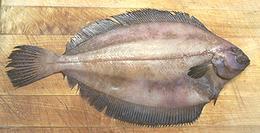 [Glyptocephalus cynoglossus]
This righteye flounder is caught in the North Atlantic from North
Carolina north around the southern tip of Greenland and around the
European coasts to northern Spain, staying mostly below the Arctic
Circle. It is often sold in Southern California as "Rex Sole", which
it clearly isn't - Rex Sole has a very long pectoral fin.
They can grow to almost 24 inches and 5-1/2 pounds, but the photo
specimen was 13-3/4 inches long and weighed 10 ounces, typical in the
markets here - though fish up to 1 pound are frequently seen. The
population is not considered threatened, Red List status NE
(Not Evaluated).
Details and Cooking.
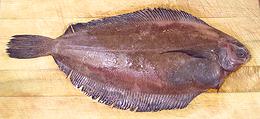 [Glyptocephalus zachirus]
This righteye flounder is caught in the North Pacific from Southern
California to the Russian coast and down to Taiwan. They can grow to
23 inches and a bit over 4 pounds, but the photo specimen was 15-5/8
inches long and weighed 1 pound 1-1/4 ounces, typical in the markets
here. Rex Sole and Gray Sole are often confused in markets, but the
rex has a very long pectoral fin and the gray a very short one. The
population is not considered threatened, Red List status NE
(Not Evaluated).
Details and Cooking.
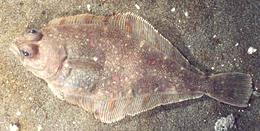 [Citharichthys sordidus (pacific), C. xanthostigma (long fin)]
This lefteye flounder was hugely popular in eateries in the San
Francisco Bay area of California but is now in short supply because of
fishery laws designed to protect shallow water rockfish. The sand dab
itself is not considered threatened. Rex Sole
is a perfect substitute (even though it is a righteye flounder from deeper
water), similar in size, flavor and cooking properties. Sanddabs grow
to 16 inches but are mostly under 1 pound.
For Details and Cooking
see Rex Sole.
Photo by U.S. National Oceanic and Atmospheric
Administration = public domain.
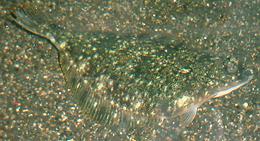 [Platichthys stellatus]
A very common fish from Santa Barbara California to Arctic Alaska and
the Sea of Japan. Strangely, it is a righteye flounder but most have their
eyes on the left side. They grow to 3 feet and 20 pounds.
Photo contributed to the public domain.