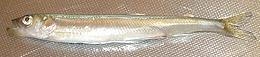
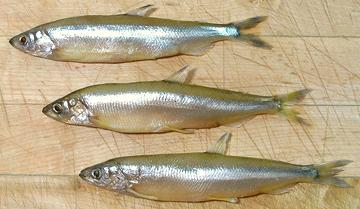
 [family Osmeridae, several genera]
These tiny fish are related to Salmon, with some freshwater species, some saltwater and some that are freshwater and coastal brackish. Various species are native to Atlantic and Pacific coasts of the U.S. and Canada, some as far south as Southern California but most in northern waters. Smelt are also found along the coasts of Europe and the western Pacific.
Note that some fish called "smelt" are not actually smelt. Examples are Jacksmelt and Topsmelt, which are actually silversides (family Atherinopsidae).
More on Varieties of Fish
(very large page).
[Osmerus mordax]
This smelt is native to the rivers, bays and a few lakes of eastern
North America, from Labrador, Canada south to New Jersey, and was
formerly the smelt most eaten in North America. A variety native to the
lakes of Maine was introduced into the U.S. Great Lakes in about 1918,
and became an important catch there. Today, the population is very
small, but showing some signs of recovery. This smelt and the closely
related European smelt are noted for their cucumber-like smell.
Details and Cooking.
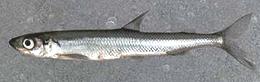 [Stinte (German), Osmerus eperlanus]
The European smelt is nearly identical to the Rainbow Smelt, including
the cucumber-like smell, and is used in the same ways. It can grow to 17
inches, though it is commonly around 6-1/2 inches. It is native to the
White Sea (far northwest corner of Russia), through the Baltic Sea, and
down the Atlantic coast to as far south as Bordeaux, France. It is
usually found in estuaries, but some populations are found in fresh
water lakes and streams. European Smelt is very similar to and closely
related to the Rainbow Smelt of North America, so use
Details and Cooking for Rainbow
Smelt.
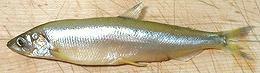 [Hypomesus pretiosus]
This fish, found from along the Aleutian islands down to Long Beach,
in Southern California, is the most economically important smelt in
California. It is often called "Day Smelt" because it spawns during the
day, in the surf zone, while most smelt spawn at night. These fish can
get up to 12 inches long in their southern range, but are usually below
9 inches at the northern range. Average size is about 6 inches.
The photo specimen, 6-1/2 inches long and weighing 1.1 ounces, was
purchased from a Philippine market in Los Angeles for 2015 US $1.99 /
pound.
Details and Cooking.
 [Hypomesus transpacificus]
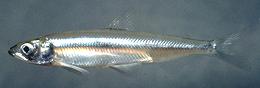
This fish is primarily noted as a political problem. Delta Smelt are very
sensitive to environmental changes, and are considered endangered. To
protect the fish a federal court has limited pumping water from the
Sacramento Delta for shipment to the Central Valley and Southern
California. Reduced pumping has resulted in job loss in the Central
Valley, though not nearly so much as its enemies claim (more is due to
several years of drought). Delta smelt grow to between 2.0 and 2.8
inches long.
Photo by U.S. Fish and Wildlife Service = public domain.
 [Shishamo (Japan (with roe)); Mallotus villosus]
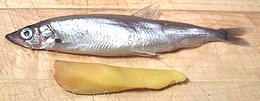
This fish is native to the Arctic region in both Atlantic and Pacific,
venturing well above the Arctic Circle (in summer). They are found as far
south as the northern tip of Japan and the US-Canada border in the
Pacific. In the Atlantic they range as far south as the Gulf of Maine,
USA and the British Isles. The largest concentrations are across the
North Pacific and around the island of Newfoundland, Canada. Capelin are
harvested for fish meal and fish oil as well as for human consumption,
the roe being a high value item. Males grow to a bit over 7-3/4 inches,
females to a little over 9-3/4 inches, but the photo specimen was 6
inches and weighed 7-1/2 ounces including 2-1/8 ounces of roe.
Details and Cooking.