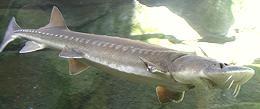
 [Family Acipenseridae of order Acipenseriformes]
Sturgeon is an ancient fish, highly successful and little changed for something like 200 million years. The related Paddlefish is a little younger, having been around for only 100 million years (that we know of). Of the 25 living species of sturgeon, most are near to extinction due to the absurd prices show-offs and "gourmets" will pay for their eggs (caviar). This pricing encourages criminal activities, which are made worse by pollution and degradation of habitat.
Pacific White Sturgeon and Lake Sturgeon are the only commercially important sturgeon not IUCN Red List "Threatened", "Endangered" or "Critically Endangered". The Pacific White is now heavily farmed in California for caviar and meat. The Lake Sturgeon are caught wild, mostly in Canada, though the fishery is now highly restricted.
Sturgeon are the largest fish found in fresh water, with the Russian Beluga (A. Huso huso) reaching 19 feet and and over 3400 pounds, while the more slender Pacific White Sturgeon (A. Acipenser transmontanus) reaches 20 feet and 1800 pounds. The specimen in the photo, smoked whole, was 27 inches long and 1.6 pounds. Sturgeon are not kosher.
More on Varieties of Fish (very
large page).
[California White Sturgeon; Acipenser transmontanus]
This is the third largest sturgeon in the world, growing to 20 feet
and 1800 pounds. While considered LC (Least Concern) in the wild,
it is heavily farmed in California for production of caviar, with
meat as a byproduct. Experts say the quality of California caviar
has improved to the point it is difficult to tell it from the
Russian.
Details and Cooking

[Sand Sturgeon, Switchtail; Scaphirhynchus platorynchus]
This is the most abundant sturgeon in North America, found in the
Missouri River and Mississippi River systems. While it is considered
an excellent eating fish, it is also now valuable for production of
caviar. It is the smallest North American sturgeon, but fast maturing.
It can reach a maximum length of 42-1/2 inches and 10-3/4 pounds, but
is more commonly 28 inches long. It is the only sturgeon caught
commercially in the United States, and aquaculture is in the early
experimental stages. The caviar is sold as "Hackleback" - apparently
"Shovelnose" didn't sound like a good marketing name. It sells for
around 2016 US $19.50 / ounce. IUCN Red Listed VU (Vulnerable).
Photo by MONGO distributed under license
Creative Commons
Attribution-ShareAlike v3.0 Unported.
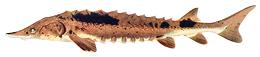 [Acipenser fulvescens]
This fish was once extremely common in the lakes and rivers along
the US / Canada border near the Great Lakes and St. Lawrence River.
Back in the days before "over regulation" about 4 million pounds
a year were taken until around 1900 when the fishery collapsed due
to no fish left. Today, taking this fish is highly restricted, though
there is still a small commercial take allowed in the St Lawrence
region of Canada. There is a restocking hatchery in Michigan serving
mostly inland waters, but this fish is a long ways from recovering.
Illustration from Fishes of Illinois, copyright
expired
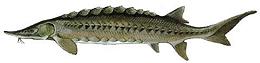 [Atlantic; Acipenser oxyrhynchus oxyrhynchus | Gulf;
Acipenser oxyrhynchus desotoi]
[Atlantic; Acipenser oxyrhynchus oxyrhynchus | Gulf;
Acipenser oxyrhynchus desotoi]
This North American Sturgeon was where Europe got its caviar from 1870 to thd beginning of the 20th century. The United States and Canada were not yet "over regulated" and the sturgeon were overfished, causing Europe to turn to the East for caviar. The Atlantic sturgeon ranged from New Brunswick, Canada to the east coast of Florida, but is now extinct in some of its range and threatened elsewhere. It is still sufficiently populous to be IUCN rated NT (Not Threatened). The essentially identical Gulf sturgeon ranges from eastern Louisiana to the west coast of Florida and is IUCN rated VU (Vulnerable). These sturgeons can grow to 15 feet and 800 pounds. They are not currently harvested for caviar.
Efforts are under way to restock the Baltic Sea region, currently
devoid of sturgeon, with Atlantic sturgeon. It was recently found
that the sturgeon that formerly lived there were Atlantics, not a
European variety.
Drawing by U.S. Fish and Game Department = public
domain.
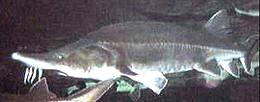 [Beluga; Huso huso | Kaluga; Huso dauricus]
These related Sturgeons are the largest in the world, and unlike most
others are not bottom feeders but aggressive predators of other fish.
The Kaluga, which lives in the Amir river which separates Russia from
China, grows to nearly 19 feet and 2200 pounds. The Beluga, inhabiting
the Caspian and Black Sea, can grow to 24 feet and 3400 pounds. Both
these fish are IUCN listed as CR (Critically Endangered) due to
intensive overfishing for their high value caviar. Trade in their
caviar is controlled mainly by Russia's murderous organized crime
syndicates. For these reasons, Beluga and wild Kaluga should not be
purchased or consumed. Kaluga is now being farmed in China.
Photo of Kaluga Sturgeon by Javontaevious distributed
under license Creative Commons
Attribution-Share Alike 3.0.
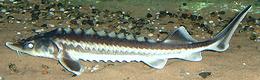 [Acipenser gueldenstaedtii]
This is the sturgeon from which Russian Osetra caviar is produced.
It is native to the Black Sea, Sea of Azov and Caspian Sea, and
enters all the rivers that drain into those seas. It has been
severely overfished, and international trade is restricted by CITES.
Its caviar is, however, available in North America because it is
being farmed very successfuly in Israel. IUCN Red Listed CR
(Critically Endangered).
Photo by Daniel Döhne distributed under license
Creative Commons
Attribution-ShareAlike v3.0 Unported.
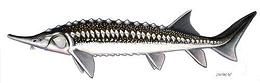 [Sevruga; Acipenser stellatus]
This is the sturgeon from which Russian Sevruga caviar is produced.
It is native to the Caspian, Black, Azov and Aegean Seas, and has
been introduced to the Aral Sea. It enters all the rivers that drain
into those seas. This fish can grow to 7 feet and 176 pounds, but is
commonly 4 feet long.It has been severely overfished, and international
trade is restricted by CITES. Its caviar is, however, available in
North America because it is being farmed in Bulgaria, and possably
elsewhere. IUCN Red Listed CR (Critically Endangered).
Drawing by Zsoldos Márton distributed under
license Creative Commons
Attribution-ShareAlike v3.0 Unported.
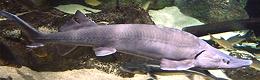 [Acipenser baerii]
This sturgeon is native to all the north draining rivers of Siberia.
While it is seriously overfished in its natural habitat it has become
of considerable interest as a farmed fish, because it tolerates the
farm environment well. It is now used for caviar production in a number
of countries. This fish can grow to about 79 inches and 463 pounds but
is more commonly about 48 inches long, weighing 140 pounds. IUCN Red
Listed EN (Endangered) and international trade is restricted by CITES.
Photo by Citron distributed under license
Creative Commons
Attribution-ShareAlike v3.0 Unported Attribution Required.
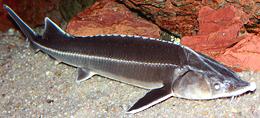 [Acipenser ruthenus]
This relatively small sturgeon is native to the large rivers that
flow into the Black Sea, Asov Sea and Caspian Sea, and north flowing
rivers in Siberia as far east as Mongolia. It is considered
vulnerable because of overfishing for meat, caviar and isinglass
throughout its range, but restocking efforts are ongoing and
significant aquaculture has been established. It is very much liked
for food in Russia and Hungary.
Photo by Karelj contributed to the Public Domain
.
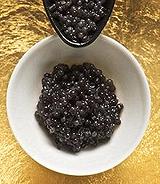 The most prestigeous (and expensive) caviar in the world is that of
Sturgeons. Caviar is not simply harvested from the fish and sold. It
is carefully graded, lightly salted and aged for two to three months
under tightly controlled conditions, then carefully packed for
shipment and sale. For details on types, grades and costs see our
Fish Eggs & Caviar page.
The most prestigeous (and expensive) caviar in the world is that of
Sturgeons. Caviar is not simply harvested from the fish and sold. It
is carefully graded, lightly salted and aged for two to three months
under tightly controlled conditions, then carefully packed for
shipment and sale. For details on types, grades and costs see our
Fish Eggs & Caviar page.
 As sturgeon aquaculture increases, the question comes up as to what to
do with the male sturgeons, who take up space and eat food, but will
never produce caviar. One solution is to turn them into products like
smoked sturgeon. Though purchased in Los Angeles, the specimen in the
photo to the left is not a California grown Pacific White Sturgeon (nose
is too sharp). It may be an Atlantic sturgeon,
(A. Acipenser oxyrinchus oxyrinchus)) but I'm not sure. It was
27 inches long and 1.6 pounds, typical for whole smoked sturgeon found
in markets serving Russian communities here.
As sturgeon aquaculture increases, the question comes up as to what to
do with the male sturgeons, who take up space and eat food, but will
never produce caviar. One solution is to turn them into products like
smoked sturgeon. Though purchased in Los Angeles, the specimen in the
photo to the left is not a California grown Pacific White Sturgeon (nose
is too sharp). It may be an Atlantic sturgeon,
(A. Acipenser oxyrinchus oxyrinchus)) but I'm not sure. It was
27 inches long and 1.6 pounds, typical for whole smoked sturgeon found
in markets serving Russian communities here.
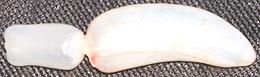 Isinglass is a substance originally made from the swim bladder of a
sturgeon, though some is now also made from cod. It is important for
"fining" (making clear) certain types of beer, a process that makes
those particular beers unsuitable for vegans (there may be traces of
isinglass left in the beer). It is also a very important adhesive
for restoration of ancient parchment documents and other conservation
tasks. The photo is not a sturgeon swim bladder as no photo of one
was available.
Photo by Uwe Gille distributed
under license Creative Commons
Attribution-Share Alike 3.0.
Isinglass is a substance originally made from the swim bladder of a
sturgeon, though some is now also made from cod. It is important for
"fining" (making clear) certain types of beer, a process that makes
those particular beers unsuitable for vegans (there may be traces of
isinglass left in the beer). It is also a very important adhesive
for restoration of ancient parchment documents and other conservation
tasks. The photo is not a sturgeon swim bladder as no photo of one
was available.
Photo by Uwe Gille distributed
under license Creative Commons
Attribution-Share Alike 3.0.