

SAFARI
Users
Varieties
Azafrán de Bolita
 [Azafrán, Azafráncillo; Ditaxis heterantha]
This seed is used as a substitute for saffron in Mexico, for the color
of course, it can't replace the flavor and aroma. It is used mainly in
soups, but also in rice. The most famous soup using this spice is
Menudo Amarillo, which is so well known it is used to describe color,
but I have yet to find a recipe for it. The photo specimens, purchased
from a multi-ethnic market in Los Angeles were 0.26 inch diameter.
Candlenut
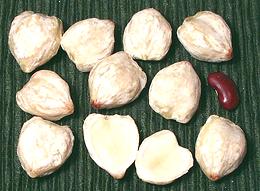 [Kukui nut (Hawaii); Indian Walnut; Buah keras (Malay); Kemiri
(Indonesia); Lumbang (Philippine); Aleurites moluccana]
[Kukui nut (Hawaii); Indian Walnut; Buah keras (Malay); Kemiri
(Indonesia); Lumbang (Philippine); Aleurites moluccana]
Nuts of a tree native to Southeast Asia, and spread by humans to the extent its true origin can not be determined. Polynesian settlers brought it to Hawaii where it became very important - the nuts for food and the rest of the tree for wood, dye, tanning chemicals, medicines and flowers for leis. Unshelled nuts take a gem-like polish and are used to make bead necklaces. As Kukui, it is the state tree of Hawaii.
Candlenuts are mildly toxic raw and sometimes used as a purgative.
Shelled nuts are a bit larger than shelled macadamia nuts and have a
softer, lumpier appearance. The largest photo specimen was 1 inch long,
7/8 inch across and 5/8 inch thick, typically 10 to the ounce. While
shelled Macadamia nuts (completely unrelated) are often used as a substitute,
the flavor is considerably different, though the oil content is similar.
As a nut, the macadamia is quite superior.
Details and Cooking.
Cassava
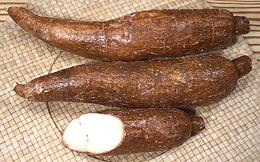 [Manioc; Yuca (Hispanic); Balinghoy, Kamoteng kahoy (Philippine);
Mogo (Africa); Mandioca, Tapioca-root (India); Manihot esculenta]
[Manioc; Yuca (Hispanic); Balinghoy, Kamoteng kahoy (Philippine);
Mogo (Africa); Mandioca, Tapioca-root (India); Manihot esculenta]
Cassava / Manioc is native to South America, but is now a critically important food crop through the tropical and subtropical regions of the world. Nigeria is now the largest producer, and Thailand is the largest exporter of dried Cassava products.. Roots are rated "sweet" (not bitter) if they have a low cyanide content and "bitter" if they have a high cyanide content. Bitter Cassava requires special processing before consumption. The largest of the photo specimen was 11-1/2 inches long, 2-1/4 inches diameter and weighed just over 1 pound.
Cassava is used to make a number of very important products, including
Gari, Manioc Farina, Cassava Flour, Tapioca Starch, and Sour Tapioca
Starch. The leaves are also edible.
Details & Cooking
Castor Bean
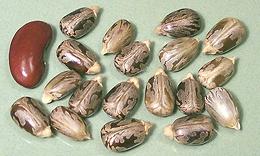 [Ricinus communis]
The attractive beans of this highly toxic shrub are used to make
Castor Oil (which contains no toxins, but it tastes like it does). The
mash left from oil production contains the super toxin Ricin, of which
one milligram is enough to kill a man. One bean is said to be sufficient
to kill a child, if broken or chewed, but if it is swallowed whole it is
harmless. Believe or Don't: in West Africa Castor Beans are used as a
food flavoring. The oil has been used medicinally, as motor oil for
race cars, and as an industrial feed stock.
Details and Cooking
Chaya
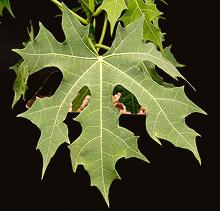 [Tree Spinach; Cnidoscolus aconitifolius]
This large shrub is native to northern Mexico to Guatemala and cultivated
as far south as Peru. It can grow to 20 feet but is usually kept pruned
to 6 feet for ease of harvesting. Leaves of this plant are more
nutritious than any other land growing green, and the plants are more
productive than any other leafy green. The leaves are a popular vegetable
in Mexico and Central America. There are several cultivars, and the one
without stinging hairs is most cultivated because it's easier to harvest.
Raw leaves are toxic (cyanide) and need to be simmered for about 20
minutes before being served, usually with oil or butter. Simmering also
destroys the stinging hairs on varieties that have them.
Photo by Frank Vincentz distributed under license Creative
Commons
Attribution-ShareAlike v3.0 Unported.
Inca-peanut
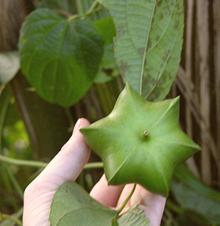 [Sacha Inchi, Sacha peanut, Mountain peanut; Plukenetia volubilis]
This vine, native to the Peruvian rain forest, has been cultivated for hundreds of years in that region. It bears star shaped pods with four to 7 points, each point containing a flat oval seed about 3/4 inch long. The pods are allowed to dry on the vine, then harvested and the seeds are shelled. They are toxic raw but pleasantly flavored when roasted. The seeds are about 27% protein, and that protein is well balanced for human nutrition. They are about 40% fats.
These seeds have recently entered the health food market because of
their high Omega 3 content. The effectiveness of vegetable Omega 3 is
not yet well established, but these nuts are being sold as a healthy
snack based on that oil content, and the oil as a supplement,
particularly for people on a vegetarian diet. It should be remembered
that oils high in Omega 3 are subject to rapid rancidity. Growing and
harvesting this vine has been bringing money into rural areas where it
is much needed.
Photo by The lifted lorax distributed under license
Creative Commons
Attribution v3.0 Unported.
Indian Nettle
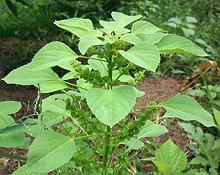 [Indian Acalypha; Poonamayakki, Kuppaimeni (Tamil); Pokok Kucing Galak
(Malay); Acalypha indica similar: A. bipartita,
A. fruticosa, & others]
[Indian Acalypha; Poonamayakki, Kuppaimeni (Tamil); Pokok Kucing Galak
(Malay); Acalypha indica similar: A. bipartita,
A. fruticosa, & others]
This herbaceous plant is native to India, Southeast Asia and Oceania. It
is also found on the Islands of the Indian Ocean and in West Africa,
probably introduced there. Young leaves and leaf shoots are used as a
vegetable in those regions, and particularly in West Africa. The plant
is also an important medicinal throughout its range, and particularly
to the Tamil people of southern India and Sri Lanka. Leaves of
A. bipartita and A. fruticosa are similarly used in
West Africa. The leaves are bland to a little bitter and are usually
chopped up and added to cooking beans and peas. Dried leaves of
A. fruticosa are used for teas in Ethiopia. The Malay name
means "Excited Cat Tree", as it has a more powerful effect than
catnip.
Photo by Delince.samuel distributed under license
Creative Commons
Attribution v3.0 Unported.
Macaranga
 [Samak (Philippine), Parasol Leaf Tree, Macaranga tanarius]
A small tree native to Southeast Asia used for medicinal purposes
and in the Philippines as a flavoring ingredient in the famous
Ilocos vinegar. The leaves and bark
are used in fermented drinks. Its nasturtium-like leaves, with the stem
entering almost at the center of the leaf, are used as flavoring food
wrappers in much of Southeast Asia. It is planted as an ornamental in
tropical regions and is listed by the USDA as a common invasive in
Hawaii.
Photo by
Forest and Kim Starr distributed under license Creative Commons
Attribution-ShareAlike 3.0 Unported, attribution required,
notification appreciated.
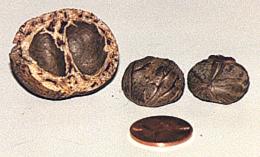
Mongongo
 [Schinziophyton rautanenii]
This medium tree (up to 65 feet) is found widely in southern Africa. It has provided edible fruit and nuts for local peoples for at least 7,000 years. The whole fruits are collected from the tree, of just nuts are recovered from elephant dung. Dry fruits are steamed to soften the skin, which is peeled to expose the maroon colored flesh. The fruit is then boiled until the flesh separates from the nuts. The flesh is eaten and the nuts dried and stored for up to a year. Of course, nuts recovered from elephant dung need only be washed and stored. The shells are cracked to expose the nuts, which may be eaten whole or pounded into flour to be used in recipes.
The nuts are about 57% fat, which is 44% polyunsaturated, which means,
once the nuts are cracked, storage life is limited due to rancidity.
They are 24% protein and contain significant amounts of vitamin E,
calcium, manganese, zinc and copper.
Photo by NoodleToo distributed under license Creative Commons
Attribution-ShareAlike v3.0 Unported, attribution required.
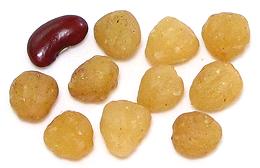
Njangsa
 [Djansang, Essessang, Essang, Ezezang, Njasang (Cameroon); Munguella
(Angola); Bofeko (Zaire); Wama (Ghana); Okhuen (Nigeria); Kishongo
(Uganda); Akpi (Côte d'Ivoire); Ricinodendron heudelotii]
[Djansang, Essessang, Essang, Ezezang, Njasang (Cameroon); Munguella
(Angola); Bofeko (Zaire); Wama (Ghana); Okhuen (Nigeria); Kishongo
(Uganda); Akpi (Côte d'Ivoire); Ricinodendron heudelotii]
This large tree, growing to about 160 feet, is native to tropical Africa
from Senegal to Tanzania, south to Angola and Mozambique, an on
Madagascar. The part used for food is the seed kernel. The kernels are
ground and used as a flavoring thickener. They are also pressed for
oil. Both male and female trees must be present to produce fruit.
The center for seed kernel production is Cameroon.
Details and Cooking
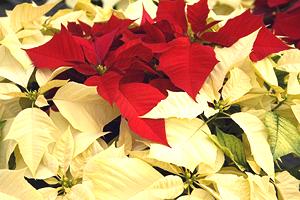
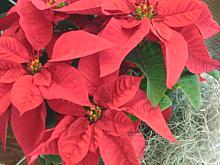
Poinsettia
 [Euphorbia pulcherrima]
Named for Joel Roberts Poinsett who popularized it to the U.S., this decorative spurge is very mildly toxic so should not be eaten and should be avoided by those with latex intolerance. This is a tricky plant to grow. Making it branch well requires a (formerly secret) grafting process and getting multiple buds requires a bacteria infection. They are difficult to get to bloom well after the first year due to a need for at least two months of uninterrupted very dark nights in autumn.
Red, pink, white and variegated varieties are most common but Mr. Poinsett
reported seeing a blue one. Extensive searching has not confirmed this. You
can get a Christmas poinsettia to survive by making sure it's pot is well
drained and well watered, but it will get quite rangy after the second
year.
Photo © i0129
.
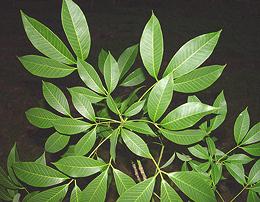
Rubber Tree
 [Para Rubber Tree, Hevea brasiliensis]
This tree, Native to Amazonian Brazil, produces nothing edible but is
interesting as the source of the latex natural rubber is made from. Cultivation
in its native Brazil has not been satisfactory but successful plantations
continue to produce in Southeast Asia. The trees stop producing at 25 to 30
years old and are cut down. The wood (rubberwood) from these trees is prized
for making high end furniture. This tree should not be confused with the
common decorative "rubber tree" (Ficus elastica) nor with the tree
used by the Aztecs for their rubber balls (Castilla elastica), both
being entirely unrelated.
Photo by AxelBoldt contributed to the Public Domain.
.
Health & Nutrition
Spurges are all toxic, to some degree, in whole or in part, and exude sap that can be a severe irritant. For those that are used for food, cooking instructions should be followed accurately. In particular, those high in cyanide need to be cooked in an open pot sufficiently to drive off the cyanide gas.
Cyanide, at low levels and with limited exposure is not dangerous. It is the distinctive flavoring in almonds.
We definitely do not recommend any spurges be included in a raw foods diet, but then we do not recommend a raw foods diet, though I've heard it is an effective male anti-fertility strategy (due to malnutrition).
Links
- S2 - Euphorbiaceae - University of Hawaii at Manoa
- S3 - Plants - Hawaiian Ecosystems at Risk project.