Capers & Caperberries
 [Capparis spinosa,
also C. sicula, C. orientalis, and C. aegyptia.
Australian "wild passionfruit" Capparis spinosa subspecies
nummularia all of genus Capparaceae]
[Capparis spinosa,
also C. sicula, C. orientalis, and C. aegyptia.
Australian "wild passionfruit" Capparis spinosa subspecies
nummularia all of genus Capparaceae]
Caper bushes are found all around the Mediterranean region, but are
also found in Madagascar, Central Asia, the Himalayas and in the
Pacific Islands. Where they originated is unknown.
Capers are most known to Americans as pickled flower buds used as a
flavoring element and garnish in salads, sauces and martinis. In the
Mediterranean region where they are native, fruits are also pickled, as
well as the leaves
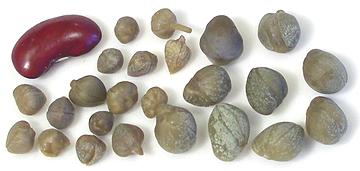
The photo specimens of pickled flower buds came from two bottles, both
qualifying for the top "Non-pareilles" designation, though the large ones
barely squeaked by at the 7 mm / 0.276 inch maximum. The small ones were
typically 4 mm or less. Connoisseurs insist salted caper buds are
superior to pickled, but those are costly and very difficult to find in
North America.
More on Brassicales.
Capers are graded by size with the smaller considered more desirable. Sizes
are:
- Non-pareil (up to 7 mm)
- Surfines (7-8 mm)
- Capucines (8-9 mm)
- Capotes (9-11 mm)
- Fines (11-13 mm)
- Grusas (14+ mm)
Nasturtium buds are sometimes
substituted for capers, having a similar taste. They are usually in the
larger sizes.
Fruit & Leaves
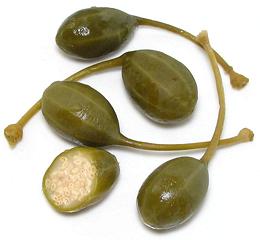 Caper fruits (caperberries) grow to about 2-3/4 inches long when ripe,
but they are usually picked immature at about 1 inch and pickled. At
this young stage the seeds are soft and edible. The berries are served as
appetizers and in salads, particularly in Spain and Greece. Some are
salted, rather than pickled, as the buds sometimes are, and are said to
be superior that way, but salted caperberries are very scarce and costly
in North America. The pickled specimens in the photo were up to 1.1
inches long and 0.78 inch diameter, weighing an average of 0.16 ounce
(4.8 grams) each. From Spain: Caperberries, water, salt, vinegar.
Caper fruits (caperberries) grow to about 2-3/4 inches long when ripe,
but they are usually picked immature at about 1 inch and pickled. At
this young stage the seeds are soft and edible. The berries are served as
appetizers and in salads, particularly in Spain and Greece. Some are
salted, rather than pickled, as the buds sometimes are, and are said to
be superior that way, but salted caperberries are very scarce and costly
in North America. The pickled specimens in the photo were up to 1.1
inches long and 0.78 inch diameter, weighing an average of 0.16 ounce
(4.8 grams) each. From Spain: Caperberries, water, salt, vinegar.
Leaves are thick and succulent. They are also pickled, and are
sometimes cooked for use in salads. These usages are local, and not
exported. Caper leaves are also used in place of rennet in coagulating
some cheeses.
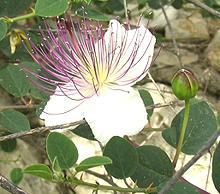
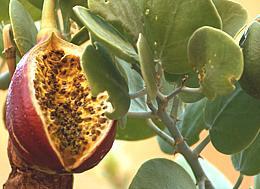 Neither flowers nor ripe fruit are much eaten (though perhaps flowers are
used as edible decorations on salads). These photos are provided
to illustrate the edible leaves, and because they were available from
earlier versions of this page. Caperberries split open when ripe,
exposing white flesh and black seeds. Photo of flower by
Lorsh contributed to the public domain. Photo of over-ripe fruit by
Florian Prischl /
Wikimedia Commons - distributed under license
Creative Commons
Attribution-Share Alike 3.0 - attribution required, notification
requested.
Neither flowers nor ripe fruit are much eaten (though perhaps flowers are
used as edible decorations on salads). These photos are provided
to illustrate the edible leaves, and because they were available from
earlier versions of this page. Caperberries split open when ripe,
exposing white flesh and black seeds. Photo of flower by
Lorsh contributed to the public domain. Photo of over-ripe fruit by
Florian Prischl /
Wikimedia Commons - distributed under license
Creative Commons
Attribution-Share Alike 3.0 - attribution required, notification
requested.
br_caperz 090110 r 140114 - www.clovegarden.com
©Andrew Grygus - agryg@clovegarden.com - Photos on
this page not otherwise credited are © cg1
- Linking to and non-commercial use of this page permitted.
