Bok Choy is not a cabbage, it is turnip greens. All versions feature a sharper flavor with thicker, crisper stems than Napa Cabbage (also a turnip green). The White Stemmed varieties are very popular in stir fries and soups, while Shanghai Bok Choy is often steamed whole or split lengthwise. Bok choy does not form tight heads but the clusters of stems form a tight bundle
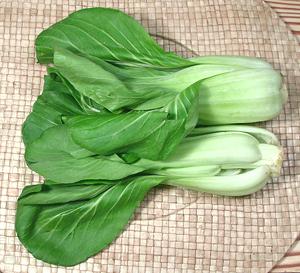 [Green Bok Choy; Baby Bok Choy (North American groceries);
Qing Cai (Shanghai Chinese, lit. "Green Vegetable"); Pak Kwang Tung
Hong Tae (Thai); Cai Bo Xoi (Viet); Chingensai (Japanese);
Brassica rapa Group Chinensis]
[Green Bok Choy; Baby Bok Choy (North American groceries);
Qing Cai (Shanghai Chinese, lit. "Green Vegetable"); Pak Kwang Tung
Hong Tae (Thai); Cai Bo Xoi (Viet); Chingensai (Japanese);
Brassica rapa Group Chinensis]
This Turnip Green is probably the most popular vegetable in the Shanghai region (Zhejiang), and is now widely available in North American produce and supermarkets. It's smaller than the white stemmed bok choy they sell, so supermarkets, always anxious to snag the yuppie dollar, call it "baby bok choy". Hey, yuppies buy "baby carrots" (machine made from large carrots) and bags of bland "baby spinach", so "baby" anything should sell, right?
The flavor of this bok choy is distinctly different from that of
the white stemmed variety. Besides being light green, the leaf stems are
much thinner and more tender. This variety is better suited to steam
whole or split lengthwise as the stems cook almost as quickly as the
greens.
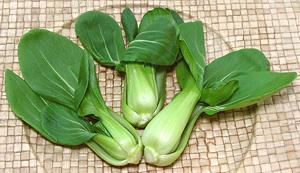 [Qing Cai Mui (Shanghai Chinese); Sin Kon Choy Mui (market)]
This is the "Mui" form of the Shanghai Bok Choy described above. It is becoming much more available in the Asian markets, and is very popular in southern China, especially for cooking whole. It is not a "baby" plant, but a dwarf variety that is fully mature and may have flower buds. The photo specimens were sold as Sin Choy Mui by a market in Los Angeles (San Gabriel) that uses a mix of Chinese and Vietnamese names. These were up to 5-1/2 inches long and average weight was 0.66 ounces each.
More on Asian Greens .