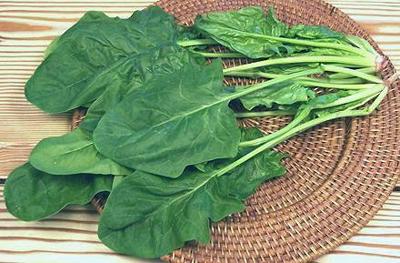
 [Spinacia oleracea of subfamily Chenopodioideae]
A native of Southwest Asia, spinach is delightful, if properly handled and cooked, but is easily abused. Many people know it only as a stringy lump of overcooked mush. Cultivars are Savoy, the most common fresh spinach, Smooth Leaf, used for frozen and processed spinach (easier to wash) and Semi-savoy, a sort of all-purpose spinach.
Baby Spinach is sold in plastic bags and boxes for the Yuppie salad trade (Yuppies will buy anything labeled "baby"). Just about all the leaves are the almost flavorless oval form.
More on Amaranth Family.
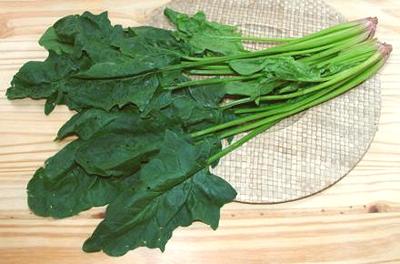 [presumably Spinacia oleracea]
This spinach is very much like our regular spinach, but a lot larger and considerably milder. The photo specimens were 22 inches long, but a few leaves were more than 24 inches. Taiwan spinach is stemmy - but the stems are very tender and most flavorful part. They should always be included in the recipe. It is a very fine vegetable for use in stir fries and soups, and can be used in place of regular spinach.
Taiwan spinach is now grown in California and often available in Asian markets here in Los Angeles. The photo specimens were from 168 Market on Valley Blvd. in Alhambra. Do not confuse this spinach with Water Spinach (Swamp Cabbage) often called "Chinese Spinach" by recipe writers. That is a very different plant, in the morning glory family.
More on Amaranth Family.
This advice is also valid for all Tropical and most Sub-Tropical cuisines as well. Our spinach is a cold climate plant, so they'd be using something else they translate as "spinach", and it is usually something with leaves that are more durable in cooking.
Canned spinach is an abomination. Frozen spinach is better but still not competitive to fresh. Frozen spinach is blanched in the freezing process so should be cooked the absolute minimum time needed to bring it to serving temperature.
The key to good spinach is to cook it the very minimum that'll do the job. The moment its all wilted and the raw color is gone it's done.
If you have prepared the spinach as described above, the amount of water left on the leaves by the salad spinner should be sufficient for cooking the spinach. Use a very little oil to keep the leaves from sticking to the pan.
The ideal pan for cooking spinach is a wok. The large diameter of a 13 inch wok can accommodate 1 pound of raw leaves, it's very easy to keep tossing the leaves for even cooking. Only a tiny amount of oil is needed, and as the spinach wilts down it gathers in the bottom.
Spinach's reputation for very high iron content was due to an analyst slipping a decimal point in 1870, not corrected until 1937, and by then Popeye the Sailor Man was a fixture. It still has a higher iron content than most vegetables but not by so spectacular a measure. Spinach is also high in calcium but a high oxalate content inhibits absorption of both calcium and iron into the body. On the other hand it is high in Vitamins A, C and E, folic acid and antioxidants. Due to the Oxalic Acid it is recommended that people suffering from kidney problems, gout and rheumatoid arthritis avoid this green
cb_spinachz 070318 - www.clovegarden.com