 [Black Mint, Muster John Henry, Southern Cone Marigold, Stinking Roger,
Wild marigold; Anisillo (Spanish); Chinchilla, Chiquilla, Chilca, Zuico,
Suico (South America); Huacatay (Peru); Huacataya (Bolivia);
Tagetes minuta]
[Black Mint, Muster John Henry, Southern Cone Marigold, Stinking Roger,
Wild marigold; Anisillo (Spanish); Chinchilla, Chiquilla, Chilca, Zuico,
Suico (South America); Huacatay (Peru); Huacataya (Bolivia);
Tagetes minuta]
This plant is native to western South America, but has been naturalized in numerous areas in Australasia, Asia, North America, Europe and Africa. Its growth habit is weedy, vertical, and up to 6 feet tall. It has long been used as a culinary flavoring and tea in Ecuador, Peru, Chile, and Bolivia. It is very strong, so must be used with discretion so it doesn't overwhelm other flavors.
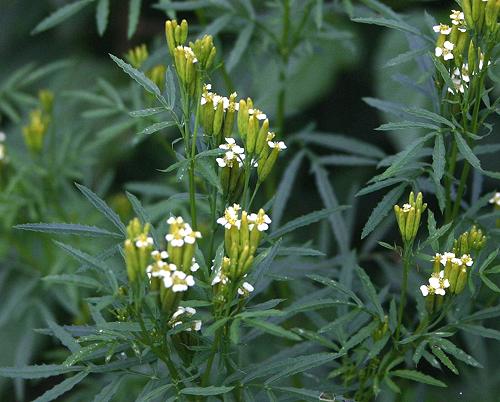
Huacatay has been recommended as a good substitute for people who can't stand Cilantro (sometimes blamed on a mutant OR6A2 gene). Photo by Paul Venter distributed under license Creative Commons Attribution-ShareAlike v3.0 unported.
More on Daisy Herbs & Flowers
Huacatay is considered an essential herb for the cuisines of the Andean Mountains region. It is used informally in many dishes, and formally in some well known dishes. It is a definitive ingredient in Locro, a popular Peruvian pumpkin, potato chili and huacatay stew. It is difficult to substitute, described as having flavors of Basil, Mint, Lime juice and Tarragon. It is also used in medicinal teas, and holds up reasonably well to drying.
Commonly called "Black Mint", Huacatay is in no way related to mints, it's in the Daisy family. The statement that it is a suitable substitute for Cilantro for people who can't stand Cilantro due to a mutated OR6A2 gene is closer, but still a bit of a stretch. Culantro would be a lot closer, and it doesn't have the OR6A2 problem.
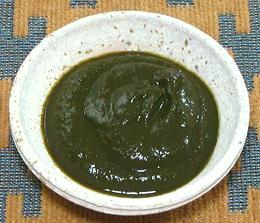 Huacatay Paste is much used in Peru as an ingredient in sauces and the
like, and can be used elsewhere when fresh leaves are not available.
Huacatay Paste is much used in Peru as an ingredient in sauces and the
like, and can be used elsewhere when fresh leaves are not available.