 [Oryza sativa var indica |
Oryza glaberrima (Upland Rice) | NERICA (New Rice
for Africa)]
[Oryza sativa var indica |
Oryza glaberrima (Upland Rice) | NERICA (New Rice
for Africa)]
General Information on Rice.
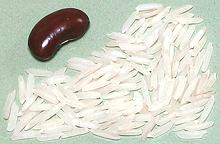 Africa imports most of its rice, and some of that is Basmati from India,
pretty much all into East Africa, which has had a close trade relationship
with Inda for thousands of years. It is grown in northern India and
Pakistan, in the foothills of the Himalayas. This is a long grain
distinctly aromatic rice that stands up well to robust flavors. The
grains are very long and properly cooked stay very separate and fluffy.
Typically 1 cup of rice takes 1-7/8 cups of water and makes 3 cups. The
photo specimens were typically 0.290 inch long by 0.060 inch wide
(7.4 x 1.5 mm). The grains expand greatly in length when cooked. The
photo specimens cooked out to about 1/2 inch long (13 mm).
Africa imports most of its rice, and some of that is Basmati from India,
pretty much all into East Africa, which has had a close trade relationship
with Inda for thousands of years. It is grown in northern India and
Pakistan, in the foothills of the Himalayas. This is a long grain
distinctly aromatic rice that stands up well to robust flavors. The
grains are very long and properly cooked stay very separate and fluffy.
Typically 1 cup of rice takes 1-7/8 cups of water and makes 3 cups. The
photo specimens were typically 0.290 inch long by 0.060 inch wide
(7.4 x 1.5 mm). The grains expand greatly in length when cooked. The
photo specimens cooked out to about 1/2 inch long (13 mm).
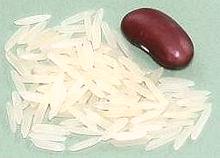 This is simply Basmati Rice that has been par boiled in the husk before
milling. It is very popular in India and Nigeria, and widely available in
North America. It is essential for making Nigerian Jollof Rice, but must
not be used for Jollof Rice in the rest of West Africa. It takes just a
little more time time to cook than regular Basmati, and a little more water
(2 cups water to 1 cup rice). It is quite tolerant of cooking conditions
and the grains remain very separate even if somewhat over cooked. Flavor
has a definite hint of brown basmati. The photo specimen grains were
typically 0.340 inch long and 0.075 inch wide (8.6 x 1.9 mm) and it cooked
out to about 0.55 inch long (14 mm).
This is simply Basmati Rice that has been par boiled in the husk before
milling. It is very popular in India and Nigeria, and widely available in
North America. It is essential for making Nigerian Jollof Rice, but must
not be used for Jollof Rice in the rest of West Africa. It takes just a
little more time time to cook than regular Basmati, and a little more water
(2 cups water to 1 cup rice). It is quite tolerant of cooking conditions
and the grains remain very separate even if somewhat over cooked. Flavor
has a definite hint of brown basmati. The photo specimen grains were
typically 0.340 inch long and 0.075 inch wide (8.6 x 1.9 mm) and it cooked
out to about 0.55 inch long (14 mm).
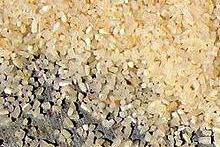 Sold mostly to food processors in most of the world, though called for
in certain Southeast Asian recipes, broken rice is very popular in West
Africa for two reasons - it costs less than full grain rice, and it can
substitute for couscous because it is of similar size and shape. The
photo was taken in Senegal, a major West African consumer of broken rice.
Photo by T.K. Naliaka (heavily cropped), distributed under
license Creative Commons
Attribution-ShareAlike v4.0 International, attribution required.
Sold mostly to food processors in most of the world, though called for
in certain Southeast Asian recipes, broken rice is very popular in West
Africa for two reasons - it costs less than full grain rice, and it can
substitute for couscous because it is of similar size and shape. The
photo was taken in Senegal, a major West African consumer of broken rice.
Photo by T.K. Naliaka (heavily cropped), distributed under
license Creative Commons
Attribution-ShareAlike v4.0 International, attribution required.
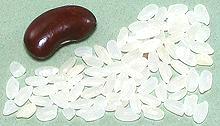 Rice cultivation is thought to have started in Egypt in the 7th century
CE. Today, most varieties produced are very high yielding
japonica type: Giza 177 (short thick grain), Sakha
101/102/103/104 (short thick grain) or Giza 178 (short thin grain).
These may be milled as natural polished white rice, white Camolino
rice (polished in oil - not common in North American markets), or
brown rice (called "cargo rice" by Egyptian manufacturers).
Rice cultivation is thought to have started in Egypt in the 7th century
CE. Today, most varieties produced are very high yielding
japonica type: Giza 177 (short thick grain), Sakha
101/102/103/104 (short thick grain) or Giza 178 (short thin grain).
These may be milled as natural polished white rice, white Camolino
rice (polished in oil - not common in North American markets), or
brown rice (called "cargo rice" by Egyptian manufacturers).
The thick grain varieties are exported to Turkey, the Levant, Arabia, and Southern California (where we have a large Near Eastern population). The thin grain variety is exported mainly to Eastern and Southeastern Europe, and to East and West Africa.
The brand I've purchased is "Egypt's Best", a thick grained variety
that I found to have very good flavor, moderate stickiness and slightly
chewy texture. The specimen grains were typically 0.220 inch long and
0.075 inch across (5.6 x 1.9 mm) . A cup of rice took about 2 cups of
water and cooked in about 25 minutes to produce 3 cups.
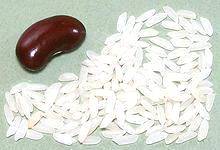 Africa imports 71% of India's non-basmati rice exports. This sector has
been declining because the rupee has increased against the dollar, making
Indian exports more expensive than those from Southeast Asia. Also, China
has been dumping aging government stocks of medium grain rice into African
countries at below market prices. The photo is of Sona Masoori, a popular
Indian non-basmati rice.
Africa imports 71% of India's non-basmati rice exports. This sector has
been declining because the rupee has increased against the dollar, making
Indian exports more expensive than those from Southeast Asia. Also, China
has been dumping aging government stocks of medium grain rice into African
countries at below market prices. The photo is of Sona Masoori, a popular
Indian non-basmati rice.
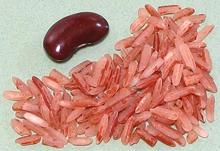 [Dista Rice]
Grown in the Lake Alaotra region of Madagascar, this unique, lightly
aromatic long grain rice is imported by Lotus Foods. It has good
yield and is grown on very marshy land, which suggest it is of Indian
descent rather than African (trade between India and Madagascar has
been going on for many centuries). The photo specimens were 0.295 inch
long and 0.070 inch wide (9.0 x 2.1 mm). One cup of rice takes 1-3/4
cups of water to make 3 cups cooked.
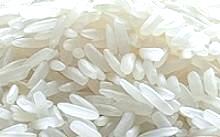 This rice is grown around the city of Mbeya in the western highlands of
Tanzania, and is a much preferred rice in that country. From photos and
descriptions of aroma, taste, and texture, I expect this rice is very
similar to Thai Jasmine rice, which will make
a good substitute. I have read some recipes by East African writers that
recommended Jasmine Rice.
Photo from Jumbe Seleman used under fair use doctrine (small,
heavily cropped, non-commercial, educational use, otherwise unavailable)
.
This rice is grown around the city of Mbeya in the western highlands of
Tanzania, and is a much preferred rice in that country. From photos and
descriptions of aroma, taste, and texture, I expect this rice is very
similar to Thai Jasmine rice, which will make
a good substitute. I have read some recipes by East African writers that
recommended Jasmine Rice.
Photo from Jumbe Seleman used under fair use doctrine (small,
heavily cropped, non-commercial, educational use, otherwise unavailable)
.
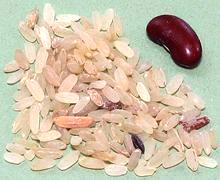 [often Oryza glaberrima and Oryza sativa blend]
Ofada Rice is grown only in the southwest corner of Nigeria. Today
it is usually a blend of several types, some of which may not be
African native. It is considered an elite rice in Nigeria, used mostly
for celebrations and other important events. African rice is difficult
to mill, so the milling is generally incomplete, adding color and
flavor to some of the grains. It is also sometimes fermented, giving
it an aromatic flavor, but reputed to smell up the kitchen during
cooking. The photo specimens were purchased on-line for 2018 US $4.00
/ pound. Predominant size was 0.265 x 0.180 inch (6.7 x 4.6 mm).
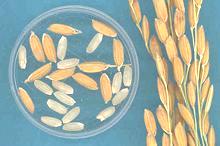 [Oryza glaberrima]
These varieties of rice are grown in West and West-Central Africa - a
completely different species from Asian rice (Oryza glaberrima
rather than Oryza sativa). This rice is almost never seen in
North America because it is low yield and not enough is grown to
supply Africa. It's main advantage is that it needs far less water
than Asian rice. It comes in many varieties from short grain to long
grain and from nearly white to very dark brown. Photo from the
USDA ARS GRIN (Germplasm
Resources Information Network) is of variety Bankoram from Ghana.
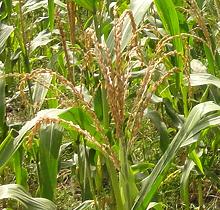 [New Rice for Africa]
This rice is a forced cross between O. glaberrima and
O. sativa to overcome the low yield of O.glaberrina
while retaining the dryland growing ability and disease and weed
resistance of that species. It is a "forced cross" because the two
species are not reproductively compatible. While still in development
stages, initial plantings have been successful and cultivation of this
rice is spreading in Sub-Saharan Africa. It will not be exported to
North America because it is still far from meeting African needs.
Photo by Africa Rice Center, distributed under license
Creative Commons
Attribution-ShareAlike v3.0 Unported, attribution required.
 [Thai Basmati; Hom Mali (Thai); Milagrosa (Philippines); Cambodia Fragrant;
Oryza sativa var indica]
[Thai Basmati; Hom Mali (Thai); Milagrosa (Philippines); Cambodia Fragrant;
Oryza sativa var indica]
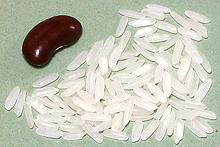
Africa imports most of its rice, so Thai Jasmine Rice is making inroads,
especially in South Africa and Nigeria. It is imported from Thailand,
Vietnam, and Cambodia. Sometimes called "Thai basmati" because of its
fragrance, this rice remains fluffy with separate grains (though not quite
as fluffy as basmati) and is an ideal rice for many types of dishes. 1 cup
rice needs about 1-3/4 cups (variable depending on age) of water to makes
about 3 cups cooked rice in 25 minutes. The photo specimens were typically
0.300 inches long and 0.075 inches wide (7.6 x 1.9 mm).
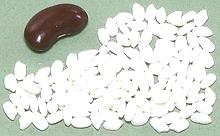
[Sticky Rice; Glutenous Rice; Mochigome (Japan)]
This intensely white short grain rice is used in Niger and northern
Nigeria to make Tuwo Shinkafa, a Fufu of rice. It is very low in amylose
and very high in amylopectin starches, so it absorbs a lot of water and
cooks up very sticky (but it contains no gluten). The photo
specimens, grown in California, by Koda Farms, were 0.200 inches long by
0.107 inch wide (5.1 x 2.7 mm). A cup of this rice needs about 2-1/2 cups
of water and cooks in about 25 minutes, much longer for Tuwo Shinkafa.