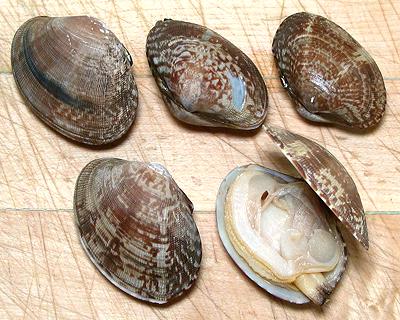
 [Japanese Littleneck; Venerupis philippinarum]
These clams were accidentally introduced in the Pacific Northwest of the U.S. and Canada when Pacific Oysters were brought from Japan. They quickly became an invasive species but are now so popular a harvest both commercially and recreationally that the fishery is highly regulated.
These clams are also an aquaculture crop and are harvested at various sizes from 1-1/4 inch to 2-1/2 inches. The main problem with this crop is slow growth, taking over 3 years to reach harvest size. The photo specimens were typically 1.9 inches the long way by 1.4 inches and 0.8 inch thick - 28 clams to the pound.
More on Bivalve Mollusks.
Given the difference in cost per ounce (see Yield below), why would anyone buy Manilla Clams in the shell? Well, a couple of reasons. First because they are so tender and delicious freshly steamed, and, if you're clever you can capture the equally delicious fresh clam juice. The second reason is fancy presentation. Many seafood soups and stews expect tiny clams in the shell as one of the ingredients.