
 [Family Gobiidae]
Gobies constitute one of the largest families of fish, but most are very small, ranging from 3/8 inches long to 12 inches long, but only a very few giant gobies are over 4 inches. Because of their size few gobies are food fish, but quite a few are popular aquarium fish.
More on Varieties of Fish
(very large page).
[Trypauchen vagina]
This fish is native to the coasts of the Indian Ocean from Southern Africa
and into the West Pacific as far as New Caladonia, from China in the North to
Tazmania and New Zealand in the south. It has also reached the Mediterranean
through the Suez Cannal. It grows to about 8-3/4 inches long.
Details and Cooking.
Photo by Shijan Kaakkara distributed under license
Creative Commons
Attribution-ShareAlike v4.0 International.
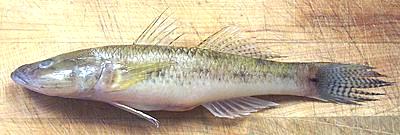
 [Cáa Kèo (Viet); Pseudapocryptes elongatus
alt P. lanceolatus]
[Cáa Kèo (Viet); Pseudapocryptes elongatus
alt P. lanceolatus]
This air breathing vegetarian fish, found from India to Tahiti and north
to China, lives only in brackish waters, particularly in the Mekong Delta of
Vietnam. It can grow to nearly 8 inches but the photo specimen was 7-1/2
inches and weighed 0.77 ounces. It was harvested wild in Vietnam where
this fish is quite popular for a hot-pot soup named after it.
Details and Cooking.
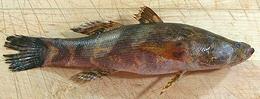 [Marble Sleeper; Ca bong Tuong (Viet); Bia (Philippines); Pla bu sai,
Pla bu jak (Thailand); Soon Hock (Singapore); Ikan Bakut, Bakutut,
Kedebuk (Indonesia); Damrey (Cambodia); Pa Bou (Laos); Belatoc
(Malaysia); Kawaango (Japan); Oxyeleotris marmorata ]
[Marble Sleeper; Ca bong Tuong (Viet); Bia (Philippines); Pla bu sai,
Pla bu jak (Thailand); Soon Hock (Singapore); Ikan Bakut, Bakutut,
Kedebuk (Indonesia); Damrey (Cambodia); Pa Bou (Laos); Belatoc
(Malaysia); Kawaango (Japan); Oxyeleotris marmorata ]
This is the largest of the Gobies, reaching 26 inches, but most
commonly 12 inches. It is widespread, found in fresh and brackish
waters throughout Southeast Asia, including Indonesia and the
Philippines. It is a very lazy ambush hunter, why it is called a
"Sleeper" - it just gulps down food that swims by its nose. It is
much sought as an outstanding eating fish, and is also popular
in aquariums.
Details and Cooking.
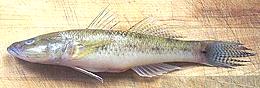 [Tank Goby (Fishbase), Flathead Goby; Ca bong cat, Ca bong da (Viet);
Glossogobius giuris]
[Tank Goby (Fishbase), Flathead Goby; Ca bong cat, Ca bong da (Viet);
Glossogobius giuris]
This fish is found in tropical fresh and brackish waters from the east
coast of Africa to the South Pacific islands. Caught wild and farmed. It is
absolutely gigantic - for a goby - most of which are between 1 and 4 inches
long. This one gets as large as 19 inches in brackish water, less in fresh,
but is generally marketed at about 9 inches and 3.2 oz.
Details and Cooking.
 [??]
[??]
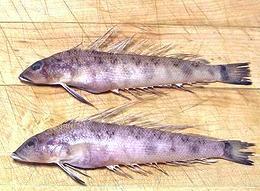
The fish shown here, wild caught in Vietnam, are not any of the
"spotted gobies" listed on Fishbase, but fishbase lists 1786 species
of goby and has photos of only half of them. I looked at all the
photos and didn't find this one, so some goby expert will have to
ID it - if it is actually a goby. These fish measured about 5-3/4
inches long and weighed about 1 ounce each.
Details and Cooking.
 [Cá Thòi Lòi (Viet); Belacac, Gabus lawut (Malaysia);
Belodoc, Blodoc (Indonesia); Bia (Philippines);
Periophthalmodon schlosseri of family Gobiidae]
[Cá Thòi Lòi (Viet); Belacac, Gabus lawut (Malaysia);
Belodoc, Blodoc (Indonesia); Bia (Philippines);
Periophthalmodon schlosseri of family Gobiidae]
This fish is native to the coastal regions of Southeast Asia, including
Indonesia, Philippines and northern Australia. It is an amphibious fish,
often seen feeding in extremely shallow water or on mud flats. It can
grow to about 10-1/2 inches long and is subject to a minor fishery. IUCN
Red Listed LC (Least Concern).
Details and Cooking.
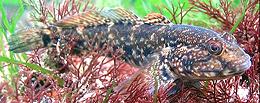 [Gò (Venice); Zosterisessor ophiocephalus formerly
Gobius venetiarum]
[Gò (Venice); Zosterisessor ophiocephalus formerly
Gobius venetiarum]
This fish is native to coasts and lagoons all around the
Mediterranean, and grows to just under 10 inches. It is not much eaten
in the region except in Venice, Italy where it is important for some
local dishes. It is fished commercially in the Black Sea and Sea of
Azov. Photo by Florin Dumitrescu contributed to the
public domain.
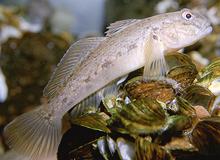 [Gobius venetiarum]
This fish, native to Black and Caspian Sea regions, is now a serious
invasive species in the Great Lakes region of North America. While it
out competes a few small native fish, it's impact hasn't been all
bad. It eats some invasive zebra and quagga mussels, unfortunately
not enough to clear them out. It has also become a favored food for
walleyes and largemouth and smallmouth bass (actually, not bass -
they are perch, like the walleye). Some are eaten by lake sturgeon,
which don't normally eat fish. They are also the salvation of the
formerly threatened Lake Erie Watersnake, which now eats almost
nothing but round gobies. These fish can grow to 9.7 inches and
a weight of 2.8 ounces.
Photo by U.S. Fish and Wildlife Service = public domain
.