 [Mudfish, Spotted Channa, Snakehead murrel (USA); Zmeegolova (Uzbek);
Dalag (Philippine); Murel, Murrel, Varaal (India);
Cá Lóc Cá Qua, Cá Chuoi (Viet);
Nga Yant (Burma); Ikan Gabus (Indonesia); Channa striata,
Chana argus and other Channa species]
[Mudfish, Spotted Channa, Snakehead murrel (USA); Zmeegolova (Uzbek);
Dalag (Philippine); Murel, Murrel, Varaal (India);
Cá Lóc Cá Qua, Cá Chuoi (Viet);
Nga Yant (Burma); Ikan Gabus (Indonesia); Channa striata,
Chana argus and other Channa species]
This excellent eating fish is sold as "Mudfish" in Southern California's Asian fish markets, and is one of the most important food fish in Thailand, Vietnam and Malaysia. It's also very popular in Central Asia, India and the Philippines. Both wild and farmed snakeheads are sold live in Asia, and will stay alive for several days in a basket of wet straw - but if you get caught with a live Mudfish here in California, it'll be you that's in very deep (legal) mud.
The Northern Snakehead (C. argus), which can stand cooler temperatures, now infests some parts of the United States, including the Potomac, Charles River, and the Mississippi Basin, introduced by brain dead aquarium owners, poorly educated Asians and careless fish farmers.
"Spotted Channa" is the name chosen by the Charles County, Maryland, Commissioners in a contest to find a more appetizing name for this fish for use in restaurants and fish markets. Given that, we should call the one in the markets here in Southern California (C. striata) "Streaky Channa", but we don't have a live fish problem here. All Snakeheads are voracious predators and are not in any way threatened - they're more on the threat side - so eat as many as you'd like, they're delicious!
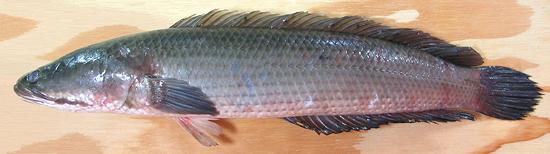
Snakeheads can grow to 40 inches and 6.6 pounds but the photo specimen, wild caught in Vietnam, was 18-3/4 inches and 2 pound 12-5/8 ounces. It's a fresh water fish preferring muddy water, and like the notorious Walking Catfish can survive extreme conditions. It can travel long distances over land to exploit new ponds and rivers.
More on Varieties of Fish (very
large page).
Snakehead flesh is pink or nearly white depending on cooking method, with an attractive flavor - most people should like it. Wet cooked, the flesh is tender, fine grained and does not flake apart, making it excellent for soups, stews and curries. It is also used to make fermented fish sauces, especially Pa Daek in Laos and Nam Pla Raa in Issan, Thailand where only freshwater fish are used. For details see our Tuk Prahok Sauce page.
This fish is extremely slimy, making it rather difficult to hold on to until it is scaled, beheaded, cleaned and rinsed several times. Scaling, cleaning, filleting and skinning a whole fish will take 20 min to 25 minutes depending on your skill level and tools.
Once down to the backbone I usually just cut the ribs from the backbone with kitchen shears, all the way to the tail. Up at the head 1/3, the ribs are very short, around 3/4 inch, but are attached to very substantial centerline pin bones (which go all the way out to the skin). I pull all these bones with long nose pliers, holding the flesh firmly to keep the bones from tearing it up. By time you have pulled all the pin bones, you'll have pulled all the ribs as well. You may still feel some prickliness along the centerline way out by the skin, but these bits will soften with cooking.