 [Chinese Cabbage, Celery Cabbage; Sui Choy, Da Baicai, Pe-Tsai,
Wong Bok (China); Chinese Leaf (UK); Wong bok, Won bok (New Zealand);
Wombok (Australia); Wombok, Pechay baguio (Philippines);
Pak kaat kao, Pak kaat kiao (Laos); Hakusai (Japan); Baechu (Korea);
Brassica rapa Group Pekinensis]
[Chinese Cabbage, Celery Cabbage; Sui Choy, Da Baicai, Pe-Tsai,
Wong Bok (China); Chinese Leaf (UK); Wong bok, Won bok (New Zealand);
Wombok (Australia); Wombok, Pechay baguio (Philippines);
Pak kaat kao, Pak kaat kiao (Laos); Hakusai (Japan); Baechu (Korea);
Brassica rapa Group Pekinensis]
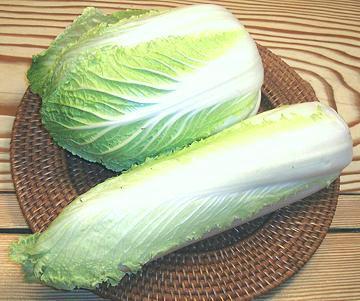
Napa Cabbage (the name comes from a Japanese word for Cabbage Leaves) is what most of the world thinks of as "Chinese Cabbage", even though it's actually a turnip green. Napa cabbage is much favored in northern China and Korea, especially for its winter keeping properties. In southern China, the name "Chinese Cabbage" more properly belongs to Bok Choy (also a turnip green).
There are two common forms, the short blocky form now found in just about every North American grocery store, and a long narrow form pointed at the top. The long form is found in markets serving Asian communities and is preferred for making Korean kimchee, Chinese sauerkraut and for other fermented or pickled applications. The taste and texture are the same, the long shape is simply more convenient for those uses.
The flavor of Napa Cabbage is different from that of real cabbage and the stem ends of the ribs are much thinner. The entire leaf is somewhat crisp and slightly sweet. From the fibrous white leaf ribs it is sometimes called "celery cabbage" but the fibers are tender, nowhere near as tough as those in celery. Napa cooks quickly so is suitable for stir fries and it does not give off a cabbage smell when it cooks.
More on Asian Greens.