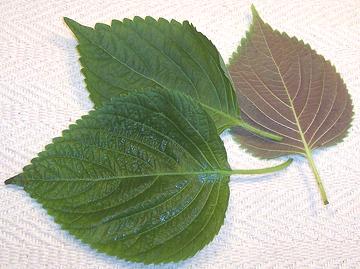
 [Shiso (Japan); Deulkkae, Tulkkae, Kkaennip, Sesame leaf
(Korea); Tia to (Vietnam); Pak Maengda (Laos); Zi su (China); Silem
(Nepal, India); Shiso, Beefsteak plant, Purple mint, Japanese basil,
Wild coleus (North America); Perilla frutescens var
japonica and others]
[Shiso (Japan); Deulkkae, Tulkkae, Kkaennip, Sesame leaf
(Korea); Tia to (Vietnam); Pak Maengda (Laos); Zi su (China); Silem
(Nepal, India); Shiso, Beefsteak plant, Purple mint, Japanese basil,
Wild coleus (North America); Perilla frutescens var
japonica and others]
These large leaves are widely used, particularly in Japan and Korea, whole or shredded, as a garnish. Young flower spikes are used as a garnish and to flavor pickles in Japan and Taiwan.
the photo specimens are clearly Korean. The Japanese Shiso leaves are much more deeply serrated, they lack the purple color on the underside common with the Korean variety, and the flavor is slightly different. The Korean variety is much more available here in Los Angeles as Japanese markets are now few and far between here.
For unknown reasons, the Korean name translates to "Wild Sesame" or "Sesame Leaf", despite perilla being related to sesame only at the very distant order level. Actual sesame leaves are rarely eaten, though edible. The Chinese use perilla mostly as a medicinal to stimulate the immune system rather than in their cuisine.
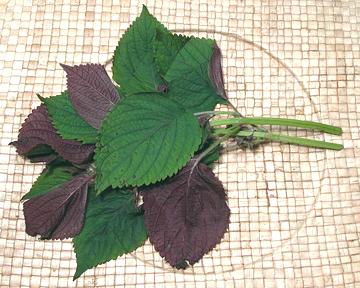 The Vietnamese variety of perilla is considerably smaller than
the Korean or Japanese and is more aromatic. It is used in soups and
stews, and particularly with rice vermicelli dishes called
bún. In Laos they are used in a similar dish called
kao phoon.
The Vietnamese variety of perilla is considerably smaller than
the Korean or Japanese and is more aromatic. It is used in soups and
stews, and particularly with rice vermicelli dishes called
bún. In Laos they are used in a similar dish called
kao phoon.
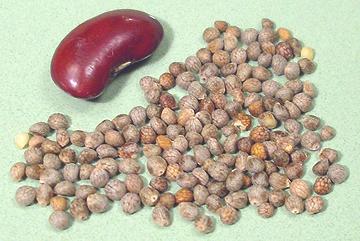 [Deulggae (Korea)]
The seeds themselves are also used. In Korea, they may be added to a recipe, or toasted, crushed and mixed with sesame and salt as a condiment. They are similarly used mixed with salt in Japan. In Nepal and nearby parts of India they are toasted, ground and mixed with salt, chili and tomato to make a condiment or dip.
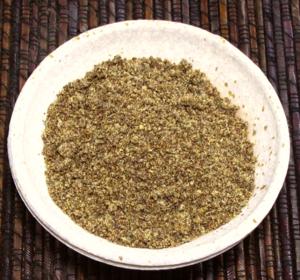 [Deulkkae-garu (Korean)]
This powder is used in Korea in soups and stews. It is a thickener that contributes a nutty flavor to the recipe. It is often placed in a fine strainer, then lowered into the soup, and a wooden spoon is used to press it through the strainer. This is a method of dispersing it so there are no lumps.
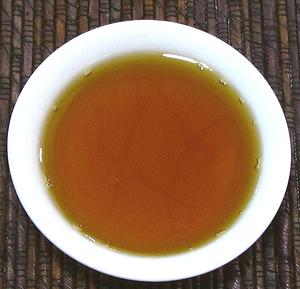 [Deul Gireum, Beopyu (Korea); Deulkkae Gireum North
Korea]
[Deul Gireum, Beopyu (Korea); Deulkkae Gireum North
Korea]
In most of the world, this oil is used mainly as a component in varnishes and the like, valued for its fast drying time, but in Korea is also used as an edible oil. The seeds are high in oil, and that oil is over 50% Omega 3 (alpha-linolenic acid (ALA)). It is currently uncertain how well the body can convert vegetable Omega 3 to the EPA and DHA forms found in fish and animals (all three are needed). Perilla oil is sold in capsules by the supplement industry.
In Korea, This oil is used in seasoned vegetable side dishes (namul), as a coating for roasted seaweed, and to fry pancake like dishes (jeon). When used for frying, keep in mind that Omega 3 is a polyunsaturated oil, so keep temperatures moderated and frying time short to reduce rancidity from heat (350°F/177°C max.
The flavor of this oil is surprising, in effect rather like fish sauce without the salt. This may be because of the large amount of Omega 3, similar to the high Omega 3 content of fish oil.