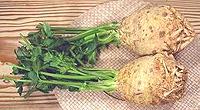
Celery is a marsh plant native to the Mediterranean region. Except for the Australian Sea Celery, all common celeries are cultivars of a single species, A. graveolens. While celery was well known to the ancient Egyptians it is not known if they cultivated it, since it was a common weed there. Celery was definitely cultivated during the Greek and Roman empires. Before Rome, celery was used medicinally, but the Romans seem to have started cooking with it, though with caution. Development of modern varieties with thick stems or large roots began in the 1600s.
More on Parsleys
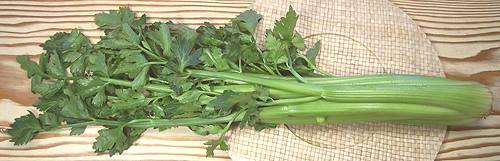 [Apiam graveolens var. dulce]
Celery grown commercially in North America is almost entirely the Pascal cultivar, which produces very large, mild flavored stems that are less fibrous than earlier varieties were. California is far and away the largest producer, but a fair amount is grown in Florida. The photo specimen was 27 inches long and weighed 1-3/4 pounds, but heads over 3 pounds are common.
There are other cultivars sometimes grown by home gardeners,
including red stemmed varieties, but these are very rarely seen and
are considered less desirable. In Europe a "self blanching" variety
is favored that is mostly pale yellow, like the center of North
American celery.
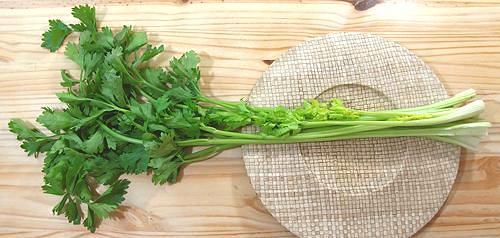 [Kinchay (Philippines); Khan Choy (China); Keun Chai (Thai);
Apiam graveolens var secalinum]
[Kinchay (Philippines); Khan Choy (China); Keun Chai (Thai);
Apiam graveolens var secalinum]
Probably much like celery grown in Europe before 1600, this plant has
relatively thin stems, is stronger in flavor, and is more fibrous than
Pascal celery. It is now grown in California and available in the many
Asian markets here. If your recipe calls for it and you can't get it,
buy the leafiest head of regular celery you can find, and use the part
above the first joint where the flavor is stronger. The specimens
were 30 inches long with stems about 1/2 inch wide 5 inches above
the leaf base. Both stems and leaves are used in recipes from China
and Southeast Asia.
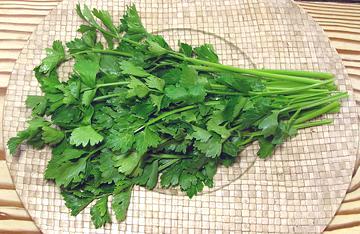 [Soup Celery, Celeri à Couper (French); Celero (Italy);
Celinon (Latin); Apiam graveolens var secalinum]
[Soup Celery, Celeri à Couper (French); Celero (Italy);
Celinon (Latin); Apiam graveolens var secalinum]
This is supposed to be the exact same thing as Chinese Celery, but grown in Europe and North America. There seems to be some variation though, as the Chinese Celery available in Southern California has a curved cross section similar to Stem Celery, and at least the cultivar Afina, popular in North America, has round hollow stems.
This is the preferred type of celery to grow in home gardens. It
grows well with little attention. Pascal celery is an industrial product
requiring special growing conditions and a lot of water, and other
stem celeries are also finicky. As in Asia, both the stems and leaves
are used. Gardeners cut off stalks continuously during the growing
season, and the plant sends up more. Note that Celery is biennial,
growing lots of leaves the first year, then going to seed the second.
This celery is used so different from leaf celery that it has its
own Root Celery page.
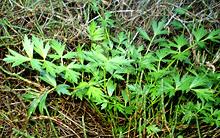 [Apium prostratum]
This celery, native to Australia and New Zealand, was an important
vegetable to early Australian colonists. Captain Cook also harvested it
to ward off scurvy among his sailors. It tastes much like regular celery,
and dried leaves are used in Australian spice mixes. Var prostratum
grows on sand dunes, while var filiforme, considered the better
for cooking, grows in mangrove swamps. Sea Celery is commercially
cultivated to a limited extent.
Photo by Zaareo, distributed under license Creative Commons
Attribution-ShareAlike v3.0 Unported.
Some recipes in European style ask to use only the yellow-green internal stems. Sometimes this is for tenderness in salads and the like, but also, Europeans favor a "self blanching" variety that is almost all yellow-green. That variety is not seen in North America.
When using celery to make soup stock cut it from the leafy end above the first joint for the best flavor. When reviving Medieval, Renaissance or Roman recipes, use Chinese / Cutting Celery, or lacking that use the part above the first joint. Do the same for Asian recipes if you can't get Chinese Celery. Pascal celery is not used in China or Southeast Asia.
What to do with the pale center? I just munch it, leaves and all, as an impromptu salad while working, dressed with a flavorful vinegar and salt. Of course, you can also add it to more formal salads.