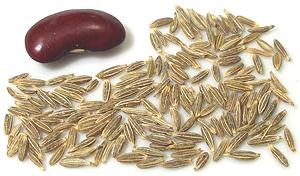
Probably originating in southwestern Asia, this plant has been native to the region from the eastern Mediterranean to eastern India since prehistoric times. What we call "Cumin Seeds" is actually the dried fruit, which contains the seeds. This is one of the most important spices in Indian cuisine, generally combined 1 teaspoon to 1 Tablespoon coriander seed, but sometimes 1 to 1. It is also one of the most important spices in North Africa, the Levant and Middle East. It is significant in Europe as well, but often displaced by Caraway Seeds. In India it is sometimes called White Cumin to differentiate it from Black Cumin. The photo specimens were typically 0.188 inch long by 0.060 inch wide (4.8 x 1.5 mm).
More on Parsley & Aralias.
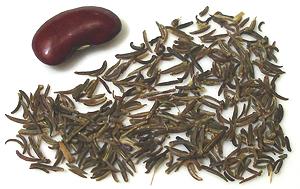
Fruits of this plant (called "seeds") are used in the cuisines of northern India, Afghanistan, Tajikistan and Persia - and are all but unknown outside that region, though the plant grows wild as far as southeastern Europe. It has a very different flavor and aroma than white cumin, so the two are not interchangeable.The photo specimens were typically 0.220 inch long by 0.020 wide (5.6 x 0.5 mm).
Leaves can be used as Parsley is, and the roots can be cooked, said to taste like sweet chestnuts, but only the fruits are available in North America.
More on Parsleys