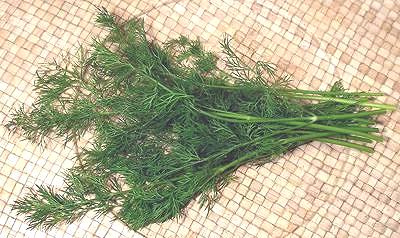
 [Shubit (Semitic); Shepu, Sowa (Asia); Thi la (Vietnam);
Anethum graveolens]
[Shubit (Semitic); Shepu, Sowa (Asia); Thi la (Vietnam);
Anethum graveolens]
Originating in Eastern Europe and/or Western Asia, dill has been cultivated since Neolithic times. The Talmud (Jewish law) requires tithes be paid in dill seeds and stems. and some stems were found in the tomb of Tutankhamen.
A favorite herb in Eastern Europe, Scandinavia, the Caucasus and into Persia and "the Stans", fresh dill is widely available in Los Angeles where those eths abound, but many Americans know it only as something that goes into dill pickles. Dill is also used through India and Southeast Asia, particularly Vietnam.
Dried dill is called for in many recipes. It's effect is far different from fresh dill, so substitutions either way should only be made if the other is unavailable.
More on Parsley Family.
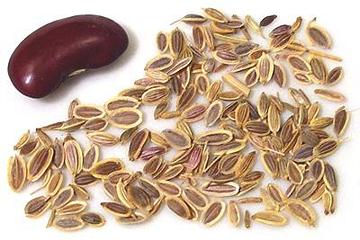
Dill Seed is surprisingly hard to find in regular supermarkets, it can be in tiny quantity for an outrageous price when it is found. It can, however, be easily found at reasonable prices in Indian and many other ethnic markets.
The seeds remains viable for 1 to 3 years, so 2 years is probably a
good maximum storage time. Store away from light and heat in a well
sealed jar.