 [order Anguilliformes families Anguillidae (freshwater),
Congridae (saltwater), Muraenidae (Morays), others, and
order Synbranchiformes (Swamp Eels)] -
See also Cusk Eels.
[order Anguilliformes families Anguillidae (freshwater),
Congridae (saltwater), Muraenidae (Morays), others, and
order Synbranchiformes (Swamp Eels)] -
See also Cusk Eels.
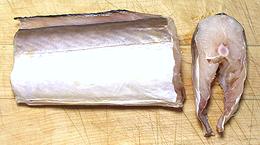
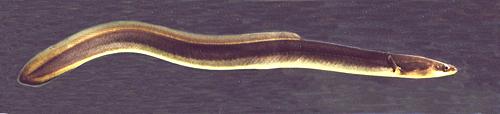
Anguilliforms is a large order of fish that have become very elongated to the point of resembling snakes and worms. While related to other modern ray-finned fish they tend to be rather primitive and a bit simplified. Freshwater eels spawn at sea and die there. Their offspring enter rivers as juveniles and live there until time to spawn. Lacking scales in most cases and scales that can be scraped off without tearing the skin in all cases, eels are not kosher. Drawing of American Eel by Ellen Edmonson and Hugh Chrisp, copyright expired.
More on Varieties of Fish
(very large page)
 [Anguilla rostrata]
This freshwater eel is found in rivers and streams along the West
Atlantic from Greenland to the tip of South America but is most common
in the temperate zones of that range. Female eels can grow to 60 inches
and 16 pounds but males only to 18 inches. North of the equator these
eels go to the Saragaso Sea to spawn and die, a little to the west of
where the European eels go. Aquaculture depends on capturing returning
juveniles. There is a big market in Asia for these juveniles because
of an eel shortfall there, but populations are declining and
protections are being considered by the U.S. Fish and Wildlife Service.
IUCN Red Listed EN (Endangered), do not catch or eat this eel.
Illustration from U.S. National Oceanic and Atmospheric
Administration = public domain.
 [Anguilla anguilla]
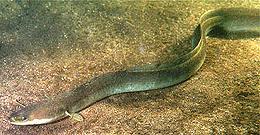
This freshwater eel is found in rivers and streams along the East Atlantic from Morocco to northern Norway and in the Mediterranean, Baltic and Black seas. These eels can grow to 52 inches and 14 pounds but market size is much smaller. These eels go to the Saragaso Sea to spawn and die, a little to the east of where the American eels go. Aquaculture depends on capturing returning juveniles but the runs have been scant recently and this eel is IUCN Red Listed CR "Critically Endangered". Do not catch or eat this eel. Photo by Ron Offermans distributed under license Creative Commons Attribution-Share Alike 3.0.
Baby eels (Elvers), still nearly transparent, have long been very
popular in Spain. They are caught as they enter the rivers from their
trip across the Atlantic, and are considered best fresh. In North America,
they are only available canned, at 2019 US $10.22 per ounce. These eels
are IUCN Red Listed CR "Critically Endangered". Do not catch or eat thse
eels. Surimi baby eels are available from the same store at $1.24 per
ounce, and are not endangered. They even have the grey stripe and eyes
like the real ones.
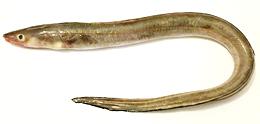
 [Unagi (sushi), Anguilla japonica]
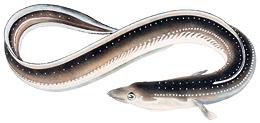
This freshwater eel, native to Japan, China, and Southeast Asia including the Philippines, is caught wild and farmed. A. japonica spawns far out to sea and then dies, so aquaculture depends on capturing returning juveniles. They can grow to nearly 60 inches but are generally marketed much smaller. This fish is highly prized and expensive in Japan, and is not seen in California markets - in fact most farmed eels in Japan are now American eels because the supply of Japanese eels is approaching "none". IUCN Red listed EN (Endangered), do not catch or eat this eel.
 [Congrio
(Spanish); Conger conger (European) | Anago
(sushi); Conger myriaster (Japanese) | others
of family Congridae]
[Congrio
(Spanish); Conger conger (European) | Anago
(sushi); Conger myriaster (Japanese) | others
of family Congridae]
This strictly ocean eel is much larger than the freshwater eels
and much more robust in its reproduction habits. The European Conger
can grow to nearly 10 feet and 350 pounds. They are found worldwide
and there isn't a lot of difference from one species to another. They
are farmed to some extent. The farms provide piles of long pipes for
the eels to occupy with just their heads sticking out, often several
eels per pipe.
Photo by Foundling distributed under license
Creative Commons
Attribution-ShareAlike v3.0 Unported.
[Hamo (Japan); Daggertooth Pike Conger, Summer Eel; Ca Lat Cat Khuc
(Viet); Muraenesox cinereus]
While this Indo-West Pacific eel can grow to 7 feet, it is commonly
about 3 feet long. Though it is very expensive to prepare and bland
in taste, hamo is very popular around Kyoto, Japan. In ancient times it
was one of very few fish tough enough to survive a multi-day journey to
the inland capital. It is shot full of bones and cannot be de-boned, so
Kyoto sushi chefs use special techniques. The photo specimens, from
Vietnam, were about 2 inches diameter by 2-1/2 inches high. This fish
has no scales so is not kosher.
Details and Cooking.
 Not actually an eel, see Peacock Spiny Eel
 [Yellow Eel, Rice Eel, Asian Swamp Eel; Monopterus albus of family
Synbranchidae]
[Yellow Eel, Rice Eel, Asian Swamp Eel; Monopterus albus of family
Synbranchidae]
This eel is native to Southeast Asia, China, Japan, and possibly Bangladesh. A very similar but smaller eel, M. cuchia is found from Pakistan through Bangladesh and Burma. M. albus can grow to a little over 39 inches but the photo specimen, bought off the ice (previously frozen) at an Asian market in California, was 32 inches and weighed 1.1 pound factory cleaned. This eel is in no way endangered and can be a pest. Feel free to eat as many as you'd like. Details and Cooking.
sf_eelz 110320 - www.clovegarden.com