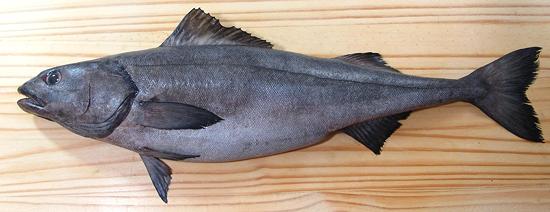
 [Coalfish, Butterfish, Blue Cod; Anoplopoma fimbria]
This fish is currently a darling of the fancy chef set (2011), under the name "Black Cod". Sablefish is not at all related to real Cod, nor much of anything else - there's only one other fish in the entire Anoplopomatidae family. Sablefish are found off the North Pacific coast in deep water with sandy bottoms. They range from mid Baja California all the way around to mid China, though they're scarce south of Los Angeles and Korea. Most of the catch on this side of the Pacific is sold to Japan. This fish can grow to 47 inches and 125 pounds, but the photo specimen was 19-3/4 inches and weighed 2 pounds 6-3/4 ounces, within the normal market range.
Sablefish farming is now being developed in Canada to the intense distress of the wild catch industry. The Sablefish fishery is highly regulated in both the U.S. and Canada to assure a sustainable harvest. The Monterey Bay Aquarium rates Sablefish from Alaska and Canada "Best Choice" and from California, Washington and Oregon "Good Alternative".
More on Varieties of Fish
(very large page).
Sablefish flesh is white, buttery soft, slightly gelatinous and very mild in flavor. It's oiliness makes it amenable to quick high temperature cooking, like grilling and broiling. These are the characteristics that have excited the fancy chefs and caused the price to rise. Cooked by dry heat, the flesh does not flake, but is soft and pulls apart very easily. Steamed or poached, it does separate into thin flakes. It should not be used for long wet cooking because it will quickly start flaking apart.
Recipes you will find for this fish are generally specific to Sablefish, because of it's unique texture, mild flavor and oiliness. Grilling and broiling are popular as well as steaming for some Asian recipes. One of the most popular recipes broils it after coating with a miso based glaze. Sablefish is also served raw as sushi in Japan.
In contrast to the way the fancy chefs use it, I sometimes just give fillets of this fish a light dusting or rice flour and pan fry it. Alternatively, I may poach it. I usually cook it skin-on.
One minor problem with this fish is the many centerline pinbones which are difficult to pull from raw fish. In Asia and Europe, where carp is much liked, people are accustomed to dealing with pinbones at the table, but most Americans are not. The pinbones are too soft to do damage but can annoy. To remove them before cooking you have to practically dig a trench down the centerline. An acid marinade would probably soften them to edibility.
Buying: Sablefish is regularly found in fish markets serving an Asian community, particularly Korean and Chinese, and I have recently found it in a Philippine market in Eagle Rock, mislabeled as "True Cod". It is a medium price fish here in Los Angeles. My most recent purchase (from a large Asian market in Alhambra) was at 2016 US $4.99 / pound, but I have bought it for as low as $2.99 / pound in a Philippine market.
Scales: The scales are tiny, soft and thin, scraping off as a gray slush. In some areas you will probably have to shave some of the scales off using the sharp edge of your prep knife. You can easily tell where by rubbing the fish from tail to head.
Cleaning: Nothing particularly difficult here except dealing with this fish's incredible limpness. You'll probably have to cut the guts from the head with kitchen shears. The gills would have to be cut out too, but you're probably just going to discard the head (see below), so you don't need to deal with them. Scrape off the red blood works down to the backbone.
Fillet: The first thing you'll notice about this fish is its limpness, which makes handling it difficult. Filleting it will sorely test your carefully honed skills because you're going to be at a loss to find bones to follow in most of this fish. Bones there are, but they're thin, short and soft. I would first remove the head. Dip your knife sharply under the collar to get as much flesh as possible. Cut behind the pectoral fins and well in front of the pelvic (bottom) fins. Cut those from the fillet later.
The skirt will be be so thin and limp you can just cut it off. You'll lose about 1 ounce per fillet with a 3 pound fish. In my experience the skirt does not have a strong or "off" flavor so it is usable. You'll be able to feel a lot of centerline spines, which are difficult to pull. They are long, kinky, deeply embedded and fragile, so leave them if you can remove them after cooking.
Skin: The skin has more flavor than the rather insipid flesh so it's left on wherever possible, particularly when broiling or grilling. It has moderate shrink. If you were to pan fry a fillet (not commonly done with this fish) shrink can be controlled by patting down the fillet after turning it skin side down. The skin is generally removed when the fish will be steamed or otherwise cooked with wet heat. The skin is thin, but much stronger than the flesh, so it is easily removed using the long knife and cutting board Method , with no loss of flesh. The skin from a fillet taken from a 3 pound fish weights about 1 ounce.
Yield: If you fillet carefully, a 3 pound 6 ounce fish will yield about 1 pound 11-1/2 ounces of skin-on fillet (51%) and about 1 pound 9-1/2 ounces skin off (47%) which is decent yield for a fish.
Stock: The head, bones and fins make a very oily stock with practically no flavor - just toss them.
Health & Nutrition: Sablefish is very high in long chain omega 3 fatty acids, EPA and DHA - about as much as wild caught salmon.
sf_sablez 100517 - www.clovegarden.com