 The rootlets shown in the photo to the left are sold in jars packed in
brine. They are purely decorative having almost no detectable flavor, but
they stay firm and hold their shape when cooked.
The rootlets shown in the photo to the left are sold in jars packed in
brine. They are purely decorative having almost no detectable flavor, but
they stay firm and hold their shape when cooked.
 [Nelumbo nucifera, Sacred Lotus]
Native to a vast area stretching from Afghanistan to Vietnam, the Asian Lotus has been an important source of food throughout it's entire range since prehistoric times. It has since been carried to all tropical and subtropical regions of the world. Flowers, seeds, leaves and rhizomes (roots) are all edible and popular throughout India, East Asia and Southeast Asia.
The American lotus (Nelumbo lutea) is similarly edible to the Asian species and was a significant native food resource into Colonial times. It is indigenous to the southeastern U.S., Mexico, Honduras and the West Indies but has been dispersed farther by humans.
The Lotus was unknown in Egypt until the Persian invasion. The "sacred lotus" of ancient Egypt was instead the blue water lily Nymphaea caerulea. Lotus and Water Lily are frequently confused but the plants are actually pretty easy to tell apart. Water lily leaves have a deep notch from the edge all the way in to the stem and they always float on the water surface. Lotus leaves are fully circular with stems in the center, no notch, and generally stand proud of the water surface (see flower photo below). Flowers of both are similar and both are noted for mild psychoactive and anesthetic properties. Water lily plants are not so edible and may be toxic.
More on Proteus Order.
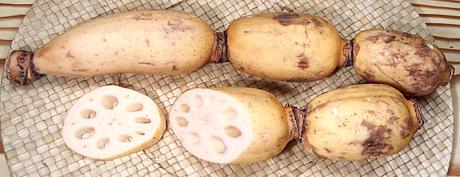
The most widely eaten part of the lotus plant is the rhizomes (roots) which are particularly decorative when sliced. Fresh rhizomes are easily available in Southern California Asian markets, but probably not in most of North America. Peeled and sliced rhizomes can often be found in the frozen foods section of Chinese, Southeast Asian and Korean markets and are perfectly good for many recipes.
The photo at the top shows typical full size rhizomes. A large link like the one at the top left will be about 6 inches long, 2-1/2 inches in diameter and weight 10 ounces The variety commonly sold here is just slightly pink and becomes just a little more pink when cooked. Look for roots that are light in color and hard with no soft spots.
The rootlets shown in the photo to the left are sold in jars packed in
brine. They are purely decorative having almost no detectable flavor, but
they stay firm and hold their shape when cooked.
Lotus rhizomes can be eaten raw, but if growing conditions are not properly sanitary it can present a risk of parasitic infection, particularly Fasciolopsiasis if pigs are raised nearby. Lotus rhizomes sold in the U.S, is probably safe but it's still better to cook it. Raw it tastes starchy and much like raw potato, just a bit sweeter and crisper.
Cooked lotus rhizomes tastes similar to potato, but the texture is very different. It becomes tender very slowly and remains quite firm, almost crisp even after long cooking. Thin slices can be eaten with just a few minutes of boiling, and will soften only slightly simmered for 45 minutes. Larger chunks are often simmered in soups for up to 2 hours. It's almost impossible to overcook lotus. Lotus slices are sometimes deep fried like potato chips, They look interesting but I think potato tastes better this way.
When preparing, cut away the ends and joints between sections and peel
with a vegetable peeler. Immediately place in water acidulated with citric
acid or lemon juice to prevent discoloration. Recipe weights should be
with the joints and ends cut away but before peeling.

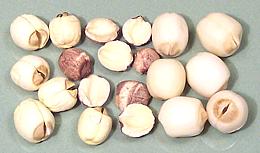 Lotus seeds pods are often seen in larger dried flower arrangements. The
seeds (often called nuts) are edible and can often be found in markets
serving an East or Southeast Asian community, packed in vacuum bags in
the produce section. Fresh (right in photo) have a mild flavor suggestive
of boiled peanut with a hint of black cardamom and other spices when
cooked. Lotus seeds are also sold dried in two forms, white (left in
photo) and fully mature split brown (center in photo). Fresh seeds are
about 3/4 inch long, 1/2 inch diameter and weigh about 13 to the ounce.
Seed Pod Photo ©
i0139.
Lotus seeds pods are often seen in larger dried flower arrangements. The
seeds (often called nuts) are edible and can often be found in markets
serving an East or Southeast Asian community, packed in vacuum bags in
the produce section. Fresh (right in photo) have a mild flavor suggestive
of boiled peanut with a hint of black cardamom and other spices when
cooked. Lotus seeds are also sold dried in two forms, white (left in
photo) and fully mature split brown (center in photo). Fresh seeds are
about 3/4 inch long, 1/2 inch diameter and weigh about 13 to the ounce.
Seed Pod Photo ©
i0139.
Before drying or packing a needle is used to remove the bitter germ from the seeds - why the ends always appear to be cracked. This is a labor intensive step adding to the cost. The brown ones are too hard for the needle so they are always split.
Lotus seeds are often added to soups and congees. In regions where they are harvested the seeds are also sold fresh still in young pods to be broken out and eaten eat as a snack. They are also sold coated with a crystallized syrup as a confection.
Cooking fresh seeds, simmering 15 minutes seems to give a good flavor and
texture - at 30 minutes they're still pretty much the same. Dried seeds need
to be soaked overnight before cooking, then simmer for about 20 minutes. In
my experience the dried white are a touch bitter while the brown are sweeter
and have a more pleasant flavor.
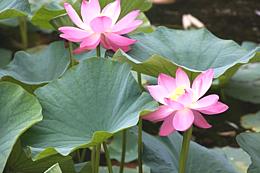 In regions where they are easily available petals from lotus flowers are
used to garnish dishes. They are reputed to have moderate psychoactive
properties and are often used in making alcoholic beverages to add that
"little something extra". They (and other parts of the lotus plant) are
used in traditional medicines.
Photo © i0128
.
In regions where they are easily available petals from lotus flowers are
used to garnish dishes. They are reputed to have moderate psychoactive
properties and are often used in making alcoholic beverages to add that
"little something extra". They (and other parts of the lotus plant) are
used in traditional medicines.
Photo © i0128
.
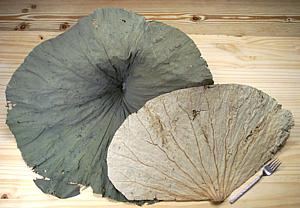 Lotus leaves are used as wrappers similar to how banana leaves are used in
other regions - except they are more edible and contribute more flavor to
the food. Bundles of dried lotus leaves are available in the U.S. from
Asian markets. Dried leaves must be soaked in warm water for about 3/4 hour
to soften them for use as wrappers. The photo shows a dried leaf folded in
half, white side out, and a leaf after soaking, unfolded and
green side up. The soaked leaf was 25 inches across.
Lotus leaves are used as wrappers similar to how banana leaves are used in
other regions - except they are more edible and contribute more flavor to
the food. Bundles of dried lotus leaves are available in the U.S. from
Asian markets. Dried leaves must be soaked in warm water for about 3/4 hour
to soften them for use as wrappers. The photo shows a dried leaf folded in
half, white side out, and a leaf after soaking, unfolded and
green side up. The soaked leaf was 25 inches across.
Lotus rhizomes are strong in dietary fiber, vitamin C, potassium, thiamin, riboflavin, vitamin B6, phosphorus, copper, and manganese. Lotus rhizomes should not be eaten raw if the growing conditions are not known. If they are not properly sanitary raw rhizomes can present a risk of parasitic infection, particularly Fasciolopsiasis if pigs are raised nearby.
pr_lotusz 080203 - www.clovegarden.com