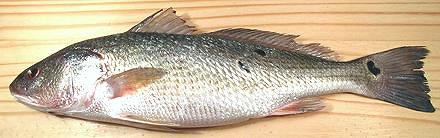
 [family Sciaenidae]
Croakers and Drums get their name from sounds they make underwater. Corvina is a Spanish name for many fish in this family. Some of the salt water varieties are often calle Sea Bass.
More on Varieties of Fish.
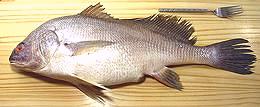
[Gasper goo, Gaspergou, Sheepshead, Lake/River drum, Grunt, Croaker,
Aplodinotus grunniens]
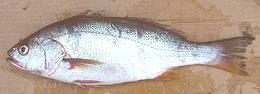
In the Asian markets of Southern California this fish has been
most often labeled "Sheephead" but the Philippine markets are now more
commonly calling it "Gasper goo". This is a pretty big fish, the
photo specimen at 21 inches and 3.85 pounds, but they can grow to
over 3 feet and 50 pounds. Found in large non-freezing lakes and
rivers in North and Central America, it is a minor commercial fish
and not considered threatened.
Details and Cooking.
Corvina / Yellow Croaker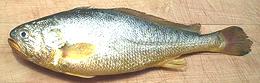 [Yellowfish, Yellow Corvina; Larimichthys polyactis alt
Pseudosciaena manchurica]
[Yellowfish, Yellow Corvina; Larimichthys polyactis alt
Pseudosciaena manchurica]
Native to the northwest Pacific, particularly the Yellow Sea and East
China Sea, this fish is highly prized among Asians in Los Angeles,
especially the Koreans. In Korean markets they are sold
frozen, dried, salted cooked and sometimes fresh, usually in lengths less
than 12 inches. They are often called "Corvina" (Spanish for croaker) or
"Yellow Corvina" to avoid confusion with the other fish called
"yellow croaker" (see Yellow Croaker above). They
are easy to tell apart, this one has a round face, the other has a pointy
face. This fish can grow to about 18 inches, but the photo specimen,
purchased from a Los Angeles market serving mostly Vietnamese and
Chinese, was 13-1/4 inches long and weighed 1 pound 2-1/2 ounces,
IUCN status NE (Not Evaluated).
Details and Cooking.
Atlantic Croaker / Yellow Croaker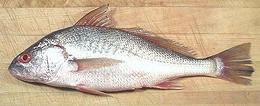
[Sea Bass; Micropogonias undulatus | very similar: Spotfin Croaker; Roncador stearnsi; Yellowfin Croaker Umbrina roncador; Sharpnose hammer croaker Johnius borneensis] See the entry for Yellow Croaker above for the confusion surrounding this fish and others. This fish is native to the West Atlantic, Gulf of Mexico and Caribbean.
It ranges from Massachusetts to Argentina and is considered a very good
eating fish. This fish can grow to 22 inches and 5 pounds 11 ounces, but
the photo specimen was 14 inches long and weighing 1 pound 3/4 oz. This
fish is currently caught wild and not farmed. It is IUCN rated LC
(Least Concern).
Details and Cooking.
|
 [Sea Bass; Corvina, Corvina Pampera, Corvinilla, Gringa (Peru); Corvinilla
(Chile): Cilus gilberti]
[Sea Bass; Corvina, Corvina Pampera, Corvinilla, Gringa (Peru); Corvinilla
(Chile): Cilus gilberti]
This fish is found along the coasts of Peru and Chile, and is highly favored
as a food fish in the region. It can grow to 36 inches, but is more commonly
around 16 inches. IUCN Red List DD (Data Deficient);
Details and Cooking.
Photo by Luis Hoyos Mayta distributed under license
Creative Commons
Attribution-NonCommercial 3.0 Unported.
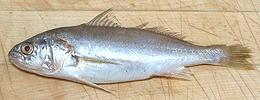 [Kingfish, Pasadena Trout; Corvina bianca (Spanish);
Genyonemus lineatus]
[Kingfish, Pasadena Trout; Corvina bianca (Spanish);
Genyonemus lineatus]
This fish is native to the west coast of North America, most common
off Southern California and fading out north of California and midway
down Baja California. It can be told from most similar croakers by lack
of a barbel under the lower lip. It can grow to 16 inches, but is
commonly under 10 inches. The photo specimen was 7-3/4 inches and wighed
2-7/8 ounces. This fish is IUCN Red Listed NT (Near Threatened).
Details and Cooking.
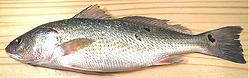 [Redfish, Channel Bass, Spottail Bass; Sciaenops ocellatus]
Strangely, this drum is not always red, and the distinctive ringed
spot at the tail may not be there on some fish either, or may appear
on only one side. This West Atlantic fish is found from Massachusetts
to northern Mexico and can grow to 61 inches and 99 pounds, but the
photo specimen was 16-1/2 inches and 2 pounds. The photo specimen,
farm raised in Taiwan, shows an extra black spot on the side. Red drum
was badly depleted to supply restaurants during the "Blackened Redfish"
craze of a few years back, but stocks have recovered and it is now
farmed - IUCN rated LC (Least Concern).
Details and Cooking.
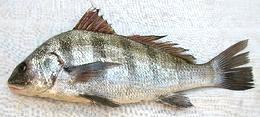 [Pogonias cromis]
This largest of the Drums & Croakers is found in the western
Atlantic from Nova Scotia, Canada, south around Florida and the Gulf
of Mexico on to Venezuela and southern Argentina. They are found mostly
in brackish waters near shore.They can grow to 67 inches and 113 pounds,
but are commonly around 20 inches. The distinct bars on young fish fade
as they become larger. Young Black Drum have the same taste and cooking
properties as the closely related Red Drum. It is suggested that fish
over 15 pounds be returned to the water, as they are very difficult to
scale and clean, and the flesh will be quite tough and will not flake.
IUCN Red Listed LC (Least Concern). For smaller Black Drum, use the
Details and Cooking for the
closely related Red Drum.
Photo by Luis Otavio Frota da Rocha distributed under
license Creative Commons
Attribution-NonCommercial 3.0 Unported.
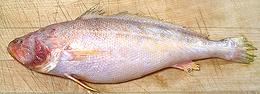 [Nebris microps alt Plagioscion microps]
This fish is native to the West Atlantic, mostly off the north coast
of South America from Columbia to Brazil, but a few can be found
farther south off Brazil. It can grow to almost 16 inches and 1-1/4
pounds, but the photo specimen was 13 inches long and weighed 1 pound
1 oz. It is well though of as a food fish, and one of the highest
priced fish in Trinidad. This fish is currently caught wild as a
commercial catch and is not farmed. IUCN Red List status Not
Evaluated.
Details and Cooking.
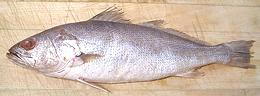 [Macrodon ancylodon]
This fish is native to the West Atlantic from Venezuela to the
northern half of Argentina. It can grow to nearly 18 inches, but
the photo specimen was 14-1/2 inches long and weighed 1 pound 1-1/2
oz. Weakfish get their name from weakness of the mouth parts - hooks
can tear loose and the fish then escapes. This fish is currently
caught wild as a minor commercial fishery and is not farmed.
IUCN Red List status LC (Least Concern).
Details and Cooking.
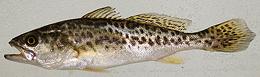 [Speckled Trout; Truite Gris (Louisiana French), Trucha de Mar (Mexican
Spanish); Cynoscion nebulosus]
[Speckled Trout; Truite Gris (Louisiana French), Trucha de Mar (Mexican
Spanish); Cynoscion nebulosus]
This fish is native to the West Atlantic from New York to southern Florida,
and along the coast of the Gulf of Mexico. It is also found around Cuba and
some other Caribbean islands. It can grow to nearly 39 inches, but is
commonly 14 inches. This fish is currently caught mainly in recreational
fishing, with minor commercial harvest, and is not farmed.
IUCN Red List status LC (Least Concern).
Details and Cooking.
Photo from Smithsonian Environmental Research Center distributed
under license Creative Commons
Attribution 2.0 Generic.
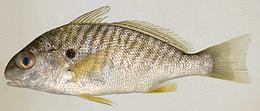 [Spot, Norfolk spot, Virginia spot; Leiostomus xanthurus]
This fish is found in brackish and salt waters. It ranges from
Massachusetts on south, following the coastline through the Gulf of Mexico
and down to the Yucatán Peninsula. It is very popular in recreational
fishing. This fish can grow to 14 inches, but is commonly 10 inches or smaller.
IUCN Red List LC (Least Concern).
Details and Cooking.
Photo from Smithsonian Environmental Research Center distributed
under license Creative Commons
Attribution 2.0 Generic.
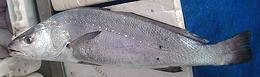 [Croaker, Jewfish, Shade-fish, Sowa, Kir, Corvina, Salmon-bass, Stone bass;
Argyrosomus regius]
[Croaker, Jewfish, Shade-fish, Sowa, Kir, Corvina, Salmon-bass, Stone bass;
Argyrosomus regius]
This fish is native to the East Atlantic coasts, Mediterranean, and
Black Seas, but has invaded the Red Sea. It is found from Norway south to
Congo, but is scarce north of France. It can grow to 90 inches and
227 pounds, but is more commonly 59 inches.
IUCN Red List status LC (Least Concern).
Details and Cooking.
Photo by Lucyin distributed under license Creative Commons
Attribution-NonCommercial 4.0 International.
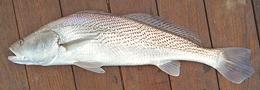 [Cassava Fish; Un-guka (Gambia); Pseudotolithus senegalensis]
This fish is native to the west coast of Africa, from Morroco down
to Angola, but most common off Senegal and not common north of there.
It can grow to 44 inches and 26 pounds, but is commonly 21 inches.
It is called for as Cassava Fish in recipes from Nigeria. This fish
is IUCN Red List rated EN (Endangered) and should not be caught or
eaten. Subst: use Atlantic Croaker or Red Drum. For
Details and Cooking
see Atlantic Croaker.
Photo by Theo Modder distributed under license
Creative Commons
Attribution 3.0 Unported.
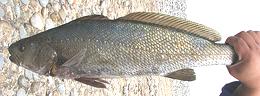 [Kob; Kabeljou (Afrikaans)l; Argyrosomus coronus]
This fish is native to the East Atlantic from South Africa north
to Angola. It can grow to 78 inches and 170 pounds, but is commonly
quite a bit smaller. This fish is currently caught wild and is not
farmed. While it is IUCN Red List status Not Evaluated, stocks are
at risk due to seine netters illegally keeping all juvenile fish
caught.
Photo by Frederick Hermanus Van der Bank, University of
Johannesburg Contributed to the Public Domain.
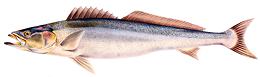 [Cape Salmon; Geelbeck (Afrikaans); Atractoscion aequidens]
This fish is native Southern Africa from Angola around and up to
Mozambique, and also along the east coast of Australia. It can grow
to 53 inches and 55 pounds, but is commonly aroud 35 inches. This
fish is highly thought of in South Africa. It is currently caught wild
and is not farmed. It is IUCN Red List status Not Evaluated.
Painting by Andrew Smith, copyright expired.