 [family Salmonidae Genus Salmo (Atlantic),
Oncorhynchus (Pacific)]
[family Salmonidae Genus Salmo (Atlantic),
Oncorhynchus (Pacific)]
Only Salmo and Oncorhynchus are officially trout, but a number of related fish are called "trout" (see below).
Among Oncorhynchus are Pacific Salmon, Apache trout (Arizona), Cutthroat trout (western North America), Gila trout (Arizona, New Mexico), Rainbow trout / Steelhead (western North America, northeast Asia and introduced everywhere).
Among Salmo are Atlantic Salmon, Adriatic trout, Brown trout (Europe and Asia), Marble Trout (southeastern Europe), Ohrid trout (Macedonia, Albania), Sevan trout (Armenia (native) and Kyrgyzstan (introduced)).
More on Varieties of Fish
(very large page).
[Oncorhynchs mykiss]
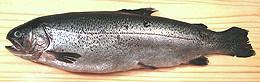
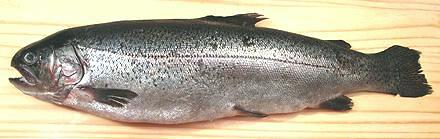
Rainbow / Steelhead was reclassified from Salmo to Oncorhynchs in 1989, so it is now officially a Pacific Trout and considered identical with the Russian trout of the same name. Rainbows are native to the west coast of North America from the Mexican border north and around across the Aleutian Islands to Russia, and as far south as northern Japan. Rainbow trout are now farmed worldwide because the supply of native trout is totally insufficient to meet demand.
Rainbows are generally between 12 and 18 inches long unless they go
to sea and become steelheads. Their bright rainbow colors fade quickly
upon death so are not evident in the fish markets. The farm raised rainbow
in the photo was 18-1/2 inches long and weighed 2 pounds 5-1/4 ounces
factory cleaned, rather larger than average market size. It's flesh was
a bright salmon color indicating it was fed a diet including the dye fed
to farmed salmon.
Details and Cooking.
 [Baby Salmon (marketing); Oncorhynchs mykiss]
Some rainbow trout stay in the lakes and rivers and are rainbows their entire lives. Others, even from the same batch of eggs, are rainbows for only one or two years, then lose their rainbow coloring and head out to sea to become Steelhead. A year or more later they return to the river of their birth to spawn, regaining their rainbow color. After spawning they turn silver gray again and head back to sea.
Nobody knows why some rainbows join the Navy and others stay at home,
but those that do go to sea grow larger, live nearly twice as long (to 11
years) and spawn over twice as many times (to 8 times). Steelhead can
exceed 40 inches and 50 pounds but most are nearer 24 inches and 8 to 11
pounds. They are considered threatened by habitat destruction.
Details and Cooking.
 [Oncorhynchus mykiss aguabonita]
This is the California State Fish, which is found only in the Kern
River drainage area of California - except the photo specimen, which was
caught outside its native range. Actually, this fish has been introduced
to a number of lakes and streams, but either dies out or quickly
hybridizes with other species of trout. It is currently near threatened.
The State of California is currently working to keep this fish alive
and pure in its native habitat.
Photo by John C. Sneddon contributed to the Public Domain
.
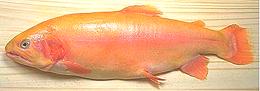 [Oncorhynchs mykiss]
This is a color variant of the Rainbow Trout, developed by the fish farms
and is not to be confused with the real California Golden Trout.
Details and Cooking.
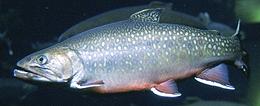 [Salvelinus fontinalis]
Actually a Char, not a Trout, but it's included here because it's what
everyone east of the Mississippi calls a "Trout". Brook Trout live
along eastern Canada and down to Georgia in the United States,
including the Great Lakes and the Mississippi River drainage basin.
They can grow to 34 inches and 20 pounds but are more commonly around
10 inches. Brook trout are now being farmed to some extent, and sold
fresh, frozen and smoked. They are also raised in hatcheries for
restocking streams and lakes, and have been introduced to other parts
of the world. They are environmentally sensitive so are much used
for environmental research.
Photo by U.S. Fish and Wildlife Service = public domain.
Details and Cooking.
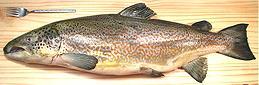
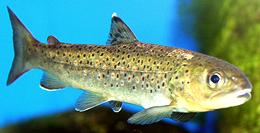 [European Trout, Caspian Trout; Salmo trutta]
This trout is endemic to Europe and the Caucasus, but has been
introduced to much of the world, including North and South America,
Australia, New Zealand and elsewhere. Hatcheries are widespread to
restock rivers and lakes for sports fishing. This trout is not
much farmed, because it's a lot fussier about food and conditions
than the Rainbow Trout. Europeans protest that this trout is far
superior to Rainbow Trout, but mostly they eat farmed Rainbows,
which are in much better supply.
Photo by Karelj, contributed to the Public Domain.
Details and Cooking.
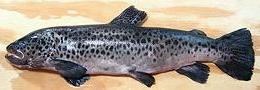 [Ishkhan (Armenia); Salmo ischchan]
Four varieties of this relative of the Brown Trout are endemic to
Lake Sevan in Armania and one has been introduced to Issyk Kul lake in
Kyrgyzstan. The largest variety can grow to almost 36 inches and 33
pounds, but the photo specimen was 19 inches long and weighed 2-1/2
pounds. Details and Cooking.
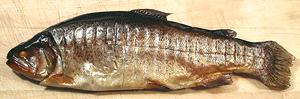 [Oncorhynchs mykiss]
Trout is a very oily fish so is suitable for smoking. Smoked trout can be
eaten skin-on, unlike smoked Whitefish (heavy scales) or smoked Mackerel
(tough skin). The hot smoked photo specimen was 14-1/4 inches long and
weighted 1 pound 3-3/8 ounces. Rainbow Trout, salt, brown sugar, natural
wood smoke.