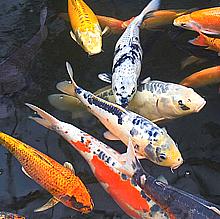
 [Koi (Japanese), family Cyprinidae]
The modern Carp family (Cyprinidae) has been around for about 55 million years and the carp order (Cypriniformes) since the end of the Cretaceous 65 million years ago. They are not considered a prime eating fish in North America, but are very popular on the menu Europe, particularly Poland, and are the most important farmed fish in Asia.
Coming in many brilliant colors and patterns, and happy to live in
small freshwater ponds, carp is the primary fish displayed in decorative
gardens. Call a fancy carp "Koi" and it can sell for hundreds or even
thousands of dollars. Unprotected ponds need big submerged pipes for
them to sleep in because they are definitely on the menu for raccoons.
More on Varieties of Fish
(very large page).
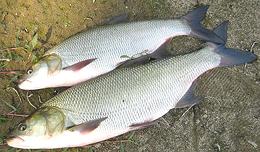 [Aral Asp (Uzbek); Zherekh (Russia, etc.); Leuciscus aspius]
This fish is native to lakes and rivers of most of Europe, including
European Russia, and rivers and lakes of Central Asia. They can grow
to nearly 47 inches and 20 pounds, but are commonly about 21 inches
long. IUCN Red Listed LC (Least Concern). This fish is both caught
wild and farmed. Preparation and cooking
is probably similar to
Silver Carp.
Photo by distributed under license similar to
Creative Commons
Attribution-ShareAlike v3.0 Unported Attribution Required.
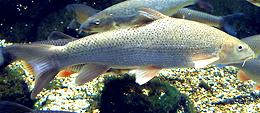 [Barbus barbus and other Barbus species]
This fish is native to lakes and rivers of most of Europe, including
European Russia. They can grow to nearly 47 inches and 26 pounds,
but are commonly about 12 inches long. Barbel are found in the rivers
of Uzbekistan, and possible other Central Asian rivers. Barbel are
pretty much all European, but these may have been introduced.
IUCN Red Listed LC (Least Concern). This fish is both caught wild
as a minor commercial catch, and farmed. Caution:
Barbel roe is highly toxic, and the female fish may have
some toxicity during the spawning season. Preparation and cooking
is probably similar to
Silver Carp.
Photo by Neil Phillips distributed under license
Creative Commons
Attribution-ShareAlike v2.0 Generic.
[Speckled Amur, Tongsan, Noble Fish, Hypothalmichthys nobilis
alt Aristichthys nobilis]
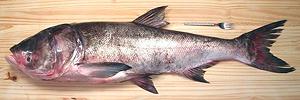
This Asian (probably Chinese) carp has been introduced worldwide and escapees from pond clearing duty now populate waters in 23 U.S. states where they, and their near relative the Silver Carp, are considered troublesome invasive species. Bighead is a filter feeding fish that lives on plankton near the surface of the water and is used to clear algae from ponds.
This fish is common in Asian markets in Los Angeles where it is
generally sold in sections due to its large size. Split heads are
sold for making soup. This fish can grow to over 5 feet and 100 pounds,
but the photo specimen was 3 feet 6 inches and weighed 19.2 pounds,
factory cleaned. That's a full size dinner fork in the picture for
scale.
Details & Cooking.
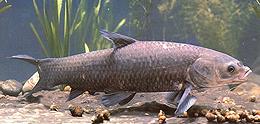 [Mylopharyngodon piceus]
This fish is native to larger lakes and rivers in East Asia, from
the Amur River Basin south to Vietnam. Black carp are highly
commercial in China and are the most prestigious (and expensive) of
the native fish there, but have not become as widespread as other
Asian carp worldwide. I have not seen them in the Asian fish markets
here in Southern California. They can grow to nearly 6 feet and 77
pounds, and can become pests if they escape. A few have been found
loose in the Mississippi basin. They live on snails and mussels so
some attempts have been made to use this fish to control mollusks.
They are considered a threat to native mollusks, so sterile fish are
generally used to prevent wild populations. It is illegal to carry a
live black carp into the United States, across state borders, or to
posses one in many states. IUCN Red Listed DD (Data Deficient). It
is both caught wild and farmed.
Photo from Chinese Academy of Fishery Sciences
distributed under license Creative Commons
Attribution-NonCommercial v3.0 Unported.
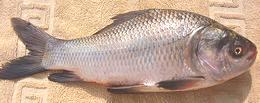 [Bhakua (Nepal, Bengal, Assam); Catla, Catal, Katla, Katol (India);
Labeo catla (formerly Gibelion catla (formerly
Catla catla))]
[Bhakua (Nepal, Bengal, Assam); Catla, Catal, Katla, Katol (India);
Labeo catla (formerly Gibelion catla (formerly
Catla catla))]
This fish is found in rivers in Pakistan, India, Bangladesh, Nepal and
Burma. It is the most heavily farmed fish in South Asia, and has been
introduced to other regions. This is a popular eating carp in India,
where 2 to 4 pound (1 to 2kg) fish are preferred by consumers. They can
grow to over 6 feet (180cm) and 86 pounds (38.6kg). Native wild
populations are common, so they are IUCN rated LC (Least Concern).
For details and cooking, see Rohu.
Photo by Khalid Mahmood distributed under license
Creative Commons
Attribution-ShareAlike v4.0 International.
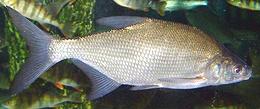 [Carp Bream, Bronze Bream; Abramis brama]
The Common Bream is a highly commercial fish from Central Europe to
Central Asia. It was once an important food for the poor in Britain,
but the flesh has been described as "bony, insipid and soft". It can
grow to 32 inches and 13 pounds but is more typically 12 to 20 inches
and 4 to 9 pounds. Juveniles are often mistaken for
Silver Bream, but the scales of this fish are
smaller. Count from the leading edge of the dorsal fin down to the
lateral line 13 or more scale rows (11 max for the Silver Bream). This
fish is not found in North America, but is imported salted and dried.
IUCN listed as LC (Least Concern).
Details and Cooking.
Photo contributed to the Public Domain.
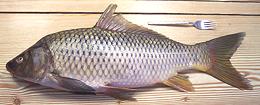 [Cyprinus carpio carpio]
Possibly originating in the Danube river, these fish have been transplanted all around the world and have become pests in some areas. They can grow to 80 pounds and 47 inches long but the photo specimen was 25-3/4 inches and weighed 7 pounds.
This is a highly commercial fish just about everywhere except North
America, where fancy varieties are used mainly as a landscaping accent.
Common Carp prefer larger lakes and slow moving streams with muddy
bottoms and eat just about anything. Wild carp and decorative koi
tend to be less deep of body and without the distinct hump typical of
farmed carp. IUCN Red Listed VU (Vulnerable, wild in their native
rivers).
Details & Cooking.
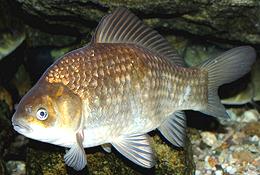 [Carassius carassius]
Native to Europe through Siberia and into China, this highly commercial carp is both farmed and caught wild, Crucians can grow to 25 inches and 6.6 pounds but are more commonly between 1 and 3 pounds. They are found throughout European lakes, streams and rivers, and as far north as Finland. It can be told from the very similar looking Prussian carp by it's more golden color, it's tail is not so deeply forked, and by the thin lining of the body cavity being white, whereas it is black for the Prussian. It also has a more rounded snout than other carp.
The Crucian Carp has an amazing ability to survive for months with
almost no oxygen. This is an adaption to allow survival in ponds that
are frozen over and covered with snow, ponds predators can't survive
in.IUCN Red Listed LC (Least Concern).
Details & Cooking.
Photo by Karlj contributed to the Public Domain.
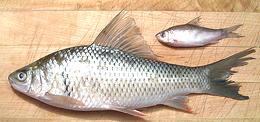 [Cirrhinus molitorella (Asia) - similar but not commercial,
Leuciscus leuciscus (Europe)]
[Cirrhinus molitorella (Asia) - similar but not commercial,
Leuciscus leuciscus (Europe)]
A common fish in fast moving fresh (or sometimes brackish) waters with a worldwide distribution in temperate climates. Dace is commonly categorized as a "course" fish and not used much for food in North America or Europe, but is quite popular in Asia for making fish balls.
The photo specimen was 11-3/4 inches long and weighed 10-1/4 ounces,
fairly typical. Some markets also have trays of small dace. The photo specimen
was 4-1/2 inches long and weighed 5/8 ounce, but the tray contained fish from
1/4 ounce to 1-3/8 ounces. In Cambodia small dace are used to make prahoc,
a pungent fermented fish condiment, but I use them differently.
Details & Cooking.
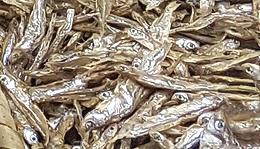 [Dagaa (Tanzania, Uganda, Kenya); Mukene (Uganda); Omena (Kenya);
Silver Cyprinid, Lake Victoria Sardine; Rastrineobola argentea]
[Dagaa (Tanzania, Uganda, Kenya); Mukene (Uganda); Omena (Kenya);
Silver Cyprinid, Lake Victoria Sardine; Rastrineobola argentea]
This is an important food fish caught in Lake Victoria and other lakes
and rivers feeding into the Nile. Dagaa is silver with a prominent
lateral stripe and a lateral line that is very low on the body. It grows
to a little over 3 inches (8 cm) long. It is caught at night using lights,
then sun dried, sold and distributed through the southern East African
region for use as both human food and chicken feed. IUCN Red Listed LC
(Least Concern).
Details & Cooking.
Photo by George Jaimi (heavily cropped) distributed under
license Creative Commons
Attribution-ShareAlike v4.0 International.
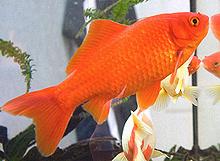 [Gold Crucian, Carassius auratus auratus]
A Siberian carp introduced throughout the world, generally pictured in a small bowl with a cat trying to get at it. This fish is actually the Prussian Carp (Carassius gibelio) bred for color variations. It can grow to 23 inches and 6.6 pounds but will stay small if kept in a small aquarium, often around 2 to 4 inches.
It's ability to survive in low oxygen environments made it possible to keep goldfish in fishbowls before the advent of aerated aquariums. This ability resulted from the Prussian Carp having to live under ice in its Siberian homeland.
Goldfish are highly variable in color and fin shape, having been bred
in China as a decorative for about 1000 years. They are edible but not
generally eaten except by cats and raccoons. Swallowing live goldfish was
once a popular stunt among college frat-brats but has long been out of style.
Not Red Listed. Photo by Heptagon contributed to the public
domain.
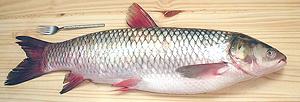 [Rehu (India); Ctenopharyngodon idella]
A silver bodied fresh water fish imported from Asia, the grass carp can grow to 59 inches and nearly 100 pounds, but the photo specimen was 27 inches and 8.4 pounds. Grass carp are voracious eaters of underwater vegetation and are an important food fish in Asia, both farmed and caught wild.
Use of triploid (sterile) grass carp to control invasive aquatic
weeds was pioneered in the Imperial Valley of California. Triploids are
created by slightly damaging eggs immediately after fertilization.
They grow to only 40 pounds in the irrigation channels and live half
as long as diploid carp but they eat about 90% as much and won't establish
wild populations where they are not wanted. The California hatchery has
been studied by teams from many states and countries.
Details and Cooking
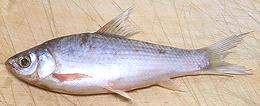 [Cá Linh (Viet); Pla soi (Thai); Trey riel tob (Khmer);
Siamese Mud Carp; Henicorhynchus siamensis]
[Cá Linh (Viet); Pla soi (Thai); Trey riel tob (Khmer);
Siamese Mud Carp; Henicorhynchus siamensis]
This small carp is native to the Mekong and Chao Phraya river basins
of Vietnam and Thailand, Laos and Cambodia. They can grow to 7-3/4
inches, but are usually quite a bit smaller. The photo specimen was
the largest in a tray of frozen carp, at 4-3/4 inches long. Nearly all
the rest were 3-1/2 inches or smaller. Wild caught in Vietnam. In
Southeast Asia they are primarily used to make fermented fish sauces,
such as prahoc and nuoc mam, but are also deep fried or used in soup.
They are a commercial catch, but IUCN rated LC (Least Concern).
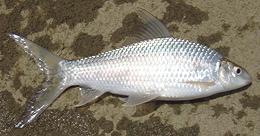 [White Carp; Morakhi, Moree (Pakistan); Cirrhinus cirrhosus]
This is a popular eating carp in India, and heavily farmed there. They
are commonly 16 inches (40cm) long, but can be over 39 inches (100cm)
and weigh as much as 28 pounds (12.7kg). Native wild populations are
now found only in the Kaveri River, which flows through Tamil Nadu,
India, so they are IUCN rated VU (Vulnerable). It has been introduced
to other regions. The photo specimen was caught in Hainan, China. For
details and cooking, see Rohu.
Photo by Anna Frodesiak contributed to the Public Domain.
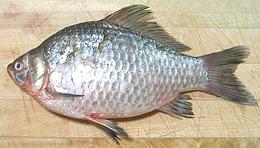 [Carassius gibelio]
This carp may have originated in eastern Asia or Siberia, but is
now also found through most of Europe. It is a fast breeder and can
becomes a pest where introduced. This fish is often confused with the
Crucian Carp, which has caused it
to be accidentally stocked where it was not wanted. The Crucian is
considered more desirable commercially. They can be told apart by
the more golden color of the Crucian, by the more deeply forked
tail of the Prussian, and the thin lining of the body cavity is black,
whereas it is white in the Crucian. This fish can grow to about 14
inches (some sources say 17 inches), but the photo specimen was 11
inches and weighed 1 pound 1-3/4 ounces.
Details and Cooking.
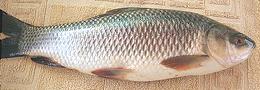 [Rohu, Rohu labeo (India & elsewhere); Labeo rohita]
This fish, native to the rivers of South Asia, is very popular in
Pakistan, Thailand, Bangladesh and northern India, especially in
West Bengal. It can grow to over 6 feet and 99 pounds, but is
generally marketed much smaller. It is farmed in Karala state, India
and has been introduced to other regions for stocking reservoirs and
aquaculture. It is Red List rated LC (Least Concern).
Details and Cooking
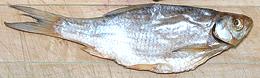 [Scardinius erythrophthalmus]
This fish, native to most European rives and estuaries, has been
introduced in the United States, Canada, Spain, New Zealand, Tunisia,
Morocco, and Madagascar. It can be a serious invasive pest where
introduced. This fish can grow to over 20 inches and 4.6 pounds, but
is commonly under 8 inches. In North America it is most often found
salted and dried in markets serving Russian, Ukrainian and Armenian
communities. The photo specimens were 7-1/2 inches long and weighed
about 0.9 ounces each. It is caught wild and farmed, Red List rated
LC (Least Concern).
Details and Cooking
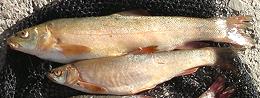 [Marinka (Finland, Russia); Schizothorax curvifrons]
This fish is native to lakes and rivers northern Asia, from
Afghanistan through Central Asia to China. They can grow
to nearly 22 inches and 2.8 pounds, but are commonly about 10 inches
long. IUCN Red Listed NE (Not Evaluated). This fish is a minor
commercial catch.
Photo by Amirekul distributed under license
Creative Commons
Attribution-ShareAlike v4.0 International.
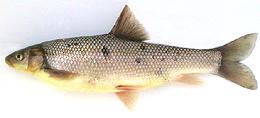 [ Caucasian scraper; Capoeta capoeta]
This fish is native to lakes and rivers from Western Asia through
Central Asia. They can grow to about 16 inches long. IUCN Red
Listed LC (Least Concern). This fish is a commercial catch.
Photo by Vladimir B. Salnikov distributed under license
Creative Commons
Attribution-NonCommercial 3.0 Unported, Attribution Required
.
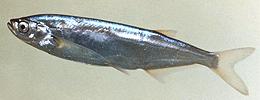 [Sichel (German, England); Ziege (US, England); Chekhon (Russia);
Sabre Carp (Russia, Austria); Pelecus cultratus]
[Sichel (German, England); Ziege (US, England); Chekhon (Russia);
Sabre Carp (Russia, Austria); Pelecus cultratus]
This fish is native to lakes and rivers northern Eurasia, including
Scandinavia and Central Asia. They can grow to nearly 23 inches and
4.4 pounds, but are commonly about 10 inches long. IUCN Red Listed
LC (Least Concern). This fish is a commercial catch.
Photo by Akos Harka distributed under license similar to
Creative Commons
Attribution-ShareAlike v3.0 Unported Attribution Required.
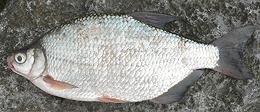 [White Bream (Fisbase); Blicca bjoerkna]
The Silver Bream is a minor commercial fish native to fresh and
brackish water of rivers draining into the Baltic, White, Black, Aral
and Marmara seas of Eastern Europe. Introduced to parts of France and
Spain and present in southern England. This is not considered a highly
desirable fish, but is eaten when caught. Juvenile
Common Bream are often mistaken for
Silver Bream, but the Silver Bream has larger scales (8 to 11 from
leading edge of the dorsal fin to lateral line). The photo specimen
is a female, males are slimmer, lacking the bulge at the chest and more
pointy at the nose. Silver Bream grow to about 14 inches and 2.2
pounds. IUCN listed as LC (Least Concern) Photo by
Viridiflavus distributed under license Creative Commons
Attribution-ShareAlike v3.p unported
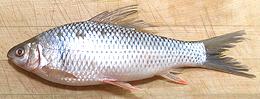 [Hypophthalmichthys molitrix]
This is an Asian carp that has been introduced worldwide for food and for cleaning algae out of lakes and reservoirs - though it often becomes a pest. This fish, like the closely related Bighead Carp, is a plankton eating filter feeder, but it feeds a little deeper than the Bighead. It is the worlds most important farmed fish, but it only began to to appear in Southern California's Asian markets in 2012. By 2015 It could be found both in the live fish tanks and frozen.
This fish is a major pest in the Mississippi, Illinois, Ohio
and Missouri rivers. While the photo specimen was just just 13 inches
long and weighed only 12-1/8 ounces, they can grow to well over 40
pounds and leap 10 feet out of the water when startled. Many
recreational boaters in fast ski boats have been injured and even
killed by leaping fish. Contests are held to catch as many as
possible, but there is no effective control method - except to eat
them all. They are notably delicious, but as with any other carp,
you have to get accustomed to dealing with the spines, something
which most of the world has accomplished.
Details and Cooking.
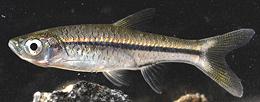 [River Baby (Asian market); Cá Lòng Tong (Viet);
Rasbora argyrotaenia]
[River Baby (Asian market); Cá Lòng Tong (Viet);
Rasbora argyrotaenia]
Found in the rivers of Southeast Asia, including Borneo and Indonesia,
these are very tiny carp, growing to 4.7 inches long, but are commonly
shorter. While primarily river fish, they will invade flooded rice
fields. They are most known as an aquarium fish, but are also eaten,
especially in Vietnam, where the fish is highly regarded.
Details & Cooking.
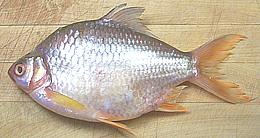 [Barbonymus altus (Red Tailed Tinfoil (photo)),
B. schwanenfeldii (Tinfoil Barb), Poropuntius malcolmi
(Goldfin Tinfoil)]
[Barbonymus altus (Red Tailed Tinfoil (photo)),
B. schwanenfeldii (Tinfoil Barb), Poropuntius malcolmi
(Goldfin Tinfoil)]
Found in the rivers of Southeast Asia these are very small carp. The
photo specimen (B. altus) is 10 inches and weighed 1 pound but most
are smaller, while B. schwanenfeldii (black edges on the tail) can
get 13 inches. The Goldfin doesn't tolerate aquaculture and is only sold
locally in Southeast Asia.
Details & Cooking.
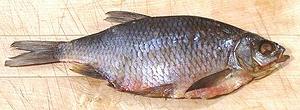 [Rutilus caspicus similar Common Roach
Rutilus rutilus]
[Rutilus caspicus similar Common Roach
Rutilus rutilus]
This fish, found in brackish and fresh waters, is native to the northern and western reaches of the Caspian Sea. At spawning time It enters the Volga, Ural, Emba, Terek and Kura river drainages. It may be a subspecies of the Common Roach which has a much larger range, including Norway, British Isles, Italy, the Adriatic basin, and Anatolia, but is not native to Iberia. Both are IUCN rated "Least Concern", but the Common Roach can become a pest.
The photo specimen, purchased from a multi-ethnic market in
Los Angeles, was from Russia, 10-1/2 inches long and weighed 4 ounces.
It was packed with three smaller fish. Dried, salted Vobla is quite an
institution in Russia, and judging by the stores I buy it from, it is
also known in Armenia, and no doubt Georgia and Azerbaijan as well. It
is often brought as a hostess gift by travelers from Moscow.
Details & Cooking.